


Yeah, yeah, I’m beating a dead horse1 I know it. But here we are again.
Some of you remember my long-running disagreement with UNLV professor Dr. Anthony Lucas on whether players can actually feel changes in slot hold. My position: they can over time. His position: proven research says they can’t. And frankly, his data are better than mine. But I still can’t shake the feeling I’m right. Some fresh numbers just gave me a little bit more ammunition.
Background
In 2017, Dr. Lucas and co-author Dr. Katherin Spilde published a rigorous study examining control machines in Australia and Mexico. Their conclusion: tightening hold had no meaningful negative impact on players, other than generating more revenue for the casino. It’s serious, thorough work. If you haven’t read the original study, find a copy. (Fair warning: if you’re not on a university faculty, you’ll pay for the privilege. I paid $37.50 years ago.)
I never disputed their data. My objection at the time was narrower: Lucas and Spilde studied the machines, not the players. They didn’t have access to player-level behavior at the time.
To his credit, Dr. Lucas has since incorporated player metrics into some of his follow-up work, including updates to that original study. His later research on “Free Play” is some of the best analysis this industry has ever seen. I am, genuinely, a fan.
The irony of a data guy who believes in luck
My first gaming paycheck came as an independent freelance writer. Fitzgeralds Casino Hotel in Reno, NV hired me to do some research on “luck.” They had done some earlier consumer surveys indicating that luck was a primary motivator for gamblers to both stay and leave. So, I wrote pieces for them on everything from rubbing Ho Tei’s belly to Egyptian lucky bees to stuffing a ham knucklebone in your pocket.
Later, as their full-time marketing manager, I gave away millions of horoscopes, ran an annual Psychic Faire, and built a wishing well from stones hauled in from Blarney Castle.
Do I believe any of it? Not a word. I had no hard science to back any of it up. And yet, it was impossible to ignore that luck was (and is) what drives gamblers through the door. Nothing else comes close. If you know how Random Number Generators work, you can only arrive at one conclusion: the only way to win at a casino is to get lucky. (My apologies to the advantage-player crowd.)
What the data does say
That brings me to a new survey from Casino.com on “America’s Luckiest Casinos.” They ran 830,250 screen scrapes from TripAdvisor reviews of 108 properties, scanning for words like lucky, jackpot, won, hand pay, cashed out, big win, comped, and generous.
They called the casinos that landed at the bottom of the list the Strip Walk of Shame,2 referring to resorts located on southern Nevada’s Las Vegas Blvd. These “unlucky” operations were all corporate properties (Caesars Palace, Mandalay Bay, Excalibur and Bellagio). You may not recall that those were the very properties to be first in line to embrace the tighter-hold gospel according to Dr. Lucas. (Casino.com said that MGM likely belongs on that list too, but a technical glitch contaminated their sample size.)
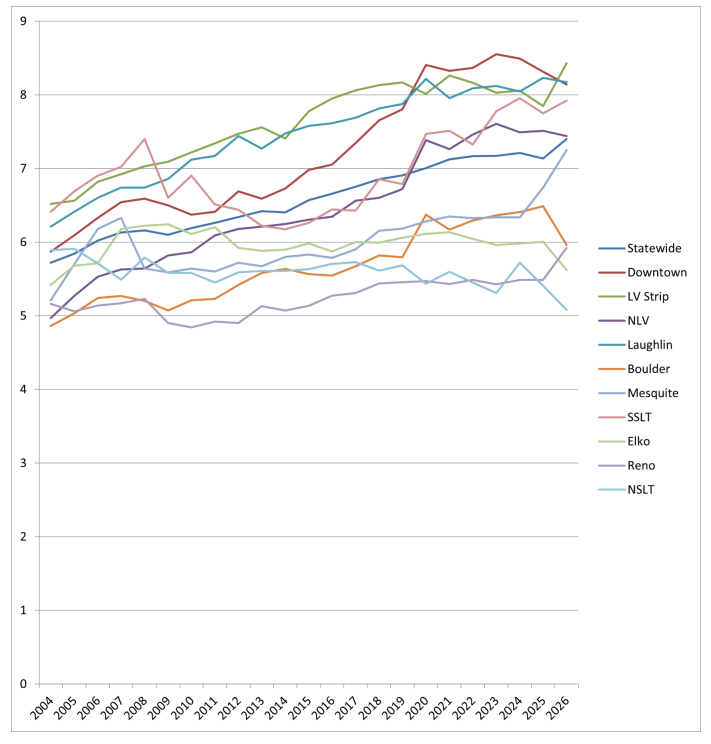
UNLV Center for Gaming Research3
Meanwhile, take a look at Nevada slot hold data from UNLV’s Center for Gaming Research. The Strip has sprinted ahead in what I’ll call the race to the top, or maybe the bottom depending on whose side you’re on.
While “Downtown” (referring to Fremont Street in Las Vegas) was once a locals’ hangout, it is now just a northern branch of the Strip philosophy (Circa and the D may be the only exceptions).

Locals and tribes hold the line
In another 2017 article, Lucas and Spilde wrote that tribal and locals casinos “try to differentiate themselves in the marketplace by advertising ‘loose slots’…This strategy seems to rely on the long-held assumption that regular players in repeater markets can perceive differences in PAR.”
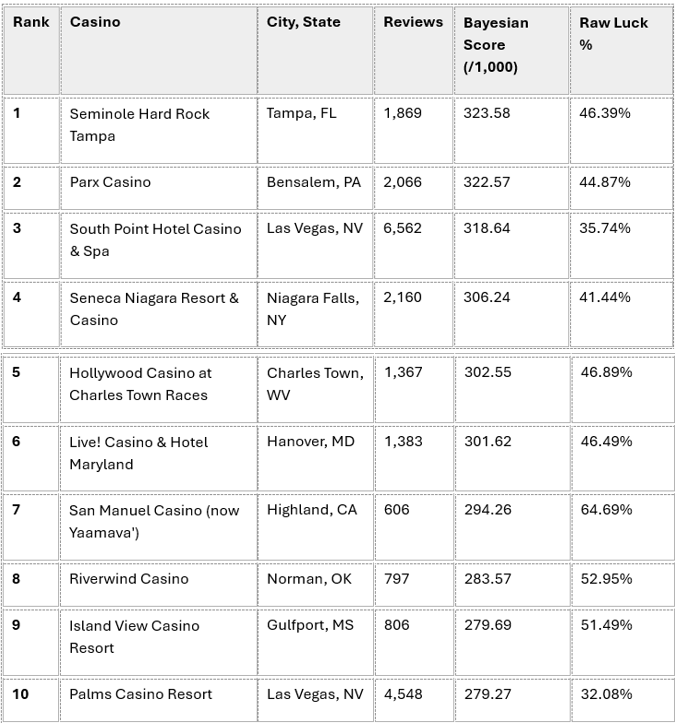
So which casinos ranked among the luckiest in the new survey? Surprise. It was those very “tribal and locals” properties, with only two Las Vegas joints in the mix:
Bayesian Score4
The first Las Vegas property (at #3) is South Point Hotel Casino & Spa. Michael Gaughan, son of the late and legendary casino pioneer Jackie Gaughan, runs it. Michael, and Jackie before him, were both champions of genuine value. Most serious industry observers consider South Point to be one of the best-operated casinos in America today, with “value based” gaming odds, F&B, attractions and promotions to match serving both locals and tourists.
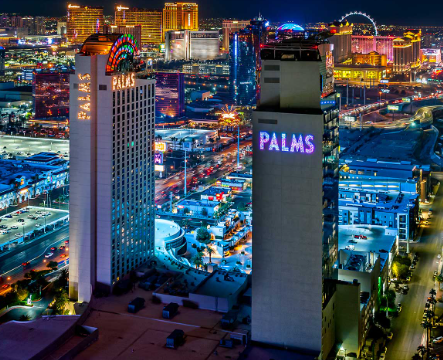
The second is Palms Casino Resort, owned by the San Manuel Gaming and Hospitality Authority, an entity of the Yuhaaviatam of San Manuel Nation. The San Manuel Entertainment Authority, another tribal entity, owns and operates Yaamava’ Resort & Casino in Southern California (#7 on the lucky list). Their Chief Gaming Officer, Peter Arceo, put it plainly: “We have continued to deliver value for our guests at both properties. I am especially proud of the Palms and how they continue to deliver a great experience and value at a time where many visitors to Las Vegas feel like their value has diminished.”
Hard to argue with that.
In fairness
I should be honest (even though being fair is never as much fun).
With the exception of South Point and the Palms, the other top-ranked “lucky” casinos on the list feature slot machines that are just as tight, or tighter, than anything on the Strip. But those properties operate under tax structures that are double, triple or more than Nevada’s burden. Given that headwind, you could argue they are trying to deliver greater relative value to their players even with comparable hold percentages.
Here’s one last tidbit to consider coming from the Nevada Gaming Control Board just last week. The “little city” of Reno, which largely resisted jumping on the bandwagon to tighten everything (see chart above), grew slot revenues more than the 51 licensees on the huge Strip ($51.9M to $50.8M) between 2025 and 2024. The state’s “2025 Gaming Abstract” also shows that slot revenues in Washoe County (think Reno) increased 5.7% year-to-year compared to just a 1% gain on the Strip. Another headline that considered all products said, “Las Vegas Strip casinos report 81% decline in 2025 net income vs. 2024.”
You might blame some of that on a Las Vegas boycott by angry Canadians, or tariffs, inflation, gouging, and foreign traveler’s fears. All good points. But maybe…just maybe…players can feel that you tightened your slots!
# # #
- “Beating A Dead Horse” – In 2018, PETA pleaded with the general public to cease usage of this idiom (along with all other such phrases that disparaged animals). My apologies. In case you’re not familiar with the quote, it is a bit of 17th century slang meaning that something, or some continuing argument, has become futile or useless. Wikipedia offers a definition of the quote that includes a disturbing photo of a man sitting atop a dead horse in the middle of a Wisconsin road with the caption “flogging a dead horse will not compel it to do useful work.”
- Strip’s Walk of Shame is a quote from a Casino.com posting on “The Luckiest Casinos in the US”
- SSLT – South Shore Lake Tahoe; NSLT – North Shore Lake Tahoe
- Bayesian Score – An index based on a probability theorem from Thomas Bayes that is used to reduce subjective uncertainty. It is widely used in medicine, but applied here to luck. For details, you can Google the complex math formula behind the scores.
