


There are few things people enjoy more than giving unsolicited opinions about a baby’s name. You can spend nine months choosing something meaningful, only to announce it at Thanksgiving and have your aunt inform you that she once knew someone with that name who was absolutely insufferable. Your uncle thinks it sounds like a pharmaceutical. Your mother wants to know what’s wrong with the names people used to give children.
The baby hasn’t even been born and somehow, you’ve already disappointed the entire family.
Corporate rebrands operate under a similar system. A company can spend months researching its market, debating its positioning, and developing an identity, only for someone to glance at the reveal and announce they would have gone in another direction.
Thank you, Gary. We’ll let the agency know.
Last year, AGS gave us something to discuss. This year, it was IGT’s turn. I heard plenty of opinions at G2E, none of which I’ll be attributing to anyone. I’m a journalist, not a narc.
But I was more interested in understanding what went into IGT’s new identity than collecting reactions to it.
We knew it was coming, but humor us
Following Apollo’s acquisition of IGT’s Gaming and Digital business with Everi, a new identity was hardly a surprise. The question was how IGT would introduce a broader organization without losing the recognition it had spent decades building.
At G2E, I toured the redesigned booth with Emily Schmitt, IGT’s SVP of Global Marketing, who explained the thinking behind the rebrand. The company offerings include games, digital, fintech, and casino systems, with the new identity intended to present those capabilities as one organization.
Schmitt described the positioning as “designed for the player and built around the operator.” Operators purchase and integrate IGT’s offerings, while players experience them in the casino environment. That positioning gives the company’s different businesses a common purpose, rather than defining IGT solely by its individual product categories.
It’s an important distinction. Customers can recognize a company without understanding everything it offers. IGT already has considerable name recognition and diverse products and services that customers may not immediately associate with the organization. The new brand identity is intended to signify IGT’s broader business capabilities.
Yes, I asked about the purple
I wasn’t going to tour a dramatically redesigned booth and pretend the color choice was none of my business.
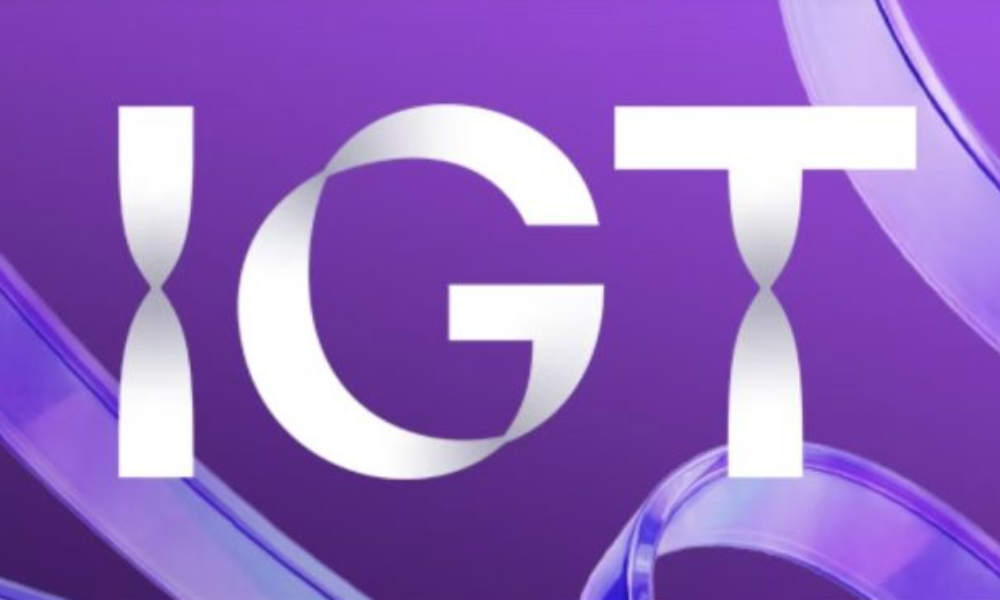
The previous IGT logo featured bold blue lettering alongside a circular blue-and-orange emblem with a white starburst. The new version eliminates the emblem, replacing it with a custom-purple wordmark featuring curved overlapping letterforms and a gradient finish.

The changes extend beyond the logo. IGT’s new visual palette introduces icy purple, chrome, and iridescent finishes, with slate-inspired textures incorporated throughout its G2E booth. The company describes its new identity through three principles: fluid, frictionless, and magnetic, reflecting its ambition to present a more connected business and experience.
Naturally, I wanted to know whether the purple was borrowed from Everi.
Schmitt explained that Everi’s former palette provided some loose inspiration, but the new icy purple is a different shade. Her team explored multiple palettes, studied competitors, and looked outside gaming to technology and consumer brands.

“Our biggest objective was to feel differentiated from what’s in the space,” Schmitt explained.
The decision also involved protecting the recognition IGT had already established. Schmitt acknowledged the equity in the previous identity and the importance of carrying that familiarity into the combined organization. “We didn’t want to lose that piece, but we did want to be bold enough to step away from it and signify that new chapter.”
Keeping the IGT name preserves a familiar connection for customers, while the new visual identity signals that the business behind it has changed. Whether that approach succeeds will depend on how customers come to recognize and understand the new IGT over time.
Taking the new look for a test drive
The booth offered a look at how IGT was applying the new identity beyond its logo. Schmitt explained that the layout was designed to resemble a journey through a casino, bringing games, systems, fintech, and digital into one visitor experience.
The intention was to help operators see how the different parts of IGT’s business could work together within an environment they already understand. It was also a physical demonstration of the company’s emphasis on a more connected experience, rather than presenting the combined businesses as separate product categories.
Another interesting decision involved IGT’s game characters, which remain part of the new visual identity. Some appeared in metallic treatments that reflected the updated branding, while others retained their familiar full-color appearances.
Schmitt explained that the company’s intellectual property remains an important connection to what players recognize on the casino floor.
That decision reflects an important consideration for gaming manufacturers. A corporate identity may change, but players often have stronger associations with familiar games and characters than with the company logo behind them. Preserving those assets allows IGT to introduce a new visual identity, while maintaining connections to its existing products.
What happens after everyone has an opinion?
The G2E reveal introduced IGT’s new direction, but the more meaningful question is how effectively the identity communicates the combined company’s capabilities over time.
Schmitt’s explanations provided context for the decisions behind the rebrand, from establishing a distinctive appearance to retaining familiar product assets. The strategy is intended to help customers recognize IGT as a broader organization, while maintaining the associations that made its name valuable in the first place.
Whether it accomplishes that will become clearer as the identity appears across the company’s products, communications, and customer experiences.
As for the opinions, I’m sure we’ll hear more. Whoever unveils the next rebrand can consider this fair warning: The industry’s unsolicited-feedback department remains fully staffed.
