
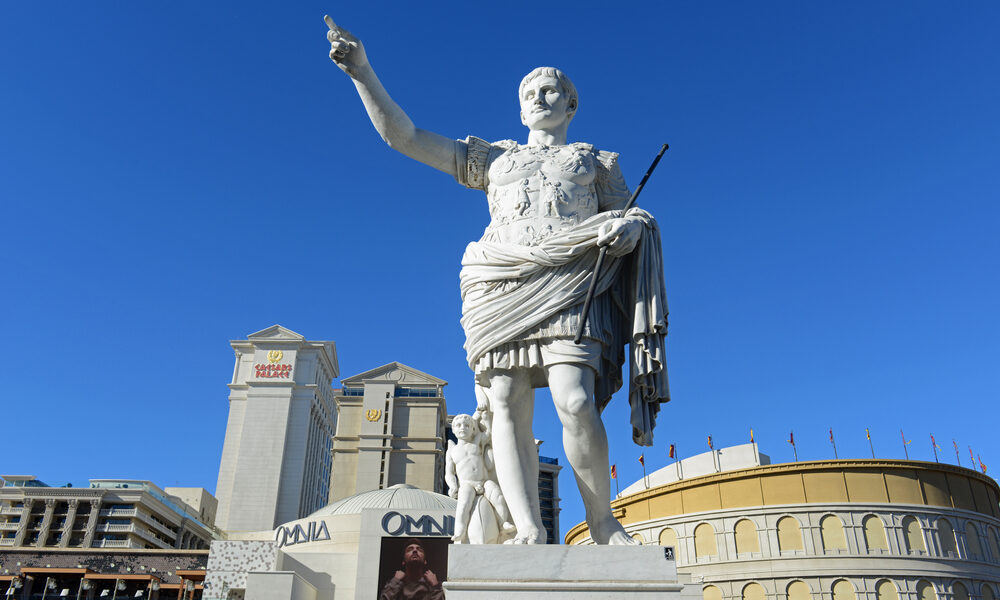

With Caesars Entertainment considering a takeover bid, Wall Street analysts are expecting mergers and acquisition talks to heat up in the casino industry. Las Vegas-based operators’ best opportunity for growth is in untapped markets.
Gaming analysts have been mum in their notes to investors about a potential takeover of Caesar,s given the lack of public information. They had a chance to weigh in on that and other M&A possibilities when they appeared Thursday night before the Economic Club of Las Vegas, moderated by club vice president and casino consultant Oliver Lovat.
Barry Jonas, managing director with Truist Securities, and John DeCree, director of equity research at CBRE, were asked about reports from the Financial Times that Texas billionaire and casino owner Tilman Fertitta was one of the bidders for Caesars, which is also considering a possible management-led buyout.
DeCree said everything has been speculative, with some high-profile news reports of what might happen, but it’s difficult to guess what will.
One item that came out is that the Caesars management team would stay in place. From an operational perspective, that wouldn’t have much impact in Las Vegas, DeCree highlighted.
Jonas said Caesars doesn’t need more than 50 properties and while the press reports are limited in details, this is not an opportunity to buy and gut it and have a strong return. The valuation is attractive from a free cash flow basis, he added.
“Let’s see if it’s for everything or a couple of assets, but I’m in the camp that we could see more M&A,” Jonas said. “Certainly, a high-profile transaction from one of the leading operators likely gets other boards of directors thinking if they should be looking at it as well.”
Jonas asked if there’s a scenario of going private and getting away from the public investors constantly hounding operators for short-term results instead of being long-term oriented.
“There’s a scenario that this could emerge in multiple years and be a successful transaction,” Jonas said of Caesars. “At the same time, there’s a lot of leverage. Caesars today is generating a lot of cash flow that over time will de-lever, but you wonder what the structure of a take-private transaction looks like and how much new leverage needs to come on. Given what we saw in 2008 with the Harrah’s ($16.7 billion buyout from private equity), there’s a focus of let’s not repeat what happened that time.”

DeCree also expects to see more M&A, saying Caesars has a large portfolio of assets. Interest rates for large corporations and the spreads are near record lows.
“The borrowing costs for casino companies are so far disconnected from equity prices,” DeCree said. “That’s why we’ve been predicting some leveraged buyouts or private-equity action. We are starting to hear about it now, because you can borrow at such low cost of capital and buy casino companies at depressed equity valuations.”
DeCree said The Mirage (Hard Rock) and Venetian (Apollo) acquisitions came from private entities rather than public companies. There’s a lot of long-term growth, but it requires capital.
“Golden Entertainment is undergoing management changes where public markets don’t appreciate the long-term value or don’t have the same time horizon,” DeCree said.
If stock valuations hold indefinitely, Jonas reiterated that he expects to see more private transactions. The gaming manufacturing space has moved to going private and the questions are casinos heading in a similar direction.
“Clearly, if you are an executive and looking at your stock price languish for multiple years now and you have been buying back stock and it’s not helping, you need to ask tough questions if you are doing everything you can and fundamentals are not enough is worth exploring other options,” Jonas said.
The industry is in a low-growth phase and the impact to stock prices has been among investors to “shoot first and ask questions later,” Jonas said. There’s no impending threat, but the question is getting to growth.
“Most executives will say, ‘I don’t need to have so many properties,’” Jonas said. “When Caesars got rid of the Rio, I would say the bulk of that EBITDA they kept in house. MGM has divested some regional assets. When deals were initially made and properties initially developed, there probably were only a handful of competitors within three hours. That has evolved, and we’re faced with some difficult challenges with leases with the OpCo PropCo (sales and leaseback) model given the saturation we see in the U.S. Could we see a phase of deconsolidation? The Venetian is astounding and numbers putting up are amazing, but as part of a larger organization (with Las Vegas Sands), it was afterthought. Sometimes you need full focus, with one GM focused on one property and not one guy focused on four or five. I think there’s an argument for de-consolidation at some point.”
Companies with significant capital looking for growth realize it’s hard to do in Las Vegas, the analysts said. They can build another resort, but going into a new market can put billions of dollars to work, DeCree said in pointing out Wynn Resort’s $5 billion resort under construction in the United Arab Emirates and MGM Resorts International building in Japan.
“MGM and their partners are spending over $10 billion in Japan,” DeCree said. “You can put a lot of money to work and generate the returns you need to. They are going to have to look at big untapped markets that haven’t brought gaming in. Las Vegas is still relevant, but the next frontier out there has been under pursuit.”
That doesn’t mean there aren’t opportunities in Las Vegas, Jonas said. It has withstood a lot of challenges and will return to growth at some point. He pointed out the Seminole Tribe in Florida saw an advantage to having a presence in the city by buying out the former Mirage and replacing it with its Hard Rock brand.
“If you want to be a player, you need to be in Las Vegas,” Jonas said. “The question is how many properties do you need? We can’t have all wins across the Strip, and there may come a time you’ll get a return on capital. Is there a scenario where a new party comes to the Strip and wants to put significant capital in for whatever reason like the Mirage that is worthy of consideration?”
Redevelopment opportunities of scale in Las Vegas would come from another party that has a vision rather than existing operators, the analysts said.
“The Mirage is a good example of that,” DeCree said. “Hard Rock was okay with taking that building offline for three years and factoring into that cost of return and spending significant capital.”
DeCree said OpCo PropCo hasn’t prevented capital investment, one of the biggest fears of the model. The Mirage is putting in close to $2 billion, while the Venetian has “been a huge success story” by acquiring it from Las Vegas Sands.
“It’s a lease property, and they have spent more than $1 billion and have done tremendously well,” DeCree said. “MGM has continued to invest in its assets. They have just spent several hundred million dollars at the MGM Grand. One of the biggest fears of the model is you’ll starve the Strip for investment and the good news is we have not seen that. The value of having an operation on the Strip is still so significant that investors and developers are still willing to put money to work in a big way.”
Not everything, however, has worked out right away despite the investment, Jonas said. Early results from the Fontainebleau and Resorts World have been challenging and hopefully they can ramp up over time. Entering a market like Las Vegas without a database to draw from and the experience makes it more challenging.
“On paper it makes sense to get rid of lower-end properties, but you need a special buyer,” Jonas said. “(Hard Rock International Chair) Jim Allen and the Seminoles are not your everyday acquirer. They are very good at what they do and have a very good database and a lot of experience.”
Both analysts praised the two major local casino operators in Red Rock Resorts and Boyd Gaming, whose stocks they said have been doing great and are executing on their strategies. The casino companies are benefiting from population growth and Red Rock has growth potential with the undeveloped parcels where it plans to build casinos.
DeCree said the question his firm often gets from investors is when the slowdown on the Strip will “bleed into the local market.” So far it hasn’t and the two operators have streamlined operations and “figured out how to serve the consumer.”

