

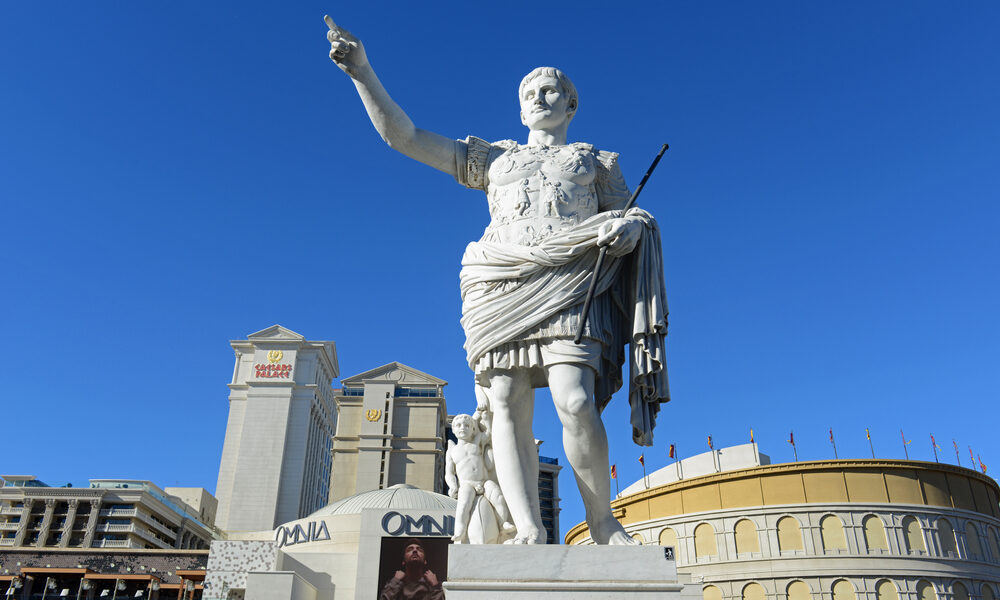

A Wall Street analyst points to MGM Resorts International and regional operators like Boyd Gaming as beneficiaries of the acquisition of Caesars Entertainment by a private company controlled by billionaire Tilman Fertitta.
The $17.6 billion deal between the Nevada-based Caesars and Houston-based Fertitta Entertainment, expected to close in about 12 months according to Wall Street analysts, will ultimately go before the Nevada Gaming Control Board and Gaming Commission for a sign off, which has been routine in the past when operators are acquired. Fertitta owns the Golden Nugget hotel-casino brand that already operates in Nevada.
“We’re aware of it and they’ll go through the process, but we don’t really comment on activities beyond what we hear at the Board meetings,” Dreitzer told CDC Gaming while attending a gaming conference at Bellagio on Thursday. “We may have more comments on it as the situation goes, but right now it’s super new.”

Wall Street, meanwhile continued, to weigh in on the deal.
Barry Jonas, an analyst with Truist Securities, said in a note to investors that after years of M&A speculation, Fertitta Entertainment is acquiring Caesars for $31 a share, which he said is lower than the media speculation of $32 to $34. It’s still a 49% premium from Feb. 25 before the deal was leaked.
Jonas expects a 12-month closing period and sees positive ramifications across the sector, specifically for MGM, which the firm upgraded yesterday.

“MGM is in the right place at the right time,” Jonas said. “Yesterday, we upgraded MGM to Buy, highlighting a Caesars transaction as a positive bank shot for MGM for several reasons, including the announced Caesars takeout multiple could imply sizable potential MGM stock price upside (to $69), about an 80% upside potential to current levels. MGM is well positioned to gain market share in the event of any disruptions, given a lengthy Caesars/Fertitta closing.”
The deal has wider industry implications, Jonas said. The Federal Trade Commission’s view may force Caesars to divest some of its properties in Nevada, New Jersey, Mississippi, and/or Louisiana.
“Operators with strong balance sheets, such as Boyd Gaming and Monarch Casino & Resorts, along with private equity, could be potential beneficiaries of any potential sales,” Jonas said. “Similar to MGM, we also think both Penn Entertainment and Boyd (operators with significant regional overlap with Caesars) could benefit from any potential transaction disruption as well. Lastly, the transaction could be a harbinger of wider M&A in the space.”
Under the deal, Fertitta Entertainment acquires Caesars in an all-cash transaction valued at $17.6 billion, including the assumption of debt. The leadership teams of both companies are expected to remain in their current roles. The transaction will be financed through a combination of equity contributed by Fertitta Entertainment, assumed Caesars debt, and new financing arranged by a group of 10 banks.
The agreement also includes a go-shop period through July 11 and what Jonas called “a relatively modest” termination fee of $100 million before the go-shop period ends, which increases to $200 million after that.
“We would, however, be surprised to see any competing offers come over the top, given the amount media speculation around a deal,” Jonas said. “Fertitta has a $450 million reverse termination fee if they don’t/can’t close the deal.”
The combined entity will offer a large diversified offering to customers, including 60 domestic casino-resorts, online sports betting and igaming, retail sports betting at over 200 third-party locations through the William Hill brand, and over 550 Fertitta Entertainment outlets, including over 450 Landry’s restaurants, Jonas said. Additionally, the combination of the company’s loyalty programs will have an expanded footprint across the country, enabling members access to Las Vegas and smaller regional markets.
Chad Beynon, a senior gaming analyst at Macquarie, said the deal is fully funded, with no financing condition, and includes a standard regulatory-approval process for gaming and antitrust matters.
“The valuation reflects a full, but not peak-cycle, multiple, we believe captures both the durability of regional gaming cash flows and the value of Caesars’ digital assets, while still offering upside potential to a strategic buyer via cost discipline and asset optimization,” Beynon said. “While the go-shop introduces theoretical topping optionality — and there are industry players with potential corporate or business synergies and regional operators seeking scale or integration benefits — we view the likelihood of a competing bid as low, given the already-robust premium, deal size, and regulatory complexity. The combined entity may also look to optimize the portfolio post-close, including potential asset sales or divestitures, particularly within overlapping regional or non-core segments, to drive deleveraging and returns.”

Beynon said Caesars transitions into a merger-arbitrage profile, with the stock expected to trade modestly below the $31 headline price, driven by timing with the closing likely into 2027 and regulatory approvals.
“Near-term focus will likely be on go-shop outcomes, though expectations remain tempered,” Beynon said. “Strategically, this deal could act as a catalyst for broader M&A across the regional gaming landscape, as operators reassess scale, portfolio mix, and capital allocation in light of a take-private clearing price for a major platform asset. For investors, the base case remains a close at terms, with modest IRR (internal rate of return) and limited upside absent a low-probability interloper. We expect the deal to close about one year from today.”
Two weeks ago, analyst Daniel Politzer of J.P. Morgan talked about the merger to raise overlap and potential for forced or opportunistic asset sales.
“Of the eight Golden Nugget casinos, there’s overlap with Caesars in Lake Tahoe, Lake Charles, Atlantic City, Biloxi, Laughlin, and Las Vegas. Cripple Creek, Colorado, and Danville, Illinois, have minimal overlap with Caesars footprint,” Politzer said. “We believe that all of the Golden Nugget casinos are wholly owned, but many of Caesars’s casinos in overlapping markets are leased, thus are more difficult and less lucrative to sell (potentially costly to break a master lease). We think potential wholly owned divestitures could net $2.3 billion in proceeds, and include Circus Circus Reno, Eldorado Reno, Horseshoe Lake Charles, Golden Nugget AC, and/or a property in LV (Flamingo, Golden Nugget).”
Politizer went on to say that deal synergies are often difficult to quantify, given Caesars already runs very lean, and Fertitta Entertainment is a private company.
“Our deal math does reflect $125 million in total synergies, as we see opportunity on the cost side from lower corporate expenses (duplicative roles, no public-company costs), improved food and beverage sourcing, and/or potentially putting Landry’s restaurants in Caesars properties,” Politzer said. “On the revenue side, we think NewCo could benefit from a larger database and broader hub/spoke network by combining Caesars Rewards and Landry’s Select Club.”
In an interview with CDC Gaming at Thursday’s conference, Alan Feldman, director of Strategic Initiatives and distinguished fellow for Responsible Gaming at the UNLV International Gaming Institute, said the deal has the opportunity to be “extraordinarily beneficial” to both companies and all the markets that they serve.
“It’s going to take a while,” Feldman said. “We just can’t say ‘Oh yes, this is it. This fixes everything and all is well.’ Having someone as experienced and knowledgeable in business as Fertitta is absolutely helpful. We’ll see where this goes.”
Feldman said any required disposal of assets will likely result in a leaner operation, but it will take time. The operator will have to decide which properties stay, which go, which they invest in and which can wait for investment, and whether there will be rebrandings.
“The biggest drawback in any of these transactions, private or not, is any uncertainty among employees or even customers and where the community relationship stands,” Feldman said. “A natural period will include some confusion and that’s perfectly fine. Hopefully, it will resolve quickly and all the entities involved will come out stronger and more stable. That way, employees can continue in their careers, new people can come in, and charitable and community promises will continue. Those are the things that matter very much.”
Over the past year, with Fertitta becoming the largest shareholder of Wynn Resorts, many speculated that he would seek to acquire that casino operator. Feldman said Fertitta must have thought Caesars was a better deal.
“It was more in keeping with the rest of his company,” Feldman said. “It doesn’t mean someone won’t want to have Wynn. It’s a great company. I don’t know that Wynn wants to be sold. There’s that too.”
Jonas said at this point they have limited information about implications for VICI and its Caesars leases, “though this will clearly be an investor focus given the well-known coverage issues with the regional lease.”
An additional question will be Caesars’s digital business and if a spin or other related transaction makes sense at some point.
“We’re still not sure if digital gaming valuations are supportive enough today,” Jonas said.
