

The Las Vegas Convention and Visitors Authority Tuesday released its annual visitor profile that looks back at the previous year. Las Vegas saw declines among mid- and lower-income travelers in 2025, especially those in their 20s, while getting more higher-income visitors. Surprisingly, the survey showed no decline in consumer satisfaction, despite negative media about the destination’s prices.
With visitation down more than 7%, it was no surprise that higher-end properties were doing better than those that cater to lower-price-point segments.
The falloff in Las Vegas travel has sparked a debate on social media and within the news media over whether the city is overpriced. Las Vegas officials have countered that, while some mistakes were made, price points are available for every segment and that the decline was mostly due to consumers fretting about their finances and staying closer to home.
Kevin Bagger, the vice president of the Research Center at the LVCVA, said visitor satisfaction is the key to Las Vegas’ success. If people say they have a good time, they will come back. Some 95% said they were satisfied in 1995 and that has remained consistent.
“We continue to see strong visitor satisfaction,” Bagger said. “They are having a really good time when they are in the destination. We are meeting and exceeding expectations.”
Bagger pointed out while a few casino CEOs admitted some prices “got a little extreme and out of whack,” that narrative was fed by social media and bots.
“Social media is the loudest voice in the room, but not always the representative voice in the room,” Bagger said. “I don’t want to minimize the value concerns at certain hotels, but it’s the broader economic environment we need to highlight. You have consumers who are more sensitive about prices in general outside of Las Vegas. We are reflective of that.”
Kate Wik, the LVCVA’s chief marketing officer, said “shock and awe headlines tend to drive engagement” on social channels and in traditional media.
“We are going to normalize at some point, and when you look at Vegas’ performance over decades, you can see it’s very popular,” Wik said.

Bagger outlined the survey results to the LVCVA Board of Directors Tuesday at
their monthly meeting. With the exception of 2020 impacted by the pandemic, the survey has been released annually since 1975, when Las Vegs hosted nine million visitors and had 35,000 hotel rooms. It has 150,000 rooms today and exceeds 40 million visitors a year.
The survey showed the decline in visitation was among those in their 20s, who have less disposable income, and retirees with fixed incomes. There was a jump in visitation from Millennials who fall in the 30-to-45 age group.
Bagger called it an interesting year for Las Vegas and discussed the broader economic environment that impacted the destination. “The visitor profile reflects that broader economy.”
While inflation has stabilized, it’s still elevated, and there are concerns about housing affordability with high mortgage rates having an impact on people and creating uncertainty for consumers, Bagger said. “This bifurcation going on between high-income and low-income consumers ripples through data.”
Consumer sentiment is near record lows. Peaks and valleys of recessions, stock market crashes, and economic declines have an impact on people. Those who are heavily invested in the stock market, with its high levels, are more confident in the economy, Bagger said.
“If you are higher income, you are generally OK and more likely to spend your discretionary dollars. If you are mid- and lower incomes, you are pulling back,” Bagger said. “That’s against the national economy where people are more cautious about rents, utilities, and food, because everything on average costs about 20% more than it did prior to the pandemic. That’s the environment we have been in the past year, and some of it seems to emerge in our visitor profile.”
An inversion going on in recent years shows a greater percentage of those earning $100,000 or more coming to Las Vegas, adjusted for inflation. In 2015, 64% of visitors had a household income of $100,000 or less. Some 26% were $100,000 or more. Adjusted for inflation, 57% earn $100,000 or more.
“We are seeing in Las Vegas what is showing up in national economic data,” Bagger said. “It’s a K-shaped economy where the high-end customer is continuing to spend and the low-end customer is spending less.”
Changes are usually gradual and the key is to monitor the trendline over the past decade, Bagger said.
The trendline of parents bringing their children to Las Vegas in the aftermath of the pandemic has continued, as is reflected by the number of guests per room at 2.2, Bagger said. It was 2.0 and below prior to the pandemic, which he called a notable difference.
“Are people doubling up as a way to save money? The short answer is not really,” Bagger said. “We still have an elevated number of people traveling with kids. If you take them out of the mix, the average is 2.0. We will keep an eye on that to see if it returns to normal levels.”
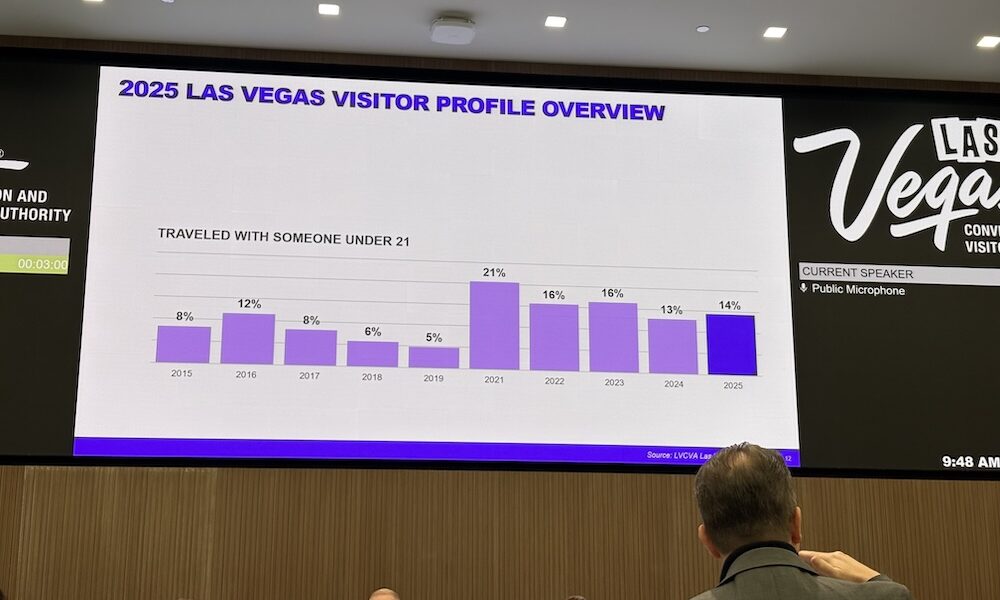
Prior to the pandemic, the range of parents who brought kids was mostly between 5% and 8% before spiking after the pandemic to 21% in 2021. It continued to be elevated to 16% in 2022 and 2023, then settled in at 14% in 2025, Bagger said.
The average age of visitors has hovered between 43 and 46 and the appeal of Las Vegas is that it attracts broad ages from the 20s to 90s, Bagger said. It was 47 in 2015 and 42.5 in 2025, the second lowest in a decade.
Those 30 to 40 made up 35% of the total, up from about 23% a decade ago. Those 40 to 49 made up 33%, up from 18% a decade ago. Those 50 to 59 have remained consistent over the decade making up 15% in 2025. Those 65 and older made up 4% in 2025, down from 19% before the pandemic.
“We have seen some changes in recent years that stand out,” Bagger said. “The 20-somethings pre-COVID hovered around 15% to 20%, and they are down to 9%. That is uniquely low. Boomers used to be about 18%. They dropped in the wake of COVID and haven’t returned. The cluster in the middle we relied heavily on and successfully of the 30- to 50-year-old Millennial and GenX crowd stands out. What that seems to be tied to is income and life stage. In your 20s, you are more sensitive to pricing in the national economy, as well as value concerns in the destination. And retirees are on fixed incomes.”
Las Vegas is relying more heavily on repeat visitors. Back in 1975, about 30% of visitors were first timers and historically, it’s been between 15% and 25%. It’s been dropping down, now to 10% (in 2025), which Bagger called “uniquely low.”
“We’re trying to understand what’s driving that,” Bagger said. “Part of that could be in the 1990s and 2000s, there was a new property every two to three years, so there was a constant reason to get people to try out the product who haven’t been here before. It could be during a period of economic uncertainty, people want a guaranteed experience. People may not want to take a risk on a trip if they don’t know what the experience will be.”
The decline in first time visitors is across age groups, Bagger said. “It’s less of an age thing and more based on income that’s driving that number down.”
One item to watch is the number of room nights per visit, normally between 3.3 and 3.5, Bagger said. It dropped to 3.2 nights, which it hasn’t been in a long time.
Food and beverage spending ebbed in 2024, and people may be pulling back on that, Bagger said. Entertainment spending is on par or up a little bit. Shopping has pulled back a little bit.
As for gaming habits, 30 years ago, nine out of 10 visitors said they gambled during their stay and the average person spent four-plus hours per day doing so. Leading up to the pandemic, it hovered around 75% to 80% gambling and the amount of time gambling was less than three hours.
Coming out of the pandemic, people spent more time gambling, because a lot of activities weren’t available, but the numbers have remained strong; eight out of 10 people who visited said they gambled in 2025.
“This echoes the broader gaming numbers,” Bagger said. “We continue to see a strong gaming demographic coming into the destination, and they are maintaining their time and money.”
The gaming budget of the average visitor was $514 in 1995 and leading up to the pandemic it ranged from $550 to $600. Post-pandemic, it ramped up, as reflected in the gaming revenue, and continued to be strong in 2025 at $849, up from $744 in 2019, adjusted for inflation. Based on inflation, the average visitor in 1995 budgeted about $1,100 in today’s dollars, which highlights the evolution of Las Vegas to more non-gaming activities.
About 12% of people said they were using social media influencers to guide their stays. By age, however, some one of four people in their 20s use social media to guide their stays.
The married versus non-married visitors continue to change. In 2015, 79% were married, but that’s now 22 points lower at 57%, Bagger said. That fits the broader national trend of those in their 20s and 30s not being married.
The mix of where visitors are coming from hasn’t changed, with Las Vegas continuing to rely historically on western states led by California with 32% of the total. The international percentage went from 14% in 2019 to 12% in 2025, which is about one million fewer visitors from abroad.
“That’s not shocking,” Bagger said. “We know the environment we are in with international visitation to the United States. Notably, the percent of international visitors in 2025 didn’t change from 2024. We have fewer visitors to the destination, but the mix of international has stayed about the same, with Canada down about 20%. Mexico has compensated for that. Overseas markets have been mixed.”

