

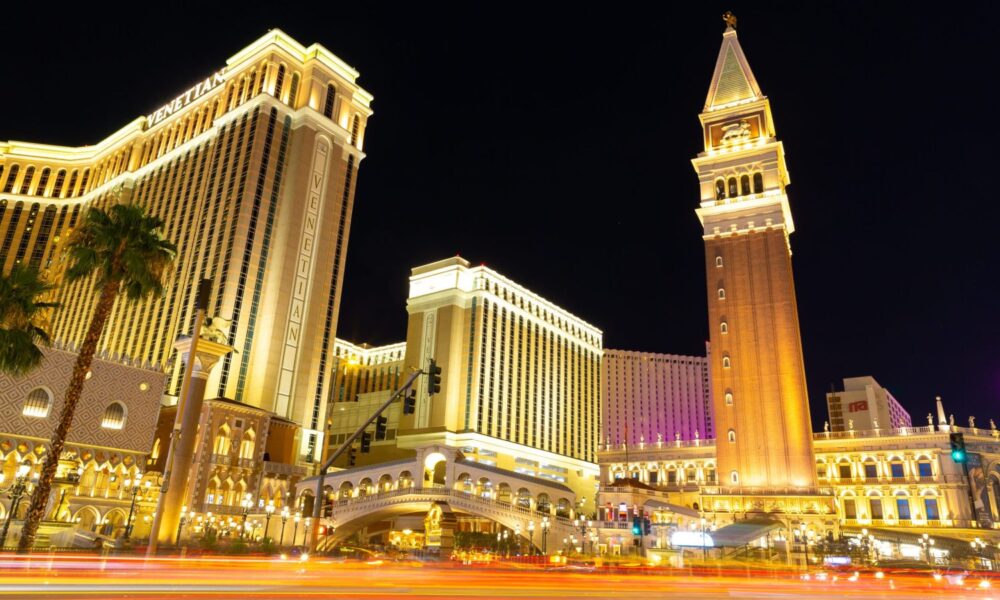

The Nevada Gaming Commission (NGC) approved a settlement agreement in which the current owners of The Venetian will pay a $7.2 million fine and institute upgrades to their anti-money-laundering procedures over illegal activities tied to convicted bookmaker Mathew Bowyer.
“This just infuriates me. This embarrasses me. It’s bad for Nevada. It’s certainly not good for our gaming industry,” Commissioner Brian Krolicki said. “But we try to make something good out of what we know is extremely bad.”
The commission Thursday approved the settlement by a vote of 3-0, with commissioners Richard Schonfeld and George Markantonis recusing themselves to avoid any conflict of interest. Markantonis, for example, was appointed general manager and COO of The Venetian in 2015 through the acquisition by Apollo Global Management in 2022 before he was named to the commission.
According to a four-count complaint released by the Nevada Gaming Control Board (NGCB), the violations largely occurred between 2019 and 2021. During the three-year span, Bowyer deposited more than $22.3 million, “wagered millions of dollars, and lost” at least $3.6 million.
Michael Somps, senior deputy attorney general with the Nevada attorney general’s office, said Bowyer was a patron of the Venetian dating back to 1999 and at least as early as 2019, the resort had concerns about his source of funds.
In outlining the settlement to the commission, Somps confirmed that the casino host knew Bowyer was an illegal bookmaker, because “he told him,” yet didn’t report that information as required under the company’s AML program.
Both Somps and NGCB Chair Mike Dreitzer said the $7.2 million fine represents two times Bowyer’s losses at the casino. Under the settlement, the Venetian will maintain or increase its current staffing levels within its AML compliance department for at least two years from Thursday’s approval and annually review and update the AML policy as appropriate based on applicable laws and regulations, with any changes being promptly provided to the control board chair.
The Venetian now has 60 days to conduct a comprehensive, in-person, training program for all independent agents, casino hosts, player support staff, marketing executives and staff, and all those with credit authority of $50,000 or more. The casino also has 60 days to designate a person with primary responsibility for the company’s AML program and 30 days to file a license for suitability or licensure with the control board.
Somps said the Venetian must also participate in the U.S. Department of Treasury’s Financial Crimes Enforcement Network’s (FinCEN) Section 314(b) information-sharing program. Section 314(b) of the USA PATRIOT Act allows voluntary information sharing among financial institutions under a legal safe harbor protecting them from liability.
Dreitzer expects to issue proposed regulations by the end of the year, making compliance with FinCEN’s Section 314(b) mandatory for all Nevada gaming licensees.
With the commission approving the settlement, Bowyer’s activities have cost Las Vegas casinos a collective $34 million in fines. Bowyer has been connected to three previous complaints and settlements against Las Vegas casinos, resulting in fines of $10.5 million assessed to Resorts World Las Vegas, an $8.5 million fine against MGM Resorts International, and a $7.8 million fine against Caesars Entertainment.
“The commission has approved three fines that involve Mr. Bowyer and his activities,” Somps said. “While all these complaints are not exactly the same as The Venetian, they do involve similar types of allegations and the board considered the prior complaints at arriving at what it believes his an appropriate fine for The Venetian.”

In the end, Somps said, the fine reflects the board’s view that The Venetian’s violations measured against the others, while serious and warranting a significant fine, were not as egregious. During the NGCB’s investigation that lasted more than a year, investigators found the property’s compliance department had no information that Bowyer could be an illegal bookmaker or that any senior executives had knowledge of Bowyer’s illegal activities.
“It’s a mitigating factor that the current owners purchased The Venetian in 2022 and at that time they obtained a new gaming license and were in control of the operation,” Somps said. “The majority of Mr. Bowyer’s play was prior to 2022 under the previous owners.”
Greg Brower, an attorney for The Venetian, told the commission that of the $3.6 million lost by Bowyer, only $88,000 was lost after Apollo took over the company. Bowyer was banned from The Venetian on March 11, 2024, because of money-laundering concerns.
The Venetian complex, which includes the Palazzo and Venetian Expo, was acquired by Apollo from Las Vegas Sands as part of a $6.25 billion transaction in February 2022.
“I want to clearly state that my client, The Venetian, very much regrets the circumstances that led to this settlement agreement,” Brower said, “Clearly, more effective and timely due diligence and decision making concerning Mr. Bowyer could have and should have been done relative to his source of funds … prior to 2022.”
Venetian President and CEO Patrick Nichols and Chief Compliance Officer Calvin Siemer attended Thursday’s hearing in Las Vegas.
Krolicki agreed, but believed it was hard to bring people to the woodshed for something that happened before they got there. He also expressed frustration that Bowyer had played at The Venetian for 25 years, saying, “Who knows what happened before we poked back to 2019?”
“I suspect the folks I really want in front of me are not in front of me,” Krolicki said. “I never want to see this again. Because if there is a phase two, you’ll get a different reaction from this commissioner.”
