
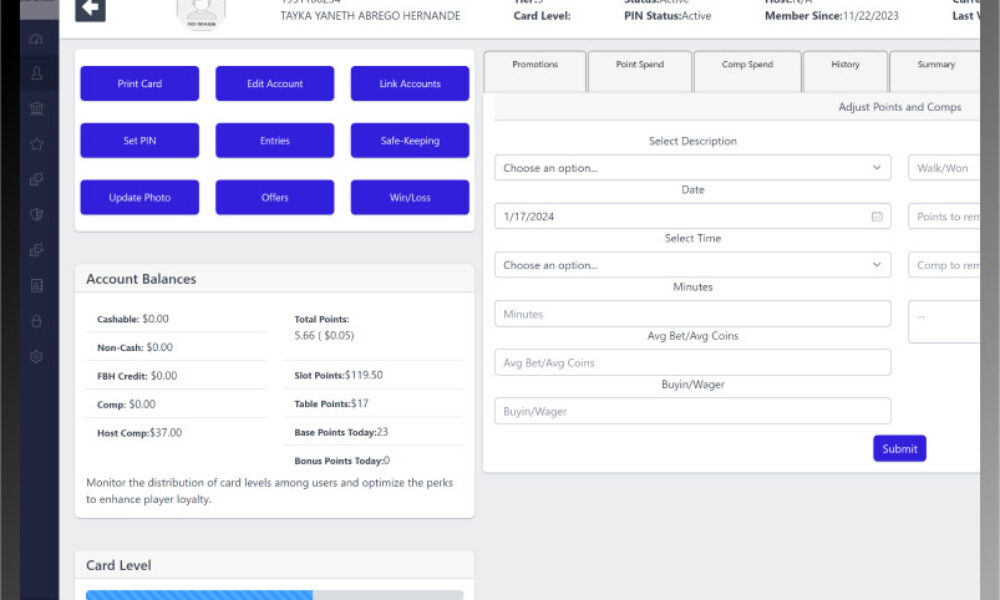

Table Trac’s newest AI tool will help pit supervisors maximize table-game revenue by providing recommendations based on real-time playing data, Founder and Chief Technology Officer Chad Hoehne says.
“Instead of being able to accurately monitor, track in detail, and make decisions about a single pit, that same knowledge could allow an operator to do an entire floor of six pits,” Hoehne said.
The application, Table Games Manager/Manager Trainer, is an overlay for Table Trac Version 5, which is under development, but will be previewed at the Indian Gaming Tradeshow and Convention March 30-April 2 at the San Diego Convention Center. Hoehne plans to have it market-ready before the Global Gaming Expo starts Sept. 28 in Las Vegas.
Table Games Manager/Manager Trainer is designed to speed the learning curve of those new to their position and to provide real-time data and recommendations to enable quicker adjustments by those with years of experience.
Hoehne said the system has a unique approach to making recommendations for raising or lowering table limits, opening or closing tables, staffing, and all the other decisions supervisors make. A starting point was Table Trac’s “mountain” of data from its 20-year history of providing management systems.
“You cannot train AI (purely) on historical information or all it will do is learn how to optimize for that data set,” he continued. “Instead, we used historical information in a novel way to create a whole group of AI player personas that we can unleash onto a floor simulator. The behaviors of these independent agents will always be varied and different.”
Some personas prefer blackjack only at a $15 minimum, while some want a $100 table. Others favor roulette or pai gow poker and wallet sizes differ. The mixture of historical data and multiple modern personas enables the system to optimize for multiple situations.
“(The system) can see the tables and seat positions on all the tables in real time,” Hoehne explained. “It knows the current status of the seats in the pit at all times, as well as the overall headcount in the casino and how many players in an overall population are going to typically be inclined to engage in table games.” It also maps all seat positions, including whether each occupant is carded or uncarded.
The Manager/Manager Trainer, which recently received a “patent-pending” designation, would be located completely on the operator’s site, as opposed to being cloud-based. Hoehne said the AI at its core is “fine-tuned” in table game knowledge from specialized textbooks, reference books, and training documents, many of them unavailable in electronic form. “This has deep knowledge in gaming space, and especially table games management and yield management.”

Pit supervisory personnel should view the Manager/Manager Trainer as an asset, not a threat, Hoehne said. “AI is, in many cases, a force multiplier for your existing staff,” he said. “They are going to be able to command a larger role by utilizing this tool. This is not meant to replace, but to augment and make their role more valuable.”
Hoehne said the Table Games Manager/Manager Trainer tool provides the background for newcomers to understand the job by competing with the AI during training. For example, a trainee could compete with the AI what steps would maximize yield over a simulated period. That exercise would take only a few minutes. “This tool can assist with that training and actually help make them a better pit manager,” he said.
More uses could be on the horizon because of how quickly AI is evolving, Hoehne said.
“The current vision is that it provides assistance not only to the table games management function, but across the entire casino management system realm, to include assistance with auditing, assistance with slot operations, assistance in player service and marketing. Every aspect of the casino management system realm is going to be impacted.”

