
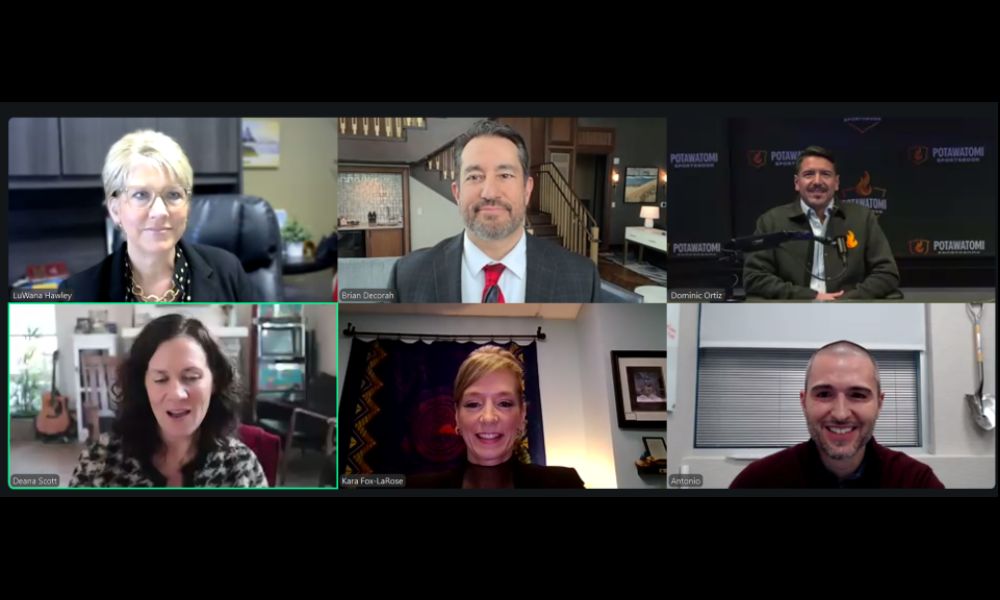

The executives who participated in a session at Raving Next Casino Strategy and Operations Summit Wednesday had various concerns about the future of tribal gaming.
Increasing revenue streams, the rapid advance of technology, and maintaining a competent workforce were some of issues raised by the panelists during “Executive Roundtable Discussion: Critical Strategies & Innovations for 2026.”
But all agreed that there’s one issue that plagues every tribal casino: Prediction markets.

“We’re lobbying our regulators, the lobbyists, elected officials to stop prediction markets,” said Gun Lake Casino Resort General Manager Brian Decorah. “In my view, they’re illegal.”
Dominic Ortiz, CEO of Potawatomi Casinos & Hotels in Wisconsin, emphasized that the best defense against prediction markets and sweepstakes providers is a regulated market.
“We run the risk, every month we delay, that these black, unregulated markets continue to grow,” Ortiz said. “We need to push for the right solution on both (tribal and commercial) fronts.”
One of the concerns with prediction markets is that they may affect other aspects of gaming. Antonio Perez, General Manager of Rivers Casino Portsmouth in Virginia, said it is important for tribal casinos to foster a welcoming atmosphere that attracts people to gamble in person.
“We focus on new ways to drive the foot traffic into the sports book and get people onto the property so that they can experience what it’s like to be inside the sports book with that environment and with that energy,” Perez said. “We are working actively to try to lobby the legislators against the Kalshis and Polymarkets because that is eating into everyone’s market share. It’s something that I believe is going to continue be a threat until it is addressed from a legislative standpoint.”
In the state of Washington, online gaming is illegal. But Kara Fox-LaRose, President and General Manager of ilani Casino Resort, a Cowlitz Tribe property in Ridgefield, said possible igaming legalization could potentially disrupt tribal operations.
“We’re spending time really understanding how these markets could shift where and how customers choose to wager, and what that means for our product mix,” Fox-LaRose said. “And then, of course, the compliance framework and competitive positioning.
“Our focus is on ensuring we’re prepared to adapt rather than be displaced or further dilution happens as wagering evolves. We’re curious to see what the future does bring, and this is why we’re always thinking about that master plan, what happens between now and 10 years from now, where none of us have a crystal ball. … “We’re strategically evolving and expanding our business over time. I think it’s important to take a measured approach.”
For LuWana Hawley at Lucky Dog Casino in Washington state, success is predicated on knowing her customers. Hawley, the General Manager presides over an operation that only has 170 slot machines, a restaurant and a bar. Hawley hasn’t always had the resources to make improvements – during COVID times were particularly lean – but she’s made things work by emphasizing the casino’s strengths.
“I think it’s just really understanding and knowing our demographic, who they are and what we are, and not trying to be something we’re not. We have a resort 20 miles down the road that sits to the east of us, and there’s a city in between. So, we both pull from that. The reason for them to come this direction, instead of that direction, is our team and what we can offer here, and knowing what they want not, trying to be something that we’re not.”
Perez emphasized the contributions brick-and-mortar casinos make to their communities. It’s a point of emphasis when lobbying politicians about what a tribal casino can mean for a region.
“With a lot of these online operators, they’re taking jobs away from people in our local communities,” Perez said. “They may have a couple of people working in one or another state, somewhere else. So, they’re not contributing the same way to the tax base. They’re not donating to the local nonprofits. You don’t see them handing out turkeys on Thanksgiving and doing check presentations monthly to all of the organizations that are in need in your communities.
“We’re making sure that we’re focusing on not only how much we’re giving back and reinvesting in our communities, but also our responsible gaming practices, because we’re building so many safeguards to make sure that we’re taking care of the guests who are coming into our properties and doing the right thing.”

