

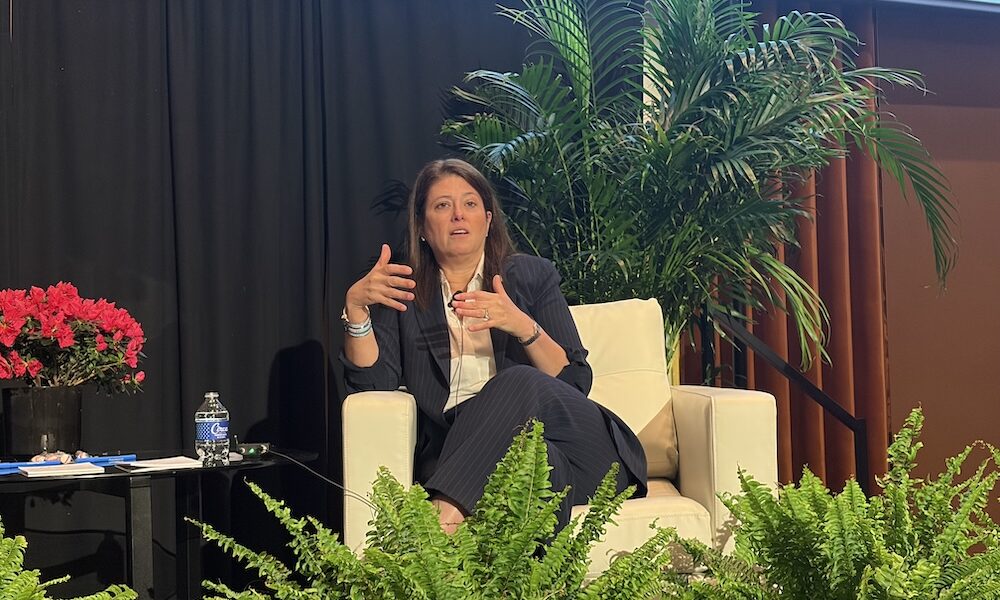

Felicia Hendrix traded in a career on Wall Street analyzing the gaming industry to work in it at a high level. The executive vice president and chief financial officer at Penn Entertainment since 2021 was a veteran of Wall Street having worked as a managing director at Lehman Brothers and Barclays before embarking on a career in gaming.
Hendrix was a highly regarded equities research analyst covering gaming, lodging, and leisure properties, according to Bryan Gosslin, Senior VP and Chief Accounting Officer at Penn, who moderated a chat with Hendrix last week at a gaming conference hosted by Nevada Society of Certified Public Accountants at Circa Las Vegas.
“Understanding how investors evaluate companies gives her a rare lens on strategy and capital allocations, leadership, and the evolving role of the CFO,” Gosslin said.
Hendrix admitted she has an eclectic background, adding it’s important to “put yourself out there and push the envelope and not be complacent of where you are at the moment.”
Hendrix wanted to be a chemical engineer, but when it came time to pick a major at the University of Virginia, she ultimately chose an English degree. She considered attending law school since her dad was a lawyer, but when she went to work as a paralegal she decided law wasn’t a career for her. It took a roommate who worked at Arthur Anderson to spur her interest in finance.
Hendrix attended Virginia’s Darden School of Business and fell in love with finance, but in the mid-1990s, it was difficult to get a job. She started with a boutique investment bank before moving to Lehman Brothers in 1998.
“If you put your mind to it and have certain skills you can transform yourself into anything,” Hendrix. “All my life, I tried to make myself uncomfortable. My first few years on Wall Street were uncomfortable and I didn’t know what I was doing.” She asked questions and learned on the job.
In March 2020, the news about casinos closing down for the pandemic prompted a change of heart.
“I was burned out and our two children were happy that I was around, because I traveled a lot. Just a few weeks later, I got a call from Penn asking if I’d thought about leaving Wall Street. It was a hard decision. I was in control of my schedule, didn’t have to learn anything new, and didn’t have to prove myself. But this was my dream.”

Hendrix said she’s not a CPA and had to learn a lot, but she had strategy, leadership, and people skills. There’s no requirement for an accounting background, which is different from the past, when the CFO was seen as the head accountant and head of finance of a company, even though treasurer does balance- sheet management.
“It has evolved over time,” Hendrix said. “I wear three hats. We are a publicly traded company. I worked on Wall Street so it’s natural that one of my hats is in industrial relations hat. The second hat is the CFO — accounting, finance, procurement and internal audit. The third that is relatively newer for CFOs is the strategic hat. I have a seat at the table with our CEO, strategy officer, and ops people where we think about the future of Penn. If an M&A opportunity, divesture, or anything strategic comes up, I’m a part of those conversations. That’s the part that’s most interesting to me. It also fits well with my background. When I was an analyst, I covered 35 companies in different industries, so I have a perspective on what a lot of companies have done over time.”
When it comes to investors, Hendrix said credibility is important to them and it’s easy for management teams to mess that up. It’s important to do what you say you’re going to and deliver on the goals and strategy laid out to investors.
“I’m not naming names, but I covered one company not in gaming that missed estimates every single quarter,” Hendrix said. “Not only is communication with Wall Street through the quarterly earnings calls, but you meet investors face to face on investor days, intimate one-on-one meetings, or group meetings. A lot of Wall Street firms have conferences. Sitting across from the CFO, CEO, or head of investor relations and getting the impression that they know their business is important. I know that sounds really obvious, but I used to sit across from a well-regarded CEO who, if I asked him what his company did, I’m not sure he would know. He was more like a diplomat. I ‘ve sat across from a lot of CFOs who didn’t seem like they had a grasp on the business either.”
That didn’t happen a lot, but it happened enough, that one of the reasons she had her eye “on the CFO prize” was because she knew she could do a better job than they did.
Her most important job is being a steward of the balance sheets. The concern that balance sheets won’t be in a healthy position keeps her up at night. In 2024, Penn was in covenant relief because it had reached its covenant levels at a time it was investing in its interactive business. “Liquidity, liquidity, liquidity is the most important thing. If you don’t have liquidity and flexibility, you can’t invest in your business or do anything else.”
Hendrix talked about Penn’s growth projects in Illinois, Ohio, and the new hotel tower in Las Vegas at the M Resort.
“We wouldn’t be able to do that if we didn’t have the strength of our balance sheets and great partners at GLPI,” Hendrix said. “We wouldn’t be able to think about future growth that’s not organic. We wouldn’t be able to kick the tires at different M&A opportunities. If your balance sheet is strong, you’re in a luxurious place and you can return cash to shareholders with stock buybacks and dividends, you can reinvest in your business, and you can de-lever.”
During the chat, Hendrix was asked to give advice for those looking to advance in their career. She talked about being curious and pushing yourself.
“Get to know senior people in your department and reach out to them,” Hendrix said. “They won’t know who you are. I’m talking about people three levels above your director. Get yourself known, be curious, ask questions, volunteer, and throw your hat in the ring if a position opens up. As a manager and leader, I love when people throw their hat in the ring even if they are not ready. If they throw the hat in the ring, that means they want to be more. Look at what you are doing and see if there are new ways to do it. Volunteer for different events in your firm to get yourself known. Not everybody is going to be that person and some folks are very comfortable with staying in their lane, but you do what to get yourself noticed.”
Hendrix was asked about the challenges of balancing a career with a family life. She said she’ll never forget what it was like at Lehman Brothers pregnant with her first child. She worked 14 hours a day and all weekend and questioned how she could also fit in travel and exercise.
“One of my colleagues came to me and said when you start your family, you’re not going to be able to do everything you did before and that’s okay,” Hendrix said. “That has resonated with me. It’s not just about being a female. Any folks out here who are young and have young families it is really hard to balance, especially if you both work. It’s okay at that point in time if you are a B-plus mechanic. You have your whole career to catch up. I was never the best in my department or the top quartile because I had to balance it. I just think it’s okay to balance and not be great all the time.”

