

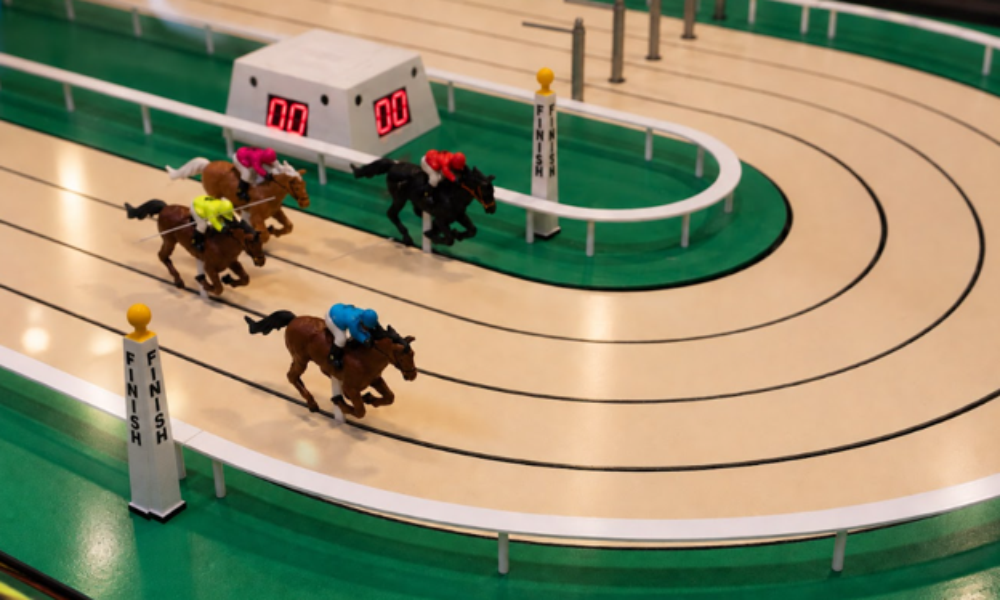

The first new Sigma Derby mechanical horse-racing game in decades is set to go live soon in Las Vegas, with a goal of spreading its unique appeal worldwide.
The first game will be available by the end of the year at Four Queens Casino, said Mike Darley, CEO of Next Gaming, one of three companies behind the reincarnation.
Patrick “Schmitty” Schmit, quarterback for the project and founder/CEO of Highbrow Gaming, said Sigma Derby appeals to a broad range of players because of the camaraderie that develops before, during, and after each race. “It’s something that the young and the old are actually drawn to,” he said.
Colt Vollmann, president and CEO of VSR Industries, said staffers put in about 4,000 hours of engineering, mechanical, and electrical work on the new Sigma Derby since November 2025. “It’s like a classic car that’s been restored to glory with modern technology under the hood,” he added.
VSR, based in Henderson, Nevada, provides cam locks, custom millwork, slot bases, and cabinets to 3,500 gaming industry customers and OEMs around the world. It produces an average of about 15,000 Class 3 slot machines a year, he said.
Schmit recalled playing the original Sigma Derby in the 1980s and ’90s. “I reveled in its simplicity and I was astonished at its popularity. There’s something innate to the game itself, the simplicity.”
The original Sigma Derby, introduced in 1985, was once a common sight in Las Vegas and elsewhere. It featured five horses racing around an oval track, although some properties synced the figures with their overall theme, such as camels at Luxor, taxis at New York-New York, and chariots at Caesars Palace.
Ten betting stations enabled players to pick which pair of the five racers would finish first and second. Odds for the 10 combinations changed each race, with a maximum payout of 200-1 offered occasionally.
But time overtook the game. Video slots grew in popularity, and the quarters-only Derby could not be converted to TITO technology. Repairs to its mechanical innards were difficult and replacement parts became increasingly harder to find.
Even though only one original Derby machine is still active, at the Golden Gate in Las Vegas, the game’s popularity has remained strong, including fan groups on Facebook, Instagram, and X.
The new game displayed at this month’s Global Gaming Expo fooled some attendees into thinking the Highbrow-Next-VSR team had simply spiffed up an old unit.
“My sole purpose was to make this game just like the old one,” Schmit said. “I didn’t want to hear anything about adding a progressive. I wanted, certainly out of the gate, to do nothing but replicate the old game as closely and as precisely as we could. And I think that’s what we’ve done.”
The new game retains the original’s lighted canopy, the horses’ back-and-forth rocking, and rounded buttons for players to make their picks or increase the number of credits wagered. It also keeps the roughly one-minute interval between races. That allows about 30 seconds for the race and for people to talk about it while placing their next bets.
“That dialog happens nearly every single time and that’s a unique element of the game,” Schmit said. “It really contributes to the social aspect.”
The new game has 10 betting stations, a bill validator, TITO, and a display of past winners, comparable to a roulette reader board. Players pick their betting unit, from 25 cents to $5. Operators can choose an RTP of 86 percent to 94 percent, Schmit said.
He added that the group has pending IP that would allow operators to schedule when some bet denominations are available or unavailable. For example, an operator could offer 25-cent to $5 credits midweek and just $1, $2, and $5 bets on a weekend, comparable to changing table-game limits.
Vollmann said VSR re-engineered and modernized the track technology for the new Derby and made the workings easily accessible for any repairs that might be needed after running around the clock for extended periods. “It’s a fresh slot machine from our eyes, with plenty of sourcing and supply chain.”
Four Queens was chosen as the first site for the new game, because casino owner Terry Caudill also founded and owns Next Gaming. “(There isn’t) another company that can make a slot product and put it in their own casino,” Darley said. “We get to experience the game before we put it out into the larger domain.”
Schmit said several other casinos have signed up for the Derby, including Pechanga in California, and the Venetian, Palazzo, and Stratosphere in Las Vegas. “We have an interest list of more than 100 and I’ve approached only five or six people. The rest have just heard and reached out to me. Supplying the demand is going to be the problem, not creating the demand.”
Sigma Derby requires a space that could hold 13 or 14 traditional slot machines, but the team doesn’t see that as an issue.
“When people are cheering and yelling while playing, it creates energy and interest that is measurable,” Darley said. “People are having fun together. You can’t do that on a slot machine.”
Its unique presentation makes Sigma Derby “a beacon on the casino floor,” he added. “The experience of playing Sigma Derby creates a loyal customer following that encourages repeat visits time and again.”
