


A year and a half ago, Mindway AI CEO Rasmus Kjaergaard admitted he was a bit frustrated with his company’s progress in the United States.
“We tend to forget that the American online market is actually still a young market, less than 10 years old,” Kjaergaard told CDC Gaming. “And if you look into how these market openings or market developments are elsewhere in the world, the regulation, the monitoring of gambling behavior, which is the key regulation that drives these assistance programs, is not in place.”
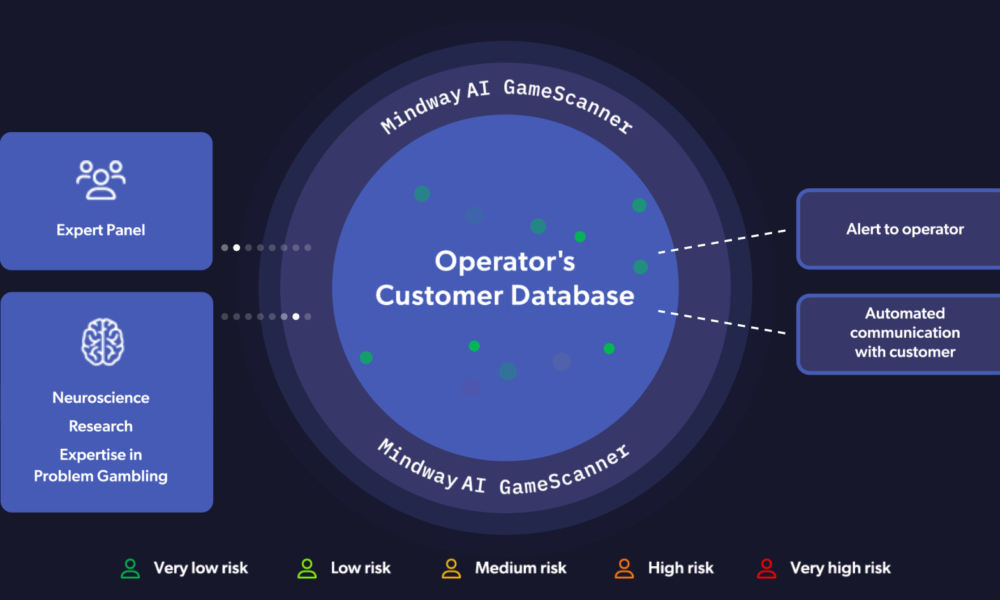
But at Global Gaming Expo (G2E) this year, Kjaergaard said his schedule was packed, that more American companies wanted to meet with him to see how Mindway AI could help their companies. Notable was the introduction of a new platform, GameScanner, which has the potential to revolutionize treating those with gambling problems.
“We train algorithms, machine-learning algorithms, which are, in my view, the absolutely right type of technology for various precise things, in contrary to large language models that are designed for something else,” Kjaergaard said. “We train it with psychologists. And what we want to achieve with this is to clarify, based on data analysis, the full picture of the gambling behavior of each individual player.”
Individual profiles are created through a combination of artificial intelligence and psychologists’ input – the “secret sauce,” according to Kjaergaard.
“Basically, it becomes a virtual psychologist because psychologists, when they assess gambling behavior, they look at the full behavior, not just money spent.”
GameScanner evaluates other factors, including chasing losses and gambling in the middle of the night or at odd times. Kjaergaard also said operators, in their terms of agreement, should let players know they are being evaluated lest there be privacy concerns.
But the alternative – allowing gamblers to proceed with risky behaviors – is a far worse alternative, he thinks.
Operators can use Game Scanner for “much more specific, individualized in their approaches to the customers when they reach out in writing,” Kjaergaard said. “And also, normally it’s good practice in particular in the countries where there is regulation around it that with very high-risk customers, you potentially call them.”
One of the hidden benefits of using GameScanner might initially seem counterintuitive: A player who may be having gambling issues can be “saved,” or prevented from riskier behavior, by being confronted or addressed via the platform. There is a belief that responsible gaming programs actually “steal” players from operators, but Kjaergaard said that’s not the case.
“We can we can say the opposite, because not only do you mitigate the risk of losing the player to self-exclusion if we reach out earlier as any with any other risk behavior that can end up being addiction towards human beings, it’s much easier to change the course earlier,” he said.
“If you manage the cost earlier with more individualized (care) earlier reaching out,” Kjaergaard added, “then the lifetime cost goes up on the customer on database on average, meaning the database becomes more sustainable and the lifetime value goes up as well. You utilize your acquisition budget.”
Operators can also minimize publicity risks associated with hardcore gamblers through early treatment with GameScanner. There are just fewer than 17 million players being helped by the platform in Europe, the United States and Canada.
