
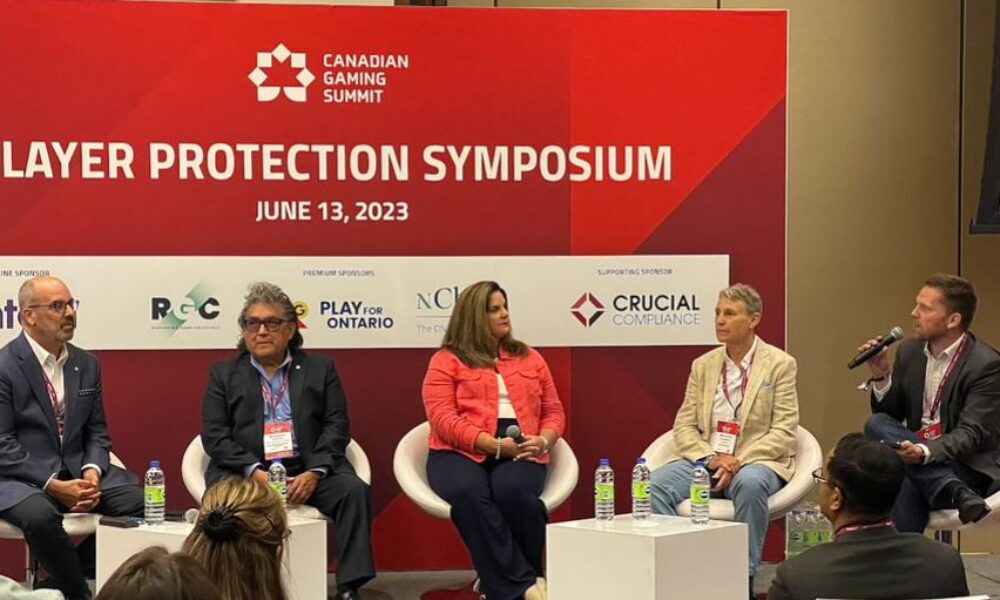

The Canadian Gaming Summit kicked off Tuesday with the Player Protection Symposium. The core panel discussions occur Wednesday and Thursday.
Tuesday’s series of discussions started with a topic that’s particularly relevant in a regulated Ontario market – walking the tightrope being player protection and market growth. Ontario just passed its one-year anniversary, with nearly 50 licensed operators and CAD$35-plus billion in total wagers after the first 12 months.
The Summit, held at the Metro Toronto Convention Centre and operated by SBC for the first time, has a full schedule of group discussions from industry leaders over the next few days, with a focus on the Canada-wide market and an exhibition floor that’s 50 percent bigger than last year’s event. More than 2,000 people are expected here.
Bill Pascrell III, principal, Princeton Public Affairs Group, was asked for his thoughts on what hasn’t gone well so far in the consumer-protection space on both sides of the border.
“We’re one newspaper headline away — I don’t care what side of the border you’re on, whatever jurisdiction you’re in, from some politician, or regulator’s son, daughter, mother, father — from this whole industry blowing up,” he said. “The best answer and solution for responsible gaming is to regulate. When you don’t regulate, your populace either goes across the border to a jurisdiction that has it, or they go bet illegally, or they bet on the street. No benefit to government, no way to track responsible gambling or understand what’s going on in the industry. As a brick-and-mortar-casino lobbyist for many years, I saw first-hand what the industry did. They treated the gambling-addicted customer as a VIP.”
This industry can’t sustain itself by doing that, he added. Through leadership, RG principals have become the focus and that’s a newer thing in the industry.
“The industry has to be self-regulatory,” Pascrell said. “It’s not about today’s payday, or land grab, or gold rush. It’s about creating an industry that our sons and daughters can come into in a sustainable way.”
Also participating were Chrissy Thurmond, senior director responsible gaming DraftKings; Jacob Coin, executive advisor to chairman, San Manuel Band of Mission Indians; and Jay Robinson, director of safer gambling and stakeholder engagement, Focal Research. The panel was moderated by Martin Lycka, SVP American regulatory affairs and responsible gambling, Entain.
There is a tension between commercial competitive pressure, especially in a market the size of Ontario, and the need to make responsible gaming practices a priority for operators. How do operators walk the line?
“The key here is education and continual learning,” said Thurmond. “We’re always learning. One of the things I think about in leadership at DraftKings is how do we educate and inform, not just our players, but our internal stakeholders? I truly believe the best-educated workforce will translate into the most informed player base.”
Operators need to provide a forum for their players to understand what they’re doing when they’re gambling and engage with their product safely and mindfully, with the knowledge of the tools available to them so they play safely. People in the industry also need to understand there is a tremendous amount that still needs to be done in terms of education.
“We’re on a journey and we have a vast expanse in front of us,” she said. “There is lots of collaboration within the RG space [among operators], protecting the players. We talk with each other regularly. We have the finger on the pulse of what’s happening. When we start seeing the tick up to risky play, it’s a little too late. Had that player had better knowledge early on, we would have a better opportunity to provide platforms to them.”

She said the industry should focus on the problem gambler and have the program breadth so it hits all their stakeholders, that engages the multiple people in the industry, including those still learning how to gamble. That’s what a leadership component entails, she added.
DraftKings does a “tremendous amount of training” in this area. Employees right away go through an education program around RG, covering education and knowledge dissemination.
Robinson agreed that it’s important for the industry to engage players early on as they engage with a product before gambling becomes a problem.
“If we can interact with someone the second time they gamble, on a device, and we can say to them through a pop-up that the way you’re gambling now is associated with harm,” she said. “We’re not saying you have a problem, but the people who do have harms gamble in the exact way that you are now. We can prevent harms from occurring if we do that.
“How does (RG communication) enrich their experience and make it that when they’re done gambling, their wife isn’t mad at them?”

