


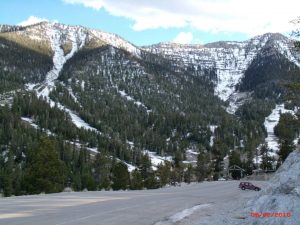
Snow lingers nearly until summer at the Las Vegas Ski and Snowboard Resort, which is situated along the mountain’s northern face.
Citing a lack of area natural attractions, a recent Travelocity report indicated Las Vegas ranked behind San Diego and Los Angeles as top destinations for summertime travelers.
While summertime heat certainly plays a role in helping those ocean-side cities rank ahead of Las Vegas, aside from the Pacific Ocean, Las Vegas contains a wide range of year-round great outdoor escapes. Among outdoor attractions and activities in and near Las Vegas are several national parks, boating, hiking, biking, downhill skiing, horseback riding, dune buggy tours, zip line rides, and much more.
The Spring Mountains National Recreation Area is located only a half hour from the Las Vegas Strip, is part of the Toiyabe National Forest and is the best way to naturally beat the summertime heat.
The Spring Mountains offer several campgrounds, hundreds of miles of tails for hiking and biking, and plenty of outdoor picnic areas. The temperature in the high mountain areas generally are 20 to 30 degrees less than in Las Vegas, and those looking for outdoor fun and to get away from the summertime heat will find no better destination.
Hikers can retrace the steps of the “Pathfinder” John C. Fremont, who was the first white man to climb the summit of Mt. Charleston, which rises 11,918 feet. He named the peak after Charleston, South Carolina, which was his wife’s hometown.
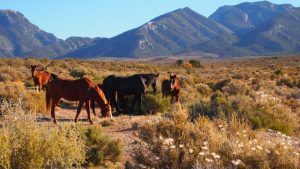
A family of wild horses grazes along Wheeler Pass in the Spring Mountains near Cold Creek.
Campgrounds near Mt. Charleston are extremely popular during the summer and generally require reservations several months in advance. They offer ideal nighttime sleeping conditions in a mostly bug-free environment during the summer, with the glamour and gaming in Las Vegas just a short drive away.
Many scenic lookouts offer exceptional views of the surrounding Mojave Desert, and wild horse sightings are common. Nevada is host to the nation’s largest population of wild horses, and many of which reside in the Spring Mountains.
On the west side of the Spring Mountains, it’s still possible to retrace an old stagecoach route that once connected Las Vegas and Pahrump via Wheeler Pass and provided timber for mining operations in Death Valley. Doing so requires a high-clearance vehicle, preferably a 4×4, or using an ATV.
In addition to wild horses, wild burros, elk and mule deer occupy the Spring Mountains, along with coyotes and mountain lions. Those who want to see wild horses are almost certain to spot them during a tour of Wheeler Pass, particularly along the Cold Creek side.
Mt. Charleston also contains the Las Vegas Ski and Snowboard Resort, which at one time was promoted more by Las Vegas casinos. A photo gallery currently on display at the Lloyd D. George Federal Courthouse in Downtown Las Vegas includes a 1955 New Year’s promotional featuring a ski-clad showgirl from the Sands welcoming guests to Mt. Charleston for the holiday celebration.
These days, though, many skiers are amazed to learn there’s a downhill ski run located about 45 minutes from the Las Vegas Strip, which is open most years from about late November to late March, with some seasons starting sooner or lasting longer. It also averages about 240 inches of snowfall per year, and has snow-making machines.
The ski area contains 30 ski runs, with 20 percent for beginners, 60 percent for intermediate skiers, and 20 percent for experts. It also has three ski lifts, a base at about 8,500 feet, a peak that is more than 11,200 feet up, and an 860-foot vertical drop among its 195 acres of ski terrain.
Those who prefer snowboarding can use a variety of rails and table-top jumps. During the off-season, the ski resort provides 250 acres of hiking and mountain-biking terrain that is challenging, popular, and scenic when the snow is gone. Whether skiing, hiking, or biking Mt. Charleston, the ski resort has a restaurant and bar for relaxing before heading back to the casinos and hotels in nearby Las Vegas.
Closer to Las Vegas, the Nellis Dunes are situated about 15 miles north of the Strip and offer free use and camping for power sports enthusiasts who enjoy climbing dunes and tearing across the sand in dune buggies, ATVs, 4x4s, and dirt bikes.
Dune buggy and ATV rentals are available. So are guided off-road tours of Nellis Dunes, portions of Lake Mead National Recreation area, and other parts of the Las Vegas Valley, including Wheeler Pass. Those looking to do something at a slower pace while still getting outdoors can opt for guided trail rides on horseback at Red Rock Canyon.

Another popular way to experience outdoor wonders near the Las Vegas Strip is to take zip line tours of the Mojave Desert and Bootleg Canyon, near Boulder City. Canyon rafting, kayaking, Jet Skiing, water skiing, fishing, and boating also are available on Lake Mead, Lake Mohave, the Colorado River, and Lake Havasu a bit further south.
Several water parks also are located in the Greater Las Vegas area, and Wynn Resorts is planning a new water park with a mile of white sand beach and water-based performances.
Las Vegas also is ideally situated for day trips to several national parks, with the Grand Canyon being the top draw. Day trips by helicopter, bus, and van are available, and self-guided tours to the nearby South Rim and the Grand Canyon Skywalk, which the Hualapai Tribe opened in 2007.
Death Valley is another popular destination for Las Vegas visitors and is only about 90 minutes away by car when entering near Shoshone, California. Badwater Basin is the lowest elevation in North American at some 282 feet below sea level and is the most visited spot in the park. Many also enjoy cooling off and eating at the Furnace Creek Ranch and taking a trip out to Scotty’s Castle before heading back to Las Vegas.
Yet, Death Valley is much more than Badwater Basin, Furnace Creek and Scotty’s Castle.
Star Wars fans can tour some of the Tatooine film locations from the original movie, parts of which were shot on location in Death Valley. Some scenes in Return of the Jedi also were filmed in Death Valley.

Death Valley also is an ideal location for star-gazing, as there is virtually no light pollution, aside from a nominal amount from Las Vegas. Amateur and professional astronomers often travel to Death Valley to view special celestial events.
The history of the Old West is easy to find in Death Valley, too, with remnants of past mining operations and former settlements remaining for visitors to explore.
Also located a relatively short drive from Las Vegas is Zion National Park in Utah, with Bryce Canyon slightly more distant. Between those parks and Las Vegas are the Lake Mead National Recreation Area and Valley of Fire State Park. And heavily visited Red Rock Canyon National Park is just a few miles west of Summerlin.
For those willing to undertake take even a relatively short drive, Las Vegas contains a variety of national and state parks, forests and recreation areas offering unique recreational potential that is limited only by summertime heat and people’s imaginations.
