
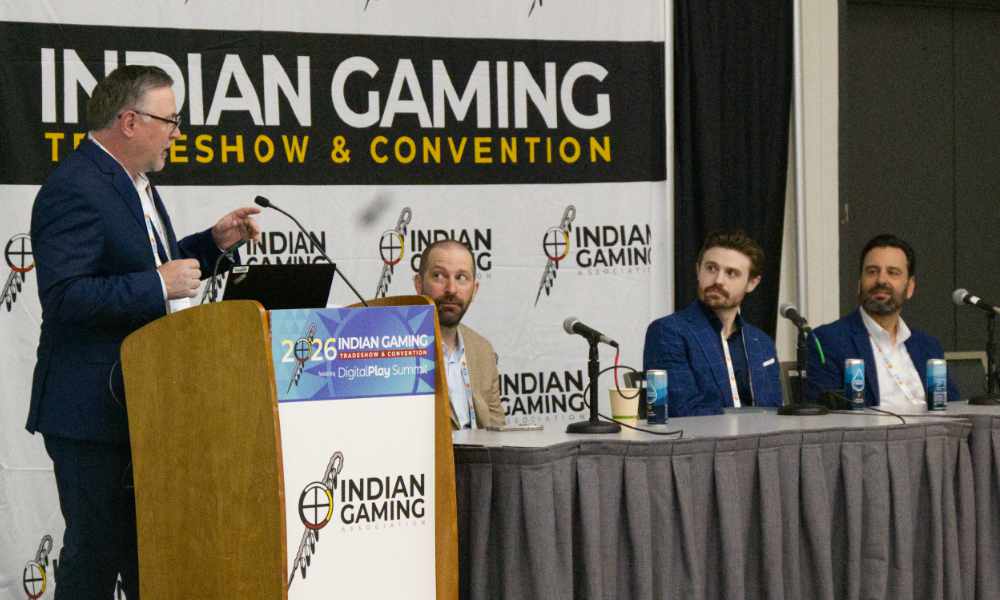

At the Indian Gaming Tradeshow & Convention Tuesday, a panel titled “From Mailbox to Mobile: Connecting Direct Mail, App, Email, and Automation for Casino Growth” turned into a more honest conversation than most on the topic.
Everyone in the room is already using multiple channels. Direct mail is still the foundation, email is active, most operators have an app, and SMS is somewhere in the mix depending on comfort level. None of that is new. More interesting was how those channels are still being prioritized and measured.
Moderator Steve Neely asked the audience a quick series of questions.
- Who has a P&L line for direct mail? Nearly every hand went up.
- Who has one for gamification or their mobile app? No hands.
- Email? Got a small handful.
It doesn’t represent the entire industry, but it is a pretty good snapshot of how some teams are structured. Direct mail is owned and defended. The rest are used, but not always treated as direct revenue drivers in the same way.
That becomes harder to justify when you look at performance.
Cameron Kane, CEO of iPost, brought up the stat everyone knows and very few seem to build around. “For every dollar that you spend in the email channel, you can expect, on average, $42 coming back.”
Email is one of the highest return channels available, but it’s still often treated like a support function instead of something that should be planned and optimized with the same level of focus as direct mail.
Kane made the distinction pretty clearly. “Doing email is easy. Doing it right is difficult.”
He also kept coming back to timing and relevance. “At the end of the day, it’s the right content at the right time and that’s where you see your ROI.”
Most operators are not struggling to send messages. They are struggling to send the right message when it actually matters. When that’s off, layering in more channels does not help.
“You can wear out your welcome,” Kane said. “These channels are in a coexist mode, but they can’t just coexist. They have to cooperate.”
That line ended up being one of the more useful ways to think about it. Most properties are already “omnichannel” in the sense that they are using multiple touchpoints. Fewer are actually sequencing them in a way that builds on itself.
Mike Paulus, COO of Engage Nation, kept the focus on how those interactions are structured. “So instead of saying, hey, you got 100 entries, let them spin the wheel. Then they get those 100 entries for a drawing … and drive them back to the property.
“To me, when I think of gamification … it’s the same reason that you wrap a Christmas gift. Opening it is the best part,” he said.
Steve Neely shared a story that grounded the entire conversation in something real. He described a night at a northern California property during a storm so severe he expected business to be down significantly. He was receiving hourly revenue updates and, by his own admission, checked them reluctantly, assuming the numbers would reflect what the weather looked like outside.
Instead, revenue was up.
Hour after hour, it continued to outperform expectations. Eventually, he reached out to his marketing team to figure out what was happening. The answer came back in two words: Engage Nation.
The property had recently launched a gamified experience through its app, giving players a reason to engage remotely and earn entries tied to an in-casino promotion. That experience was being supported by email and reinforced through direct mail.

“We made a lot of money,” he said. “It was the first time I really encountered what I would reference as omnichannel.”
The campaign wasn’t overly complicated. Direct mail introduced the promotion. Email reinforced it. The app created something interactive. Players engaged before they even walked in. There was no single channel to point to as the reason it worked. “It’s not always that you can point to a very specific thing and say that’s what drove the revenue,” he said.
That is part of the challenge. The lift is coming from how everything connects, not from one channel outperforming the others in isolation.
Mark Neely from TPI framed it in a way that felt more practical than theoretical. “I try to look at a campaign as not one channel specific,” he said. “You establish, you reinforce, and you expand across all your channels.”
He also pointed out something that should probably be happening more often than it is. “Simply sending an email after a direct-mail piece will increase redemptions on average by 30%.”
Another moment that stood out was how little testing is still happening. One person in the room said they actively test email. A few said they test direct mail. That was it.
Given the amount of data available across all of these channels, that is probably the most straightforward opportunity. Kane mentioned it directly. “If it’s not performing and actually bringing folks back to property, it doesn’t really make sense to send it.”
SMS and push notifications came up more in the context of timing. “Ninety-four precent of SMSs are read within the first three to five minutes of arriving on your phone,” Paulus said.
Push notifications sit somewhere in between, especially when tied to an app that players are already engaging with.
None of this requires new technology or major changes to infrastructure. It comes down to how campaigns are built and how decisions are made around timing, sequencing, and measurement.
Steve Neely closed the panel with a point that did not need much explanation. “It doesn’t matter how good your email program is, how good your direct mail program is. None of that matters if you’re not delivering on revenue.”

