
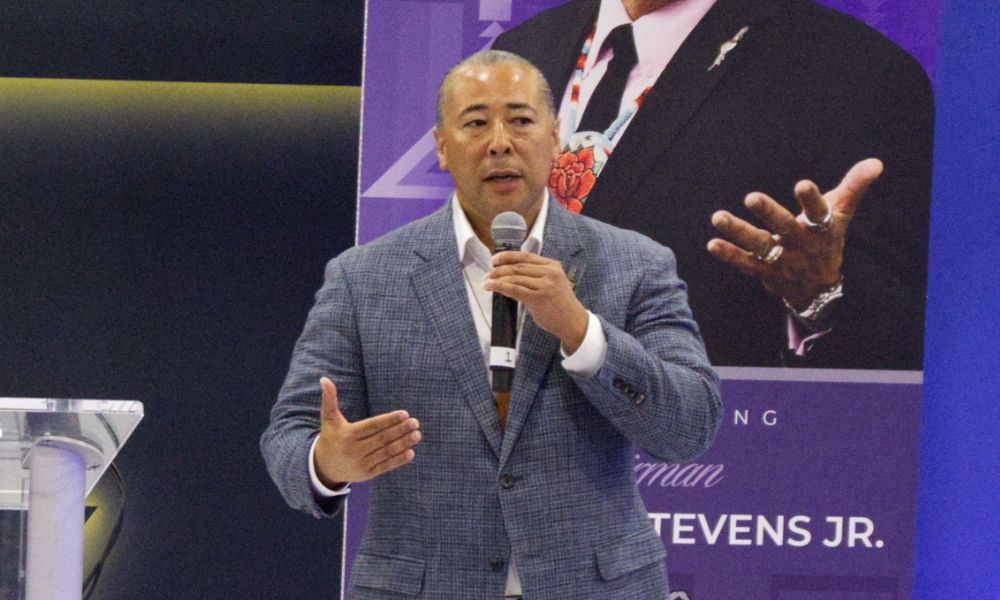

Indian Gaming Association Chairman David Bean kicked off the National Congress of American Indians Executive Council meeting Tuesday in Washington, D.C., talking about the strength of the tribal gaming economy. He noted that tribal gaming faces urgent threats from illegal sweepstakes operations and sports betting prediction markets.
Bean opened by acknowledging that it has been an interesting four months since the death of former IGA Chairman Ernie Stevens Jr. and reaffirmed the Association’s commitment to carry forward his mission.
“I know I cannot fill those shoes,” Bean said. “There will never be another Ernie Stevens Jr. I simply want to walk in his footsteps, as he walked in the footsteps of his elders and ancestors, and carry on that important task of protecting tribal sovereignty and promoting economic self-sufficiency.”

Bean told tribal leaders that while Indian Country lost a powerful leader, the mission, message, and team at IGA remain unchanged. “Our goal in traveling throughout Indian Country is to give assurance to our member tribes that the same team remains, the same mission remains, and we continue this work together.”
Referencing the latest report from the National Indian Gaming Commission, Bean highlighted tribal gaming generating $43.9 billion in revenue in 2025, a $2 billion increase over 2024, supporting nearly 700,000 American jobs, and contributing more than $19 billion to state and federal governments through taxes and compact payments.
“Indian gaming remains the most successful economic development tool ever employed by tribal governments,” Bean said. “It provides a consistent and stable source of revenue that supports our communities, our elders, and our youth.”
Bean emphasized that while cybersecurity remains a concern, the greatest current threat to Indian gaming is the rapid expansion of illegal sweepstakes gaming and Commodity Futures Trading Commission-authorized sports prediction markets operating in all 50 states, regardless of tribal exclusivity or state authorization.
“Tribes and states are distinct sovereigns,” Bean said. “They should be deciding gambling public policy, not foreign companies exploiting loopholes in new technology.”
Bean noted that more than 25 states are now taking enforcement action against illegal sweepstakes operations and warned that prediction market platforms are attempting to circumvent the intent of the Indian Gaming Regulatory Act by positioning gambling as financial contracts under CFTC oversight.
“Nothing could be further from the truth,” Bean said. “These are gambling products and the next step will be casino-style games, if we do not act.”
Bean invited tribal leaders to participate in the Joint IGA/NCAI Task Force session and Capitol Hill preparation meetings, underscoring the need for coordinated advocacy in Congress to amend the Commodities Exchange Act and prohibit sports wagering and casino gaming on prediction markets.
Building on his own teachings from his Puyallup tribe in Washington state, Bean said, “We must move like a canoe society. We cannot move forward unless we are paddling in the same direction. Whether the waters are smooth or rough, we keep paddling together.”
Bean also announced that IGA’s renewed commitment to outreach will include an extensive schedule of regional and tribal visits nationwide to extend the legacy of Chairman Stevens by engaging directly with tribal governments.
He paused during his remarks to recognize youth leaders in the room, echoing Chairman Stevens’s words, “You are not the leaders of tomorrow. You are the leaders of today.”
Bean closed by thanking tribal leaders, attorneys, lobbyists, and elders for their continued leadership.
“Our elders endured far more difficult times than we will ever know,” Bean said. “We honor them by continuing the hard work they began, protecting what we have built, and ensuring future generations inherit strong tribal economies.”

