

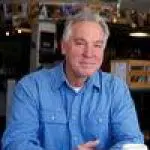
As Nevada’s straight-talking Gaming Control Board Chairman during much of the turbulent 1970s, Phil Hannifin battled mob casino influence, worked to solve the mystery of billionaire recluse Howard Hughes, and fought side by side with a tough task master in Gov. Mike O’Callaghan – all for approximately $25,000 a year.
Reflecting on those years recently, the 84-year-old Hannifin almost made it sound like just another day at the office thanks to his friend, O’Callaghan.

Phil Hannifin – third from left – at a Control Board meeting in the 1970s (Photo via Las Vegas Review-Journal)
“Back at that point in time, I was really, I think, blessed by the fact that the governor, who was my friend and acquaintance for years before that, was a very honest man,” Hannifin said. “He just didn’t get involved in trying to dictate gaming policy or practice. He protected us from the political side of things, but I know he took a lot of heat and abuse over the years because he would not interfere. He let gaming control do what it was intended to do, to control and keep as clean as possible this growing industry that we had, one that at that time was so important to the state of Nevada.”
And Hannifin played a key role in that growing industry both as a regulator and as a corporate casino executive. He’s one of four persons set for induction into the Gaming Hall of Fame’s Class of 2018. The ceremony is scheduled to take place Oct. 10 at the Chairman’s Reception in Las Vegas during the Global Gaming Expo.
The honor adds to Hannifin’s legacy as a central player in the casino business’ at times controversial evolution into a corporate commercial industry that today employs approximately 340,000 nationwide. He expressed gratitude and noted how much times have changed.
“It’s an indication of how well the industry has grown and how stable it has become,” Hannifin said. “The American Gaming Association, all the folks in the business collectively, come together to create a tradition that celebrates the growth and the wellbeing of the industry.”
But times weren’t always so celebratory. Although he’d worked in a casino during college and was mentored by legendary Nevada gaming figure Warren Nelson, Hannifin was just 36 in 1971 when O’Callaghan appointed him as chairman of the Control Board. He remained there until 1977 and was known for his no-nonsense style.
There were battles with casino operators who held shadowy links to the Chicago mob and other organized crime groups. Hannifin’s battles include a fight to keep his own reputation intact while representing the state’s interests. Former Gaming Control Board Member and longtime casino industry attorney Jeff Silver saw what Hannifin went through. He remains an admirer.
“I have the highest regard for Phil,” Silver said. “He was a tremendous chairman during tumultuous times. Phil was intelligent, incisive and trustworthy. He was dedicated to Gov. Mike O’Callaghan’s mission which was to root out organized crime influence from the gaming industry. Phil is most deserving to receive this recognition and it was an honor to have served with him on the board.”
Hannifin will also be remembered to his effort to sort out the complex, intriguing and frustrating Hughes licensing. The billionaire, who swept into Las Vegas on Thanksgiving in 1966 under a cloak of secrecy and soon embarked on a plan to buy out many of state’s obviously mob-connected casino properties. He was originally licensed during the Paul Laxalt administration without being compelled to appear at a public hearing.
Times changed after O’Callaghan’s 1970 election. Hannifin eventually joined the governor on a flight to London to meet face-to-face with Hughes, whose disappearing act had angered the state’s chief executive. A Reno newspaper quoted Hannifin’s frustration. Communicating with Hughes was like “yelling into a big barrel. All I ever hear is my own voice.”
“We did go to see him,” Hannifin said. “O’Callaghan and I traveled to London, and we did visit with him. That particular event generated news not only in Nevada, but all around the world.”

The Hughes he saw obviously suffered greatly from injuries incurred in multiple plane crashes. Hannifin later learned that Hughes’ many assistants had made a great effort to clean him up and prepare him for the interview.
Hannifin would leave the regulatory board and embark on a successful career in the industry, first with Summa Corp. during its transition away from Hughes, who died in April 1976.
After leaving Summa, Hannifin played an executive role at Harrah’s, the original MGM Grand, and the Riviera in Las Vegas, as well as Fitzgerald’s Corp. in Reno.
But it’s safe to say nothing in those latter years could compare to his time on the control board.
Hannifin’s departure from the board moved the Reno Gazette-Journal to opine, “He proved gaming can be conducted by legitimate businessmen on a large scale. His advent into Nevada was the forerunner of the big public corporations. He gave some credibility to the business and gave courage to others to try it.”
While many can take pride in having a ringside seat to Nevada gaming history, Phil Hannifin will be remembered as a man who rolled up his sleeves and entered the ring.

Editor’s note: Third in a series of profiles on the 2018 Gaming Hall of Fame inductees.
Contact John L. Smith at jlnevadasmith@gmail.com. On Twitter: @jlnevadasmith.
