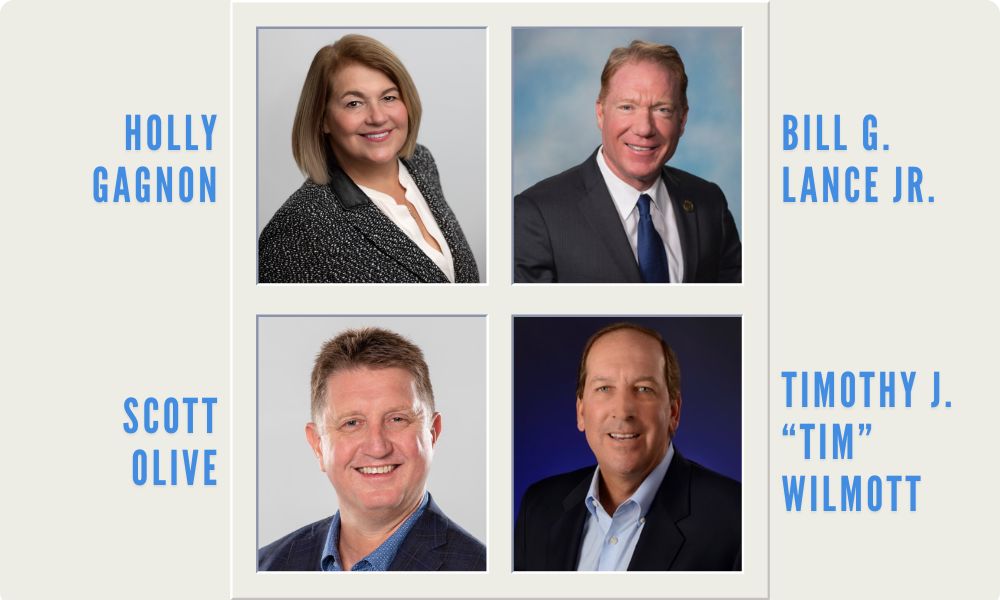

The four inductees of the 2026 Gaming Hall of Fame took the stage at this year’s Global Gaming Expo (G2E) in Las Vegas to dispense advice and how the industry defined their careers.
Their presentation was titled “Visionaries” and was hosted by Alan Feldman, distinguished fellow at the University of Nevada Las Vegas International Gaming Institute.
Feldman’s guests were Chickasaw Nation Secretary of State Bill Lance, former Penn Entertainment CEO Timothy Wilmott, MRG Studios founder Scott Olive, and Bragg Gaming Group board member Holly Gagnon, a founder of Global Gaming Women.
“Gaming definitely found me,” said Lance, when asked for his origins story. In December 2008, he was tapped to head the Commerce Department of the Chickasaw Nation, on the strength of his having run their health operations with significant business success. “It was a blessing,” he said of the move into tribal gaming.
Wilmott’s nodal moment came in March 1987 when he was finishing business school and then-Harrah’s Entertainment came calling. Wilmott noticed that, at the time, there were 16 state lotteries and he figured casinos were likely to follow, as politicians always loved finding new revenue sources.
“I was fortunate to grow up in the industry,” volunteered Olive. His father sat on the board of an Australian social club, where Olive got a job straight out of middle school. He worked in the slot-machine business through college and in 1996 answered an ad in the Sydney Morning Herald for a mathematician at Aristocrat Leisure, where he spent 30 years.
A newspaper advertisement also had a decisive impact on Gagnon, who answered one from The Day in New London, Connecticut. Something called MPGE was looking for a director of internal audit. She was told it would be 80 hours’ work a week and, as she had a baby daughter, Gagnon said no. But what turned out to be Mashantucket Pequot Gaming Enterprises kept calling and she accepted a modified offer. “I had [my daughter] in my office shredding on the weekends,” Gagnon laughed.
Mentorship took many forms for the foursome. Gagnon recalled one who imparted information by telling stories. Lance’s mentor said of leadership qualities, “They will recognize it before you recognize it in yourself.”
For Olive, it was Cliff Biggs of Aristocrat, a father figure of 25 years. He was credited with teaching Olive that games had to be complemented with an understanding of the entire business.
Wilmott’s leadership style was shaped by then-Harrah’s President Phil Satre and how he engaged with employees of all ranks. “He treated every single employee like they were the most important person at that moment in time.”
Guiding principles of the group could be aspirational or practical. Lance looked to the Chickasaw process of thinking in terms of how beneficial a decision might be seven generations down the line.
“Protecting that integrity,” he said of tribal gaming, “helps protect that sovereignty.”
Wilmott said he was judged every three months on the progress of five-year plans. “I wish the U.S. would change the laws,” he pined, to semi-annual reporting. Planning on a quarterly basis, he said, is planning to fail.
Like Griggs, Olive had become a big believer in exposing his teams to the whole slot-making gestalt. He said it was to get them to understand, ‘Why are we doing this?’
It boiled down to people for Gagnon, whether it was igaming, brick and mortar, or manufacturing. She said she wanted to create a place where people could be seen at every level. “You can have the best ideas in strategy at the top, but if you’re not in lockstep with your team, you’re not going to get anywhere.”
The turning point of Gagnon’s career, she continued, was when she left the comfort of Harrah’s to become the CEO of the Choctaw Nation’s casinos. Tribal headquarters had recently been raided by the FBI and “I had no team … but it was a great experience,” because Gagnon was able to build from scratch, a confidence-building exercise, as well as a validation of her and the tribe.
After 10 years with Aristocrat, in 2000 Olive left to form a third-party content creator, True Blue Gaming. He said it gave him the opportunity to meet with and learn from other developers, an experience he likened to the three years he later spent in Japan, learning to always keep an open mind, at Aruze Gaming.
Looking ahead at the biggest opportunity or risk facing gaming, Lance pointed to prediction markets, “this time bomb that exploded in 2024. We’ve been very united on this issue,” he said of the American Gaming and Indian Gaming associations. “But this is going to play out for years. I’ve never witnessed a more volatile time in the industry.”
Wilmott’s perspective was informed by having spent over six years away from the industry. He felt that a balance needed to be struck between monetization of igaming and the preservation of the brick-and-mortar experience, while still delivering what Wall Street expected.
For Olive, the key issue facing him was keeping games green for younger players. The good news was that 18- to-24-year-olds are “an absolutely blooming sector of the market” and are staying engaged.
The industry, Gagnon concluded, is perhaps too focused on profit-and-loss statements at the expense of the casino experience. “When we deliver experiences that different for our customers,” she advised, “we win.”