


Saskatchewan Indian Gaming Authority (SIGA), founded in 1995, owns seven First Nations casinos in that Canadian province. It also controls an igaming platform and has been trying to better understand the convergences and divergences of its land-based, online, and omnichannel players.
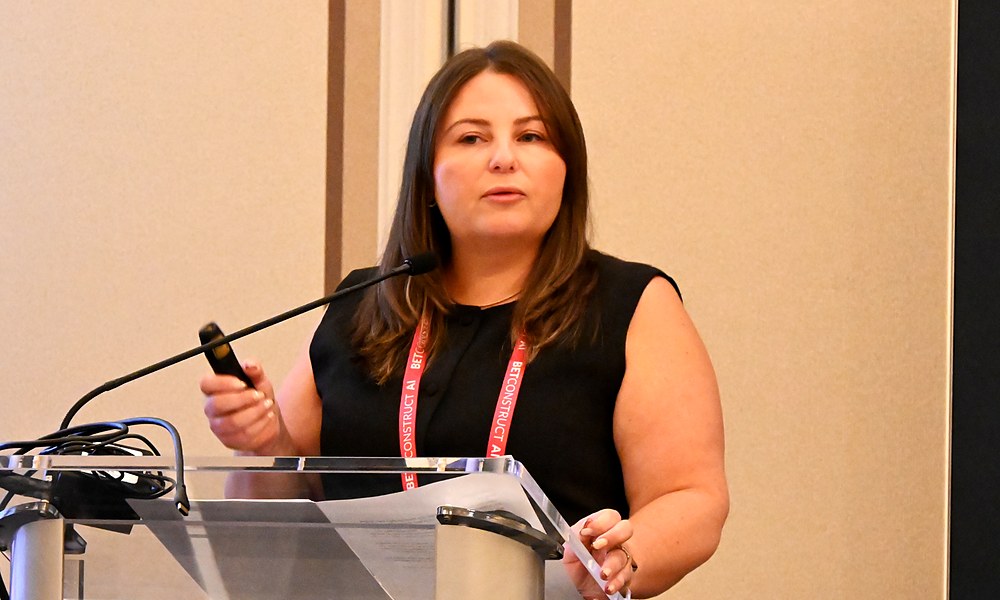
To that end, it hired Environics Analytics to drill down into the Saskatchewan player base. Environics Vice President of Client Strategy Sophie Marai and SIGA Director of Marketing Kacey Pambrun presented their findings in a Global Gaming Expo panel on Tuesday, “From Casino Floor to Online Play: Using Data to Understand and Unlock Omnichannel Growth.”
Marai boiled down the research to one question: “What’s the size of the prize?” In assessing land-based versus digital players, she said, “You can better understand what you don’t know from your customer base.”
While determining whence SIGA’s players come, Marai found the Canadian market to be at a stalemate. “Millennials now outpace Boomers,” she said, and “Gen Z is a completely different gamer. They are completely agnostic online,” which means they lack brand loyalty. “Gen Z wants as frictionless a experience as possible,” and if one online casino doesn’t provide it, another will.
However, Canadians were found to be digital-savvy and have been adopting artificial intelligence at an 82 percent clip, outpacing the rest of the world. They’re also primarily channeling their online play to unregulated sites at a rate of 65 percent.
At present, there are roughly 929,700 residents in Saskatchewan, projected to push past one million over the next decade. It’s also a diversifying market, with an influx of Filipinos, Southeast Asians, and Black people, Marai said.
“We see a significant amount of the customer base is driven by the loyalty core,” Marai continued. But with only 63 percent already engaged, an “opportunity gap” is exists. And out of the overall Saskatchewan population, only six percent has engaged with igaming. “That’s a lot of runway,” Marai observed.
“We know our land-based customer very well,” Pambrun took over, adding that SIGA couldn’t assume a digital overlap or shared behaviors, hence the Environics research. “We wanted something actionable” for branding, media buys, and so forth.
Marai said her company used both SIGA and broader market data to understand the existing customer bases and what marketing channels to prioritize, as well as finding those groups that are at risk of being exploited by unregulated igaming. Forty-one percent of those surveyed were already engaged core players. Opportunity lies in “those groups that you can’t see today.”
However, “not everyone is going to be a priority,” Marai cautioned. Core players, she said, “are fantastic to SIGA. They’re the ones you want to grow,” even as unengaged players should also be prioritized.
An example of whom SIGA wants to target is Canadian players who dropped CAD$2,800 a year on gambling, but who had only a 5.2 percent SIGA penetration rate. As Marai put it, “They’re not playing at SIGA, but they’re spending in the market.”
Players who over-indexed for both land-based and digital play were 46 percent captured by SIGA, Marai added. Land-based-only players represented four percent of the SIGA customer base.
In capturing players, Marai continued, SIGA needs to concentrate its media buys on the metro areas of Saskatoon and Regina, where the most untapped players are, especially the younger demographics.
Once Environics collected the data, “this is where the work really starts,” Pambrun resumed. “The bigger objective was the next phase of our growth,” namely developing a digital strategy congruent with SIGA’s seven brick-and-mortar casinos. SIGA’s online operations, she said, lack the advantage of the SIGA brand.
“There’s a significant opportunity outside our established customer base,” Pambrun said. It has many different iterations, requiring differing strategies. “Acquisition can’t simply mean spending more money.”

The research data, she continued, is “not just telling you something interesting about your customer. It’s changing what you already do.”
One can’t assume, Pambrun said, that one message will resonate across the board. “Do you know where your customers sit across land-based, digital, and omnichannel behavior? Our casinos didn’t know our digital customer until this data. The most important thing is just that open communication” within the various branches of SIGA.
The panelists were asked how to get Generation Z to make the transition “from click brick,” as the questioner put it. Marai said to ask them questions. What do they do outside of igaming? What entertainment do they prioritize? How do they receive marketing messages?
Another questioner was blunt, asking, “Is the juice worth the squeeze?” Marai was emphatically of the opinion that it is. She said it’s because one has to understand the squeeze in the first place in order to make those decision of its worth. She added that you can be leaving money on the table by not squeezing.
