
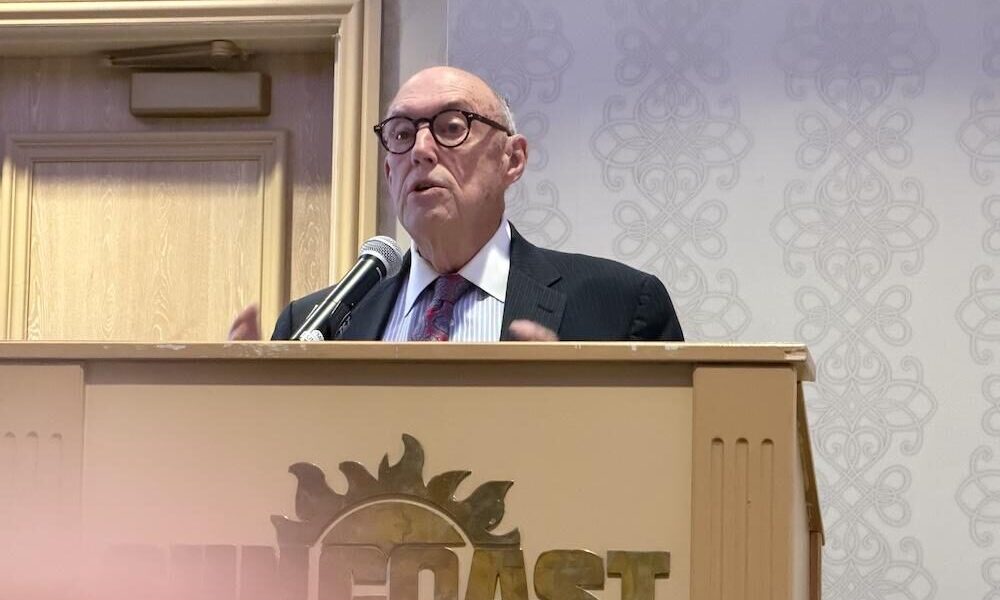

Nevada’s gaming history is colorful and Jeffrey Silver, a retired attorney and former member of the Gaming Control Board in the 1970s, was part of that legacy when he led the effort to deny a license to mob-connected Frank “Lefty” Rosenthal.
Silver, who was inducted into the American Gaming Association Hall of Fame in 2020, is a former chairman of the Mob Museum in Las Vegas. He recounted his most interesting interactions to a group of gaming lawyers gathered for its annual conference sponsored by the State Bar of Nevada.
Nevada at one time had a basic regulatory framework and members of the Gaming Control Board were testing every aspect of the laws in place, because organized crime had a lot of history of corruption and coercion, Silver said.
“If they couldn’t corrupt you, they would kill you,” Silver said. “That mentality came to Las Vegas with some of the stalwarts involved in the industry.
“When I was appointed by Governor Michael O’Callaghan in his second term, he didn’t know me from Adam,” Silver said. “I was a prosecutor for the Clark County District Attorney’s Office doing regular crime.”
Silver said a Board member was retiring and he learned about the position and what the Board did and found it interesting. Silver called a district judge and asked how he could get appointed; he was told to write a letter to the governor, even though Silver had never met O’Callaghan.
“I did and two weeks later, I got a phone call from O’Callaghan. He said, ‘This is Mike.’ I said, ‘I don’t know who you are.’ He said, ‘I got your application and I’d like to see what we can do about a background investigation.’ I said, ‘Go ahead.’”
Three weeks later, the governor called him back and told him the job was his if he still wanted it. He quickly added that Silver needed to fly to Carson City, so the governor could say he met him.
“I say that as background, because I wasn’t known to anybody in the industry,” Silver said. “People involved in the casino business who had questionable connections were trying to figure out how to get to me and influence me. I was just there, a fresh face.”
He was appointed in 1975 the week before mob boss Sam Giancana was murdered. Gianana had connections to Las Vegas. “To me, that was an introduction that these people play for keeps.”
Silver started preparing for the first few meetings while a lot was happening in Las Vegas that was unsavory. It was a daily occurrence in the press of Gaming Control Board stories. One of those occurrences was the licensing request of Frank Rosenthal, who was played by Robert DeNiro in the movie Casino.
“Rosenthal was looking for a big job at the Stardust,” Silver said. “The federal government all thought we were crooks and scoundrels. Nevada was a pariah and we got no information.”
Finally, a former FBI agent filled him in on Rosenthal’s dubious background; for example, when testifying before Congress in the 1960s, he took the Fifth Amendment 37 times. Silver received a box with transcripts of the hearing, with testimony from an Oregon football player who said Rosenthal offered him $5,000 to throw a game against Michigan. Rosenthal pleaded no contest to charges of point shaving.
“I never saw any of these things mentioned in the investigative summary,” Silver said of the Board process.
Silver said he was only on the Board for two months when he asked staff why none of that was in the report. He was told to talk to Chair Philip Hannifin. Silver told him about the damning information on Rosenthal. Hannifin said they had previously agreed to confine it to a local investigation.
“He asked if it was bad and I said it was really bad,” Silver said. “He sighed on the phone and said, ‘You’re going to have to go with it.’”
Silver found out years later from a reporter that Rosenthal had agreed to be an informant for Hannifin. In essence, Rosenthal was counting on it’s being a local investigation.
“We got to this hearing and now all of this is front and center in Carson City in January 1976,” Silver said. “Here I am with the head of the Stardust, Lefty Rosenthal, and Oscar Goodman (one of Rosenthal’s two attorneys). The two attorneys never handled a gaming case in their life. They were worried about the criminal aspects and didn’t understand that in the Gaming Control Act, you can’t invoke the Fifth Amendment. That’s grounds for denial. And you can’t refuse to answer any questions. I could ask anything I wanted and I did.”

Silver asked questions for the next two days, essentially prosecuting Rosenthal. “If looks could kill, I was dead 15 times over.”
The Board unanimously recommended Rosenthal be denied a license for lack of good character, honesty, and integrity and that he had relationships with mobsters.
“Rosenthal was such a narcissist and egomaniac that any time the Gaming Control Board had a hearing, he was contesting it in court and fighting this and that,” Silver said. “People asked me if these were dangerous times, and yes, they were. At one point during the hearing, he looked at me and said, ‘You’re Jewish and I’m Jewish. Why can’t we all get along?’ The conversation was in the men’s room in adjacent urinals. I felt very intimidated by the whole thing. The FBI called me at one point and told me they had a transcript of cohorts of Rosenthal wanting to kill me. They said, no, we changed our mind.”
Silver related the story that O’Callaghan’s driver, Johnny Pappas, a casino worker with underworld ties, told him about a tip that the Stardust was double invoicing and for regulators to keep an eye out for that. Pappas disappeared in August 1976 after leaving to meet buyers for his boat. His case remains unsolved and his remains were never found. “These guys did play for keeps.”
Silver said the Rosenthal case affirmed the discretion of regulators in licensing decisions and confirmed the confidentiality of Board records, that the burden of proof falls on the applicant, and any evidence can be used by the Board for denial.
“If it were not for the appearance of Rosenthal before the Gaming Control Board and his steadfast determination not to accept that he wasn’t suitable to hold a Nevada gaming license, things might have been delayed many more years,” Silver said. “We might not be where we are today. New Jersey might not have decided to step into the water and become the second gaming jurisdiction. All we did in Nevada was confirm that this basic regulatory system has the granular effect as it does today, such as knowing your customer and other things that are more important to make sure the Mafia isn’t hiding behind every stone. We’re all happy for that and I’m happy that I was part of the process.”

