

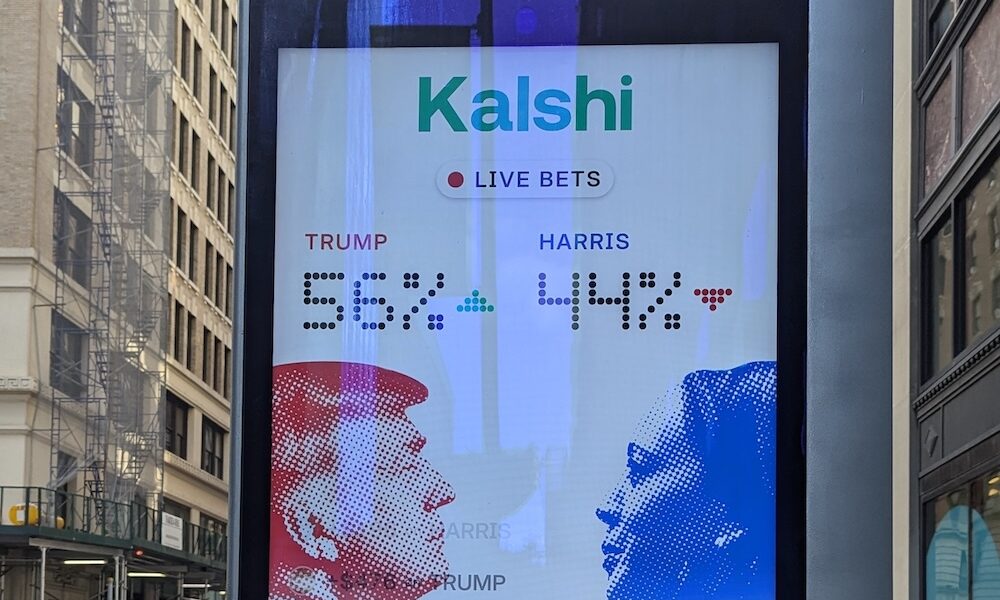

In a week, G2E, the annual gaming convention and trade show held in Las Vegas, begins. And the American Gaming Association (AGA) has called an audible.
The AGA announced an addition to its panel discussions on prediction markets. “Collaboration both across and beyond the industry is critically important in preserving and protecting the state- and tribal-regulated gaming market, its employees, consumers, and the communities we serve. In the midst of prediction markets’ brazen encroachment, our panel of leaders will showcase the strength of our unity,” the AGA said in a statement.
Prediction markets have been in the news all year, so the threat should not come as a surprise to the AGA or anyone else. It should not have required an audible. But sometimes, things sneak up on us. A monster appears out of the blue and threatens to change or destroy everything. Only it is not out of the blue; the monster has been growing stronger all along. We were warned of this kind of phenomenon a long time ago.
In March 2000, Malcolm Gladwell published his now-famous book, The Tipping Point. The title quickly entered the language and its concepts captured the popular imagination. The country was primed for a way to make sense of the world after having survived the scare of Y2K. There had been thousands and thousands of predictions that the world would end, the world’s computers would crash, and entire economies would collapse. In the end, nothing much out of the ordinary happened.
However, the scare was real and collectively we wanted some way to understand what was happening around us and a way to predict the future. Gladwell said that if we paid attention, we might see a monster in the making. He defines a tipping point as “the moment of critical mass, the threshold, the boiling point.” It sometimes takes a long time for critical mass to occur, for the temperature to reach the boiling point. It is then more than a tipping point; it is a point of no return.
As it turned out, 2000 was not a tipping point. There was no critical mass, no boiling point. It was just another year. But in our recent history, there have been tipping points or rather moments when the status quo changed enough to be recognizable as different from its predecessor. For example, after 9/11, air travel changed seemingly forever, although some restrictions have been lessened or eliminated. Another example is the dissemination of information. The way we consume news has changed, with far fewer printed newspapers and many many more digital news sources. The news may be cheaper and more readily available today, but it is less reliable and as a rule poorly edited. Print and broadcast media still exist, but digital has reached the critical mass necessary to control the flow of information. Online shopping is another example.
Gaming has had a few key moments when change began. In 1978, the first casino opened in Atlantic City. That was the beginning point of the expansion of gaming across the nation. It took 10 years before the next round of expansion, but each subsequent round came faster. The Indian Gaming Regulatory Act of 1988 was another beginning point. From virtually zero revenue in 1988, the industry grew to $46 billion in 2025.
May 2018 was another point of change. That month, the Supreme Court declared sports betting to be the exclusive right of the states. In just eight years, legal sports betting has grown from a few million in annual wagers to $167 billion in 2025, with $17 billion in revenue. Those forces completely changed the gaming industry from its pre-1978 status to the 2026 industry. The mass built slowly, until seemingly from one day to the next, a full-blown $150 billion industry jumped out of the bushes.
The prediction markets are a step in another direction and do not belong to that $150 billion industry. As it stands currently, prediction markets are regulated only by the federal Commodity Futures Trading Commission. There is no state oversight, no regulation and no taxation. That is as one would expect if the prediction market transactions are indeed commodity trades. However, a significant percentage of those trades deal with the outcomes of sporting events.

To the uninformed, that sounds like sports betting. Sports betting is a states’ rights issue, right? If you answered yes, you might be a casino operator, gaming official, tribal leader, state lawmaker, or the American Gaming Association. The AGA is hoping to huddle up with the industry and develop a set of plays that will rein in the prediction markets.
The risk from prediction markets for the gaming industry is much like that posed by artificial intelligence. The risk is not in the thing itself, but in the critical mass, the tipping point, the point of no return. If allowed to continue unchecked, prediction markets have the potential to completely alter the game. Let us hope that the audible came in time to prevent that outcome.
