


Join CDC Gaming as we embark upon a road trip Inside America’s Casinos. For our fifth stop, we visit Bally’s Lincoln.
After wrapping up my visit to Plainridge Park Casino, it was time to head south to my next stop: Bally’s Lincoln in Rhode Island. It was less than an hour’s drive, but the two properties couldn’t be more different.
Massachusetts, a state of about seven million people, waited until 2011 to formally legalize casino gaming with its Expanded Gaming Act after decades of bans rooted in the state’s history. Rhode Island, with just over 1.1 million people, took a very different path. The RH lottery was established in 1973, followed by the introduction of electronic gaming machines in the early 1990s. It then went on to legalize igaming in 2023.
Given the differences in population size and gambling history in both states, when I was planning my trip, I imagined Massachusetts casinos to be newer, more polished, and purposely built, like Encore Boston Harbor, and Rhode Island casinos to be small-town older venues that evolved over the years, similar to Plainridge Park. But I was in for a surprise.
Courtesy photo
Why Twin River?
The history of Bally’s Twin River goes back to 1947, when the property operated as Lincoln Downs, a racetrack built to host thousands of spectators. Over the decades, it continued to evolve. In 1977, it hosted greyhound racing as Lincoln Greyhound Park and in 1993, it became Lincoln Park. Then in 2007, it changed its name again to Twin River Casino, a much more recognizable name, before being bought by Bally’s in 2021.
But the real turning point was during the ’90x. In 1992, Rhode Island authorized video lottery terminals, due to competition from Foxwoods Casino across the state line in Connecticut. That meant terminals were installed in Lincoln Park, starting with 189 and expanding to 900 by 1993.
Full casino gaming came much later, in 2012, after voters approved a ballot question asking if they wanted state-operated casino gaming at the Twin River venue. By 2013, the property underwent yet another expansion, adding Las Vegas-style table games.
After that, a 136-room hotel tower was added in 2018. It was rebranded as Bally’s in 2021 and in 2023, it introduced online gaming.
Looking at the history of this property, it simply isn’t a single project. Instead, it’s the result of decades of change, evolving in conjunction with an ever-maturing market. And I was curious to see the current result.
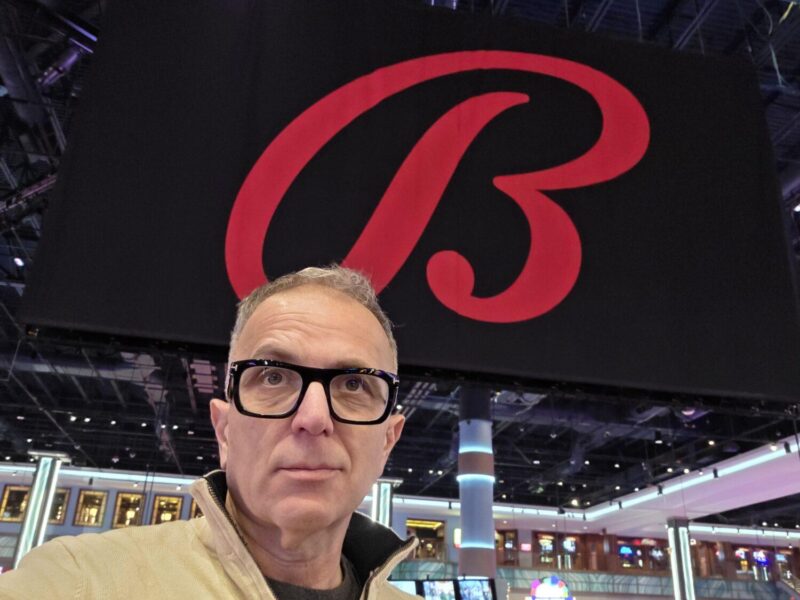
Bally’s is the single operator in Rhode Island, providing an efficient gaming model.. (Ziv Chen photo for CDC Gaming)
First impressions – A shopping-mall look
Plainville felt like a small town, with local restaurants, fast-food joints, and motels stretching across one long main road. Plainridge Park Casino fits right in, just one of the turns off the main road, leading to a horse racetrack and a small (though fun and contained) slot-only gaming hall. Like the entire town, the casino is a place that, unless you are local, you pass by on your way to somewhere. So I was expecting the same quaint small-town vibe in Rhode Island, but boy, was I wrong.
As I was driving south on I-95, then cutting westward onto I-295 toward the Rhode Island state line, I thought again about the difference between the two jurisdictions. Where Massachusetts introduced structure, meticulously planning everything from the state’s proposed gaming regions to its casino license categories, leading to a smooth rollout of casino gaming, Rhode Island was not the same.
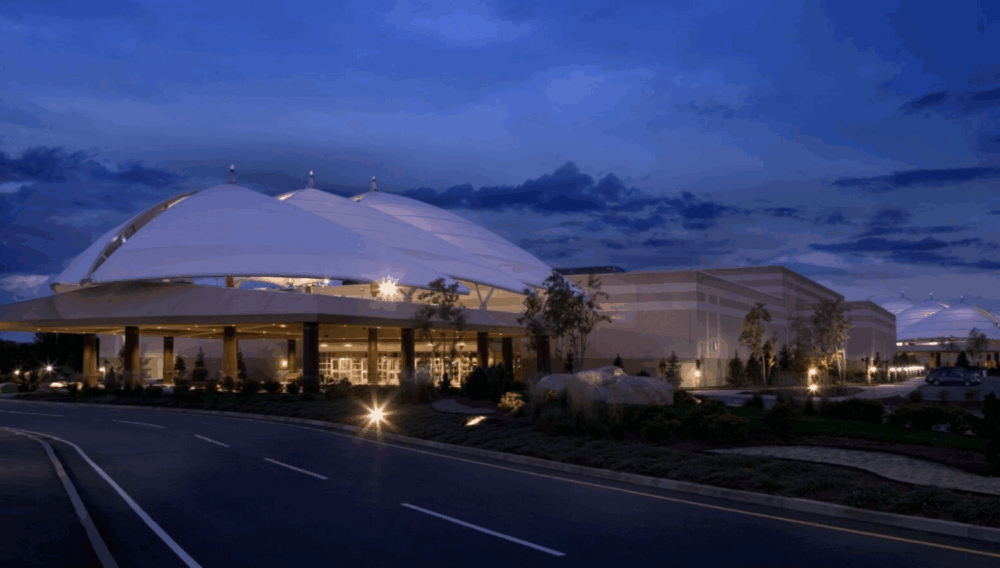
If Boston Encore looked like a polished glass office building and MGM Springfield looked like a preserved historical structure, my first impression of Bally’s Lincoln was of a shopping mall — a huge white structure surrounded by endless parking lots. The exterior didn’t give off a unique sense of prestige or luxury. Everything just looked big and functional. Before I even stepped inside the casino, I got a sense that it was bigger and knew exactly how to draw visitors from Rhode Island and neighboring states and cater to their needs. I was right on the money.
Inside the casino – A Bally’s ecosystem
After a long walk from the spot I found in the busy parking lot and entering the casino, Bally’s Twin River gave me the exact feeling I had when I approached it and first saw it from the outside: that I was stepping into a highly efficient and functional ecosystem, ruled by one operator, one brand, and one framework that encompasses the duality of the online and retail casino worlds.

Unlike other states, Rhode Island decided to keep its market more refined, with only two casinos in operation: Bally’s Twin River and Bally’s Tiverton. Both share the same operator and are tied to the same regulatory structure.
Built through expansion
The first thing I noticed wasn’t the casino’s design, but rather the density of people and slots packed inside. While it’s huge, the floor was still incredibly busy and active.
Compared to the casinos in Boston, no grand lobby gave me an immediate sense of arrival and no clear boundary separated spaces. Here, I felt like the gaming floor was a fusion of each expansion the property underwent. There was no unified vision; instead, the architecture reflects decades of additions. While the design feels disjointed, it is surprisingly functional.
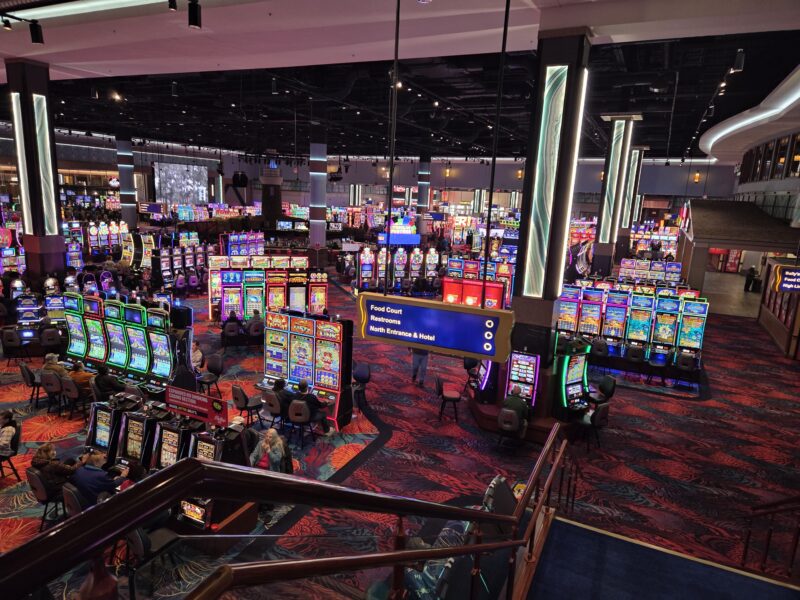
The high exposed ceilings and large open plan give a vibe of an industrial/warehouse space at Bally’s Lincoln. (Ziv Chen photo for CDC Gaming)
The gaming floor – An ocean of gaming machines
While walking around and looking up at the high industrial ceilings, I tried to understand the magnitude of this place. The numbers helped me with that. The gaming space is just over 200,000 square feet, placing it among the larger properties in the Northeast. But unlike other layouts that were designed to give players a sense of wide space, the gaming floor at Bally’s Lincoln is heavily utilized.
There are 3,800 to 4,000 video lottery terminals (VLTs) at Twin River. Additionally, of 110-125 table games, 32 are poker tables. I also noticed that VLTs offer multiple gaming formats, including slots, keno, and video poker.
In total, Twin River has well over 5,000 gaming positions, enhancing the casino’s packed ambience, which I felt. I noticed that machines are close together and clusters of tables distributed throughout the gaming floor. Like the players around me, I couldn’t stop walking, playing, and moving around. There’s always someone sitting, getting up, or shifting between games. Traffic on the gaming floor never slows down.
Talking to players – A regional hub
Speaking to different players confirmed my earlier assumptions. Bally’s Twin River is not just a local casino. With only two properties in the state, it draws visitors from all over. During my time there, I met many people from Providence and the area, who live about 10 minutes away, as well as people from farther afield, from different parts of Massachusetts and Connecticut.
Everyone was in constant movement, but while tourists like me walked more slowly, looked at signs, and asked for directions, I noticed many fast-pacing regulars who clearly had the layout of the casino mapped to memory.
Sports betting – An early mover
Rhode Island didn’t waste time once the Supreme Court overturned PASPA in 2018. By November of the same year, Twin River became the first casino in New England to accept sports wagers.

The time between the ruling and the state legalizing sports betting is central here. It shows a more decisive controlled approach taken by regulators. Mobile sports betting followed a year later, run by a single operator, IGT.
I looked carefully at each state and followed closely the ones that regulated shortly after Nevada lost its near-monopoly on sports betting in the country following the 2018 PASPA ruling, and Rhode Island was quick to respond. Like everything else, it feeds into the same well-governed ecosystem. Two casinos, one owner, and one sportsbook. It might not be the most competitive market, but it’s surely efficient.
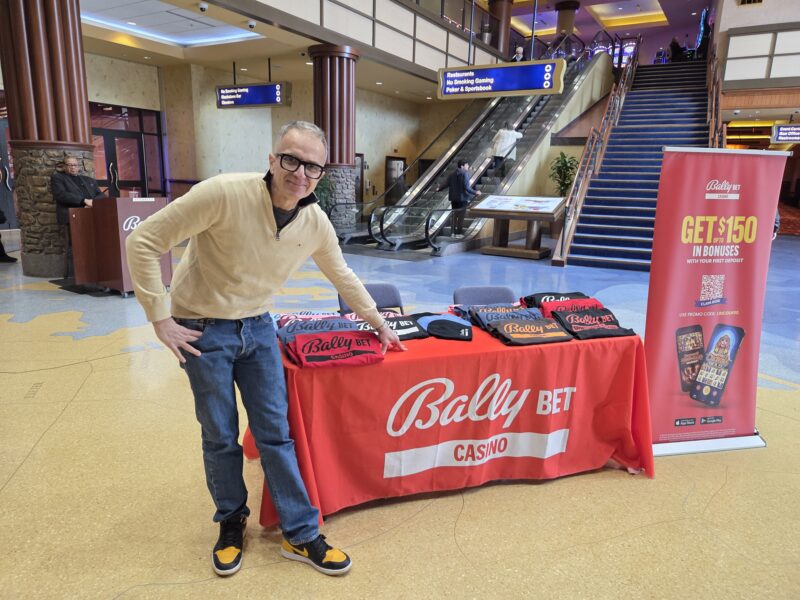
Extensive promotion of online casino and sportsbook is evident on the gaming floor at Bally’s Lincoln. (Ziv Chen photo for CDC Gaming).
Online gambling – An integral part of Bally’s
Rhode Island didn’t stop its expansion at mobile sports betting. In 2023, it became the seventh state to legalize igaming, with Bally’s as the exclusive operator, much as IGT was for its sportsbook.
In 2024, Bally’s launched Bally Bet, becoming the only legal online casino option in the state. That exclusivity creates something unique for the state’s gambling landscape. Online and retail don’t compete; they’re simply intertwined.
Walking the floor – Seeing online everywhere
Unlike other casinos I visited, which may have a few billboards advertising their online casino on the way to the parking lot, I started noticing the presence of Bally Bet, Bally’s online brand, almost immediately after I walked in. Even compared to some land-based casinos that promote their online app on the gaming floor, Bally Bet wasn’t just present; it was dominant.
The first thing I saw was a table offering to sign me up for an online account and claim a welcome bonus and T-shirt. Technically, the first Bally’s employee who greeted me at the property was an online gambling rep. There were also tables with online reps at different spots in the casino and food courts.
I also noticed many screens promoting the Bally Bet app and QR codes were scattered across tables. Bally’s branding is anything but subtle. At one point, I came to a stop at a live-dealer table. I noticed the cameras immediately. They weren’t for surveillance, but production. That same game I was playing was being streamed live to online players across the state. How cool is that?
Virtual meets real life
That was when it clicked. Bally’s RH isn’t your average casino floor. It’s part of a wider framework that seamlessly combines retail and digital elements. But Bally’s easily created a new world in which both could co-exist. Live dealer games originate on-site and are then streamed online. Players are actively encouraged to move between retail and digital spaces. Promotions clearly overlap both channels.
Leaving Twin River
As I left Twin River, I didn’t just think about the property itself, but rather its model. Rhode Island chose a different path than other gaming states I’ve visited — fewer operators, tighter control, and a deeper connection between digital and land-based gaming.
Walking back to the car, I could feel that difference. It wasn’t just about the overall size of the casino or how busy it felt. Twin River showed me a new era of gaming, one that connects people across multiple mediums.
As I left the casino and walked to my car, I noticed a group of younger people who were also leaving, holding the Bally Bet shirts given inside the casino to those signing up for an online account. They told me they’re from Attleboro, a town in Massachusetts about 20 minutes away, and that they plan to cross the border and make sports bets from a McDonald’s in Rhode Island that’s closer to their town.
Like them, I felt that I wasn’t leaving a casino. I was just logging off a network for a bit.
