

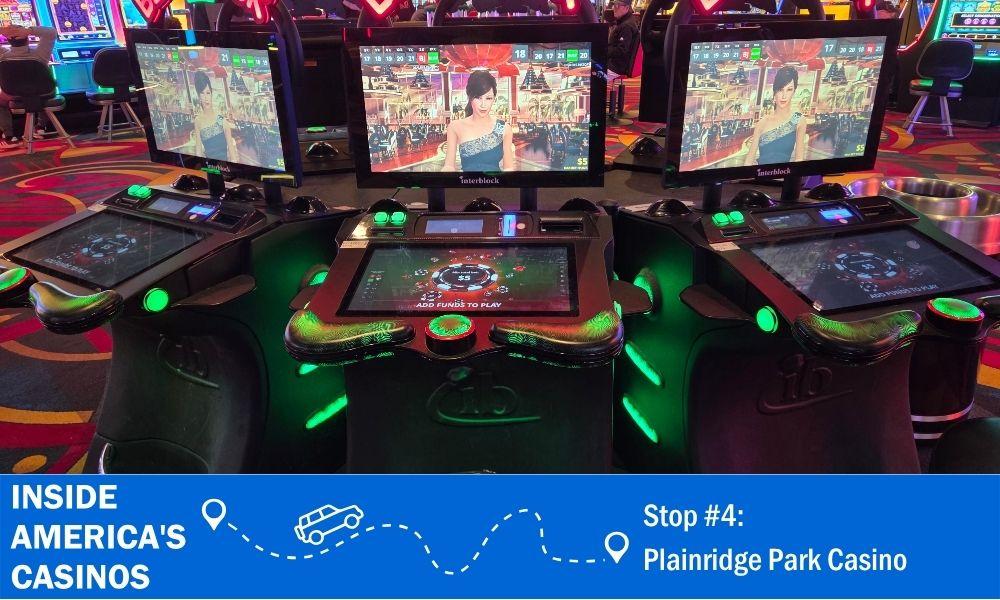

Join CDC Gaming as we embark upon a road trip Inside America’s Casinos. For our fourth stop, we visit Plainridge Park Casino.
Coming up to Plainville, a suburban town in Hartford City and home to about 17,500 people, I had already experienced two distinct versions of what casino gaming looks like in Massachusetts.
Boston had shown me scale: a carefully engineered, somewhat tightly controlled casino detached from its surroundings. Springfield, on the other hand, represented integration, a casino that almost seemed stitched into the fabric of the city, giving off the vibe that it wanted to become part of its daily rhythm.
Understandably, my curiosity was piqued when thinking about the state’s first casino in comparison to the other two.
Because Plainridge Park isn’t a casino trying to impress the masses, it neither presents itself as a destination resort nor carries the weight of urban redevelopment. In my opinion, this (more) quaint casino sits on an entirely different part of the spectrum.
And in many ways, it’s where the story truly begins.
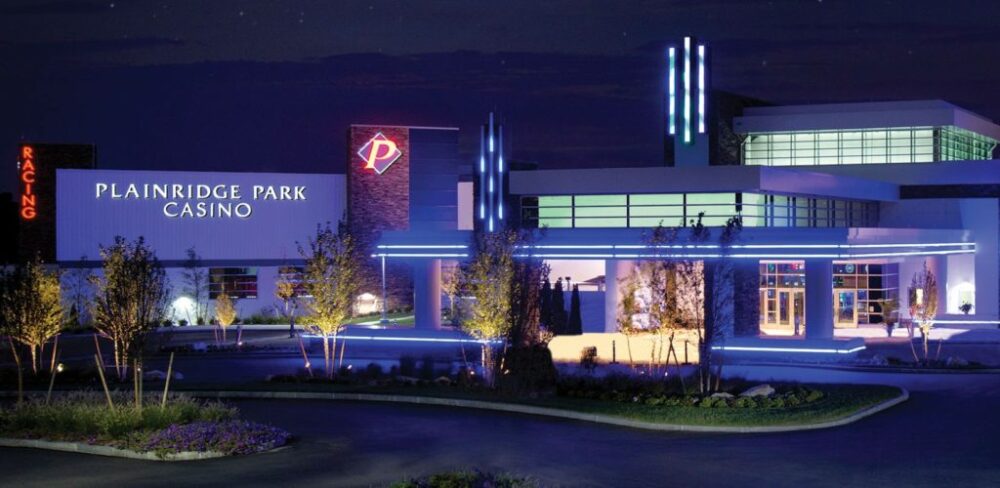
Plainridge Park Casino (courtesy)
Why Plainridge?
To understand Plainridge, I need to take you back to 2011, when Massachusetts then-Governor Deval Patrick signed the state’s Expanded Gaming Act into law, opening the door to legalized casino gambling in a state that, historically, opposed it.

In addition to bringing new jobs and revenue, the Gaming Act also created the possibility for the state to welcome three new resort casinos in three geographically diverse regions, A, B, and C. Additionally, one smaller slots-only facility was also allowed.
And that was how Plainridge Park Casino was born.
The casino opened its doors to visitors on June 24, 2015, predating that of MGM Springfield (2018) and Encore Boston Harbor (2019), to become the state’s first legal casino property.
The timing surrounding Plainridge’s opening matters. It wasn’t simply another casino opening; rather, it was Massachusetts’s first real-world test of how regulated gambling would function.
Plainridge holds a Category 2 license, limited to slot machines, fairly distinct from its casino counterparts in Boston and Springfield. That constraint shapes the property in terms of its size, layout, audience, and role in the market.
At a cost of $250 million, Plainridge is drastically smaller than its neighbors (MGM Springfield cost nearly $1 billion and Encore Boston Harbor $2.6 billion). But that is clearly reflected in the casino’s intentions. Plainridge wasn’t designed to transform a city or compete regionally; it was designed to operate.

The sportsbook and casino serve locals and provide a casual and friendly gaming vibe. (Ziv Chen photo for CDC Gaming)
First impressions – A racetrack that evolved
Driving up to the property, the first thing I noticed was not the casino, but its racetrack. Plainridge Park was initially a harness-racing venue. The grandstand still anchors the property, overlooking the track that, in my opinion, defines the site. Even from the parking lot, it feels more like a racing complex than a casino.
That impression doesn’t go away when you walk inside. Unlike Boston and Springfield, the casino doesn’t define the place; it seems to be an addition to it, more like an extension to something that already exists. That distinction changes how you can approach this place. It’s more down-to-earth; there is no dramatic entry sequence, no sense of arrival. You simply park, walk in, and in seconds, stand on the gaming floor.
It’s direct, almost abrupt, in how it presents itself, but definitely efficient.
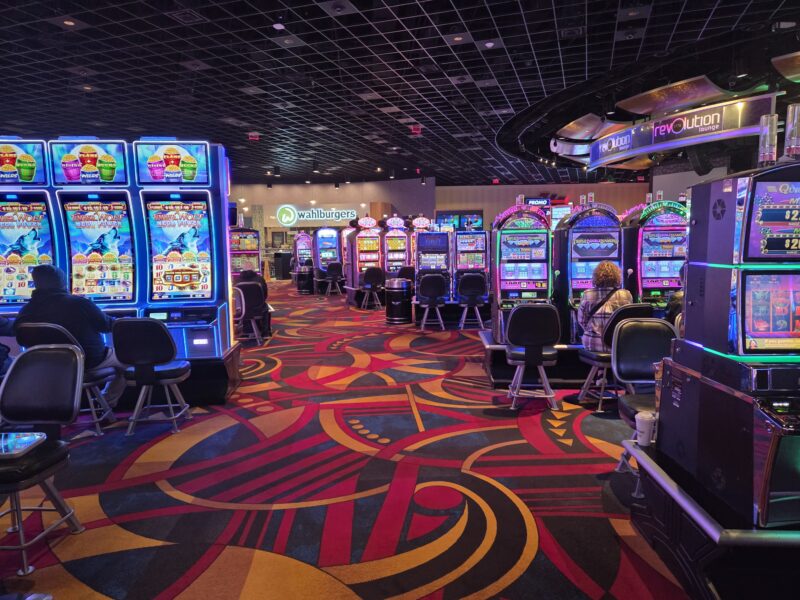
The gaming floor in Plainridge Park is small, but well-maintained. (Ziv Chen photo for CDC Gaming)
The property – built for function
The casino’s operational structure becomes clear when you walk inside. The gaming floor features around 1,250 slot machines spread across 44,500 square feet. No table games or poker rooms break up the sea of slot machines; it’s just one continuous environment.
I walked across the entire floor in minutes.
The layout is straightforward: rows of slots arranged in a grid, with enough space to move comfortably between them. The layout isn’t designed to create separate experiences within the space. Instead, the gaming floor provides very little friction between entering, playing, and leaving.

As was its intention. There’s no attempt to slow visitors down through immersive design; the focus seems to be on accessibility and repetition. This is a noticeable contrast to other casinos, which tend to guide you through an almost dizzying array of spaces, instead of a compressed functional zone.
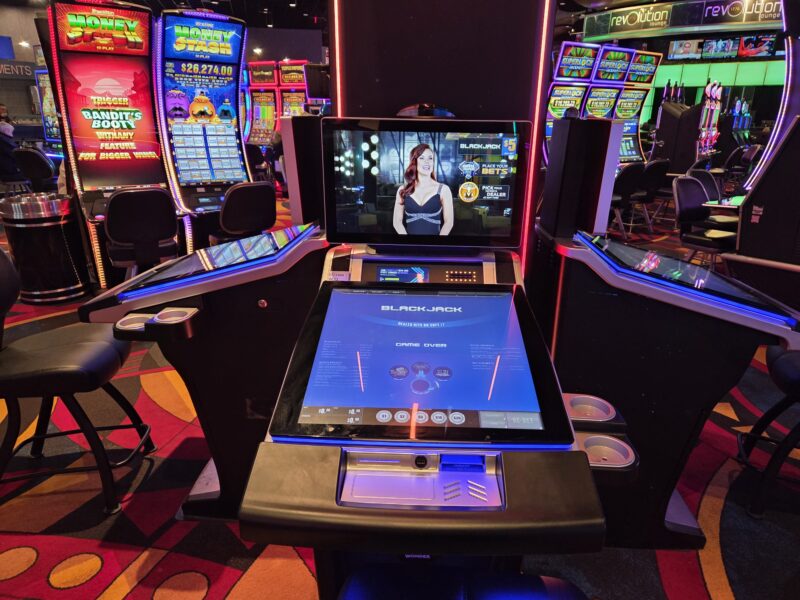
Virtual table games occupy prominent positions on the gaming floor. (Ziv Chen photo for CDC Gaming)
The rhythm of slots-only gaming
With no table games, the casino’s overall energy seems to shift. No crowds are hunched over blackjack tables, no noise comes from a roulette spin, and no tension is shared by dealers and players. Instead, the experience is more contained.
Someone sits at a machine, plays, then moves on. At first, this makes the gaming floor appear quieter, not in terms of sound, but rather interaction. Conversations remain short and movements become predictable. It creates an almost mechanical rhythm.
But the casino was never empty. In actuality, the floor remained full the entire time I was there. Machines were in constant use, there was a steady cycle of players joining and leaving the floor, and engagement remained stable.
That stability makes sense; the casino isn’t a place built around peaks of excitement, but one of consistency.
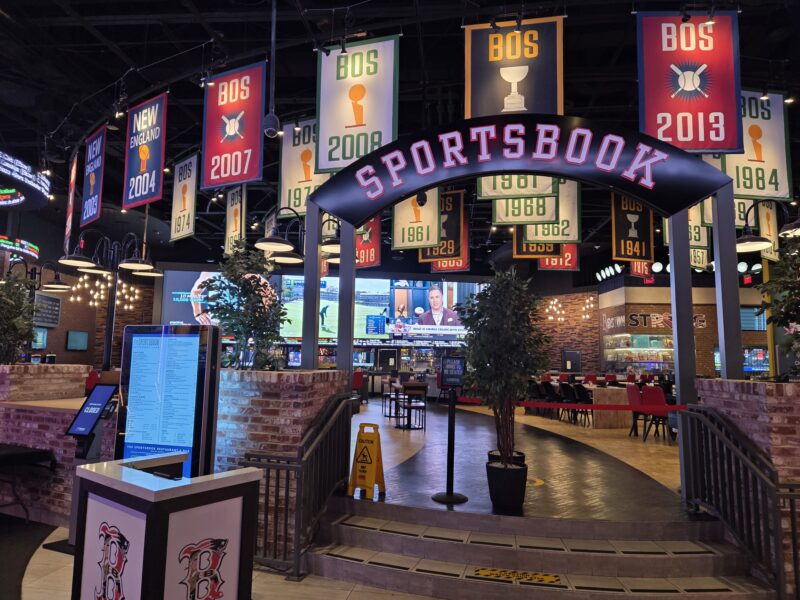
Plainridge Park’s retail sportsbook. (Ziv Chen photo for CDC Gaming)
Racing and gaming – parallel worlds
Plainridge is a unique case; the casino doesn’t replace the racetrack, it coexists with it. Harness racing still operates onsite and when you happen to come across a day when the racing is in full swing, it provides a new element to the experience. On race day, two distinct audiences are present: racing enthusiasts and casino players.
During my visit, I made sure to visit the track. The contrast to the casino is immediate. Inside, you have the steady thrum of slot machines, while outside, you’re greeted by a more peaceful environment, offering traditional betting tied to live events. The grandstand, combined with the track and pacing, felt rooted in a different era.
Yet both exist side by side; neither is fully integrated, but not exactly separate either. Instead, it’s less about fusion and more about coexistence. The casino and the racetrack maintain their own identities, while continuing to operate in parallel to each other.
The numbers – A different kind of scale
Compared to the other properties I visited, Plainridge operates on a smaller more compact scale. The gaming and racing floor measures 106,000 square feet. With no table games, the casino is instead home to around 1,250 slot machines, and the entire facility measures approximately 250,000 square feet.
The property is owned by PENN Entertainment, which operates casinos throughout the U.S. That operational experience shows in Plainridge; everything feels refined. It’s not a space that boasts luxury; it never was. Instead, you get a sense of efficiency that drives visitation through repetition.
The players – Familiar patterns
That repeated visitation can be seen on the gaming floor. The longer I stayed there, the more I got a handle on the players. It wasn’t a tourist-heavy crowd. I didn’t see many people breaking from routine to take pictures or trying to figure out how things worked. Most people who came in already had a plan in mind.
There was a pattern to how players navigated Plainridge. They went to specific machines, stayed for a set period, and left without hesitation. It reminded me more of a destination for locals. It felt like a place that people incorporated into their own schedules rather than planning trips around it – somewhat like going to a bar for a quick drink after work.
That type of attitude shapes everything, from how people decide to interact with the space to how long they stay there.
The role it plays
As I stood, I began to think about Plainridge’s role in the broader Massachusetts gaming market. It’s not meant to compete with bigger resorts; it doesn’t need flashy hotel towers or extensive dining and entertainment options. It has a more renowned purpose – to serve a regional audience.
Plainridge offers a consistent, accessible form of gaming that functions well within its boundaries. In many ways, it represents the most controlled form of gambling, a model that is restricted in scope, simple to operate, and does not require creating a new venue from scratch.
Leaving Plainridge
Exiting Plainridge was swift. One minute I was on the gaming floor, surrounded by slots, the next I was outside with a racetrack stretching across the parking lot. There was no gradual exit that you sometimes find in larger properties, just a clean break.
And that felt consistent with everything else I experienced at Plainridge. It’s a casino that doesn’t need to offer players a layered experience designed to keep them moving from one activity to the next. Instead, it allows people to experience its offering at their own pace.
Driving away, I thought about how different Plainridge was from the other stops. It wasn’t better or worse, just clearer.
Before Massachusetts developed its own big resorts, it experimented with a more urban model – how gambling can be integrated into the community. So the state’s gambling journey started here, in a smaller environment that was easier to manage and paved the way for Boston and Springfield.
Plainridge Park is more than a casino; it’s a foundation for everything that came after.
