
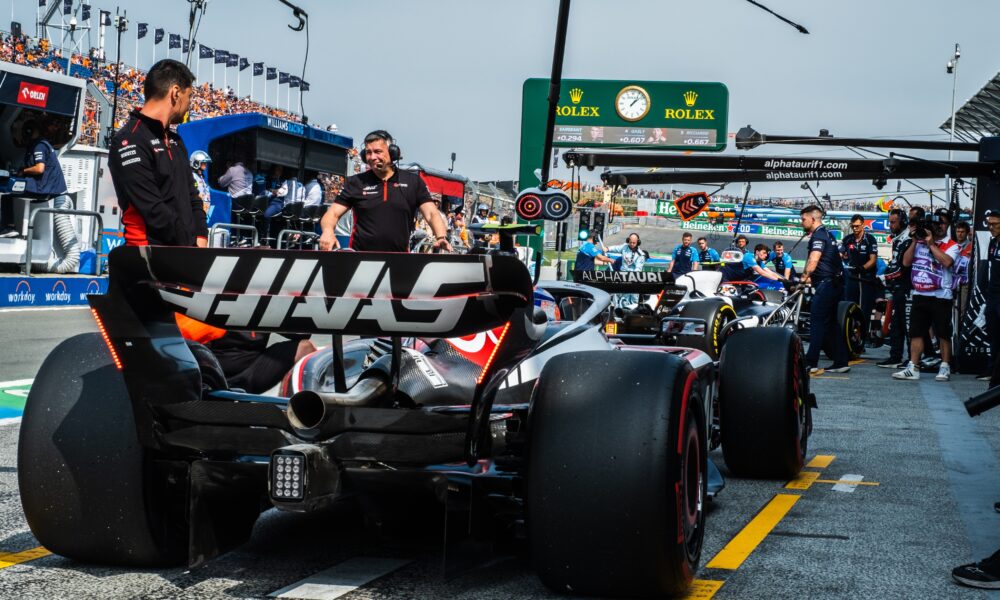

An estimated 300,000 people descended on Las Vegas for the Las Vegas Grand Prix. From the outside, it looked like one massive shared spectacle. Inside the Paddock, it became clear very quickly that Formula 1 is not one experience at all. It’s layered by access, visibility and proximity, and that structure is exactly what allows sponsorship at this level to behave differently from traditional brand-awareness marketing.
As of 2025, Formula 1 reportedly has a global fanbase of approximately 826.5 million, according to Forbes. The most recent Las Vegas Grand Prix averaged about 1.5 million U.S. viewers on ESPN, a 66 percent increase over the prior year, as reported in the Las Vegas Review-Journal. Those numbers explain why brands want to be on the grid. What they don’t show is how that exposure behaves once it leaves the screen and starts living in physical space, on personal devices, and inside rooms most fans will never see.
Play’n GO’s partnership with the MoneyGram Haas F1 Team shows how that layering works in practice.
For a full week leading into the race, the MoneyGram Haas show car was on display inside the Cosmopolitan as a formal 24-hour activation. It was positioned directly in the path of daily foot traffic. Guests passed it on their way to coffee, meetings, dinner, and whatever version of nightlife Vegas delivered that night. Many stopped to take photos.
Those photos probably didn’t stay in their camera rolls. They went straight to Instagram, group chats, and stories, quietly extending the reach far beyond the people who physically walked past it.
The same multiplication happened at the driver meet and greets, where fans waited for hours to take a single photo that now lives permanently online. Every one of those images became its own piece of distribution, carrying the Play’n GO logo with it. Add in the global broadcast, international media coverage, and Netflix crews moving through the garage and the exposure stops behaving like a moment and starts behaving like a system.
That’s the public-facing layer.
The second layer is where sponsorship becomes far more powerful.
Across from the main Paddock Club structure sit the Team Suites. These aren’t the rooftop branded lounges most people associate with Paddock hospitality. The suites function as the private headquarters for each team. Access isn’t tied to your Paddock pass. It must be issued directly by the team. Guests are vetted in advance. Badges display your name, company, photo, and a unique QR code tied only to you. Your name is checked against an iPad at the entrance and if it’s not on the list, the interaction is brief, efficient, and final.
Magnus Olsson, CCO at Play’n GO, explained it with a laugh. Even Paris Hilton couldn’t walk up and buy this pass. Let’s be real; I fully believe Paris could probably buy the building, the team, and the parking lot if she felt like it, but the point still lands. This experience is not for sale. It has to be granted. And as we have all come to learn, people love an exclusive experience.
Inside the MoneyGram Haas Team Suite, the space is built for staying. Lounge seating, work tables, a full bar and food service running steadily in the background. Along the back, partitioned areas where engineers, drivers, sponsors, and partners move in and out of private conversations while the race unfolds just outside. This is where people spend real time together, away from the noise.
From the suite, guests are walked directly into the garage. Headsets go on, so live team communication can be heard in real time. A walkie is placed in your hand. You stand within a few feet of the cars, while strategies shift and crews move with quiet urgency. Netflix cameras roam through the space trying to be in the right place at the right second. Somewhere in their footage is a clean racing moment and, very likely, me in the background trying to understand what just happened.

Behind all of it sits operational discipline. The Haas team provided a dedicated app with the full three-day itinerary broken down by the hour, shuttle routing, access instructions, and live contacts. The movement of guests, the timing of events, and the flow between spaces were deliberate. That structure allows an environment this layered to feel controlled rather than chaotic.
From a brand standpoint, Play’n GO’s partnership operates on two levels at once. On one level, the brand receives continuous global visibility across broadcast, physical installations, social sharing, and media coverage. On another level, it creates private environments where executive-level partners experience the brand inside the sport itself. One layer drives reach. The other shapes memory and long-term perception.
Brand awareness often struggles with attribution. Boards want conversion paths. Decks want clean ROI. Standing inside a Formula 1 team operation makes it clear that some impact isn’t designed to be measured immediately. Some impact shows up later, in recall. In trust. In which brand feels familiar when a real business decision is on the table.
In a gaming market where most brands are competing for attention through the same digital channels, sustained physical-world visibility is hard to replicate. Formula 1 gives Play’n GO repeated touchpoints at global scale, while still supporting private, high-trust partner access, which turns the sponsorship into a long-term brand asset, rather than a brief campaign.

