

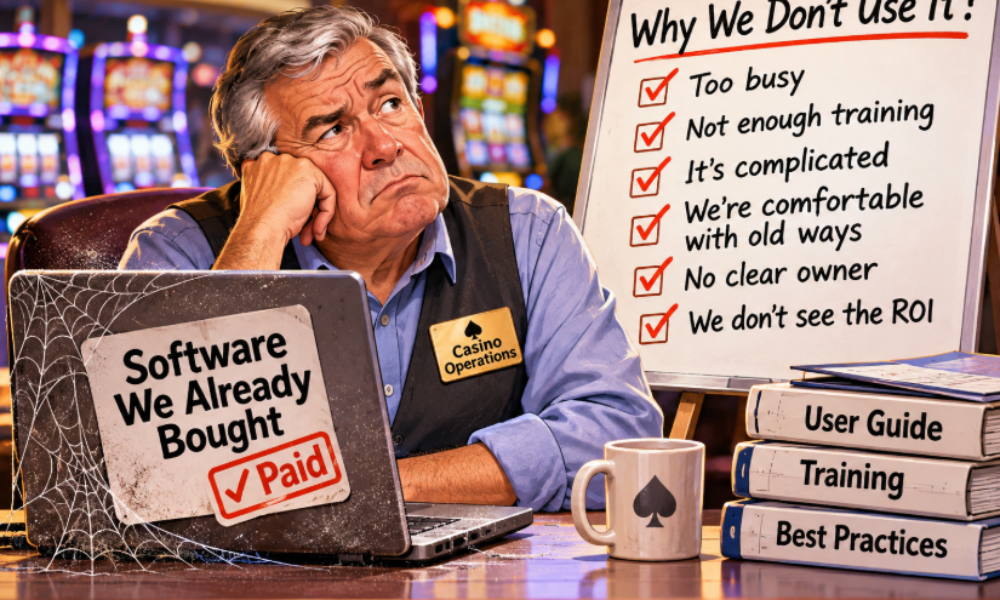

The Ferrari in the garage
A while back I sat in the back office of a mid-sized regional casino with a slot director I’ve known for years. Good operator. Sharp instincts. Knows his floor like most of us know our living rooms. We were talking about his game mix, and I asked how he was tracking performance on a bank of new premium leased units that had gone in about 90 days earlier.
He pulled up a spreadsheet. Not a report from his slot system. A spreadsheet. One he built himself, fed by a data dump his analyst exported every Monday morning, cleaned up by hand, and pasted into tabs with names like “USE THIS ONE.”
I asked, as gently as I could, why he wasn’t using the performance analytics module in his slot tracking system. The one his company paid for. The one that does exactly what his spreadsheet does, plus about 40 other things, refreshed in near-real time, with drilldowns by denomination, location, theme and hour of day.
He looked at me like I’d asked, “Are you using quantum computers,” and said, “We have that?”
They did. They’d had it for three years. It was part of an upgrade, and more importantly that same feature (but even more advanced) was one of the many tools included with their newest AI analytics package. He’d never spent time looking at its many dashboards, the advanced real-time floor mapping, the proactive dispatching module, used its chatbot nor any of the predictive slot move or budgeting suggestions. As far as I could tell, the only feature anyone used regularly was the one that looked most like their old Excel spreadsheet.
I’ve been writing about slot operations for a long time now, and I can tell you this is not an isolated story. In the last few years, I’ve seen it over and over: properties sitting on powerful tools they’ve already bought and paid for, while managers keep doing things the old way. It’s like owning a Ferrari and using it as a garage coat rack.

And here’s what worries me. The next wave isn’t just better reports. It’s AI-driven analytics that can suggest and deliver massive revenue gains and better guest experiences. Importantly, most can now answer plain-English questions about your data. If we can’t get our teams to use the simple and intuitive tools they already own, how are we going to get them to trust a machine-learning model with these revolutionary chatbot improvements?
So, I went looking for answers. Not in the casino trade press, but in the world of psychology. What I found is that the problem is a lot more interesting, and a lot more fixable, than simple stubbornness.
hamdi bendali / Shutterstock.com
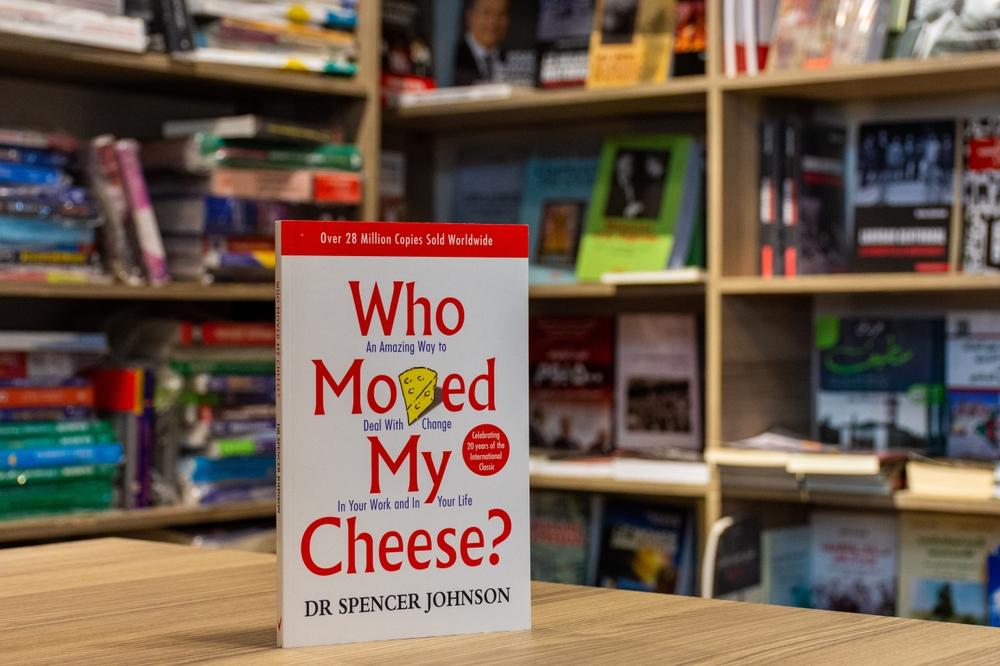
Is it just the cheese?
If you’ve read my book review columns, you know that one of my favorites (that I reread at least twice a year) is Spencer Johnson’s Who Moved My Cheese? (1998). It’s the little parable about two mice and two “little people” in a maze. When the cheese disappears, the mice simply go and find new cheese. The little people complain, wait for the old cheese to come back, and suffer for it. The lesson: change is inevitable, so adapt early and stop clinging to what used to work.
It’s a quick, but important read. The main topic is fear of change and that is certainly real. But after digging into the research, I’ll now have to argue that the Cheese explanation is just part of the problem. It treats resistance as a character flaw, a matter of attitude.
Most of the slot managers I know aren’t afraid of change. They live with it every day. Games come and go, regulations shift, top management changes, the competition down the street launches a new promotion or the power goes out. These are not timid people.
My time at the university was spent in Electrical Engineering and Journalism. I don’t think I ever took a single class in Psychology. Therefore, I asked for help from my friend Claude1 (who apparently spends a lot of time reading everything on the internet). The text below in italics are things he provided, along with a summary that said, “Even brave, competent people (like most slot directors) are wired to protect what they already have.”
In 1979, psychologists Daniel Kahneman and Amos Tversky introduced prospect theory, and with it the idea of loss aversion: we fear losses more than we value gains. Later work suggested people weigh a loss roughly twice as heavily as a gain of the same size (Tversky & Kahneman, 1991). Kahneman eventually won a Nobel Prize in “Economic Sciences” for this line of research.
Now apply that to a slot director. Learning more about the slot system or a new analytics module offers a potential gain: better insight, faster decisions. But it also carries certain losses: time, the comfort of a familiar spreadsheet, and, most painfully, the status of being the person who knows how things work. The gain is speculative. The losses are immediate and personal. Loss aversion predicts exactly what I have been seeing with the reluctance to openly adopt new tech.
Economists William Samuelson and Richard Zeckhauser (1988) gave this tendency another name: status quo bias. In their experiments, people disproportionately stuck with whatever option was presented as the current state of affairs, even when alternatives were objectively better. The default has gravity.
So yes, the cheese matters. But loss aversion and protecting status quo aren’t just about fear. It’s the math our brains do without asking permission. That matters, because you don’t fix a cognitive bias with just a pep talk or a sales presentation.
6 other explanations hiding on your floor
Here are some other culprits. I’ll bet you recognize many of them on your own team.
- 1. “Is it worth it, and is it hard?” In 1989, Fred Davis published the Technology Acceptance Model. He found that two beliefs largely predict whether people adopt a technology: perceived usefulness (will this help me do my job better?) and perceived ease of use (how much effort will it take?). Viswanath Venkatesh and colleagues (2003) later expanded this into the Unified Theory of Acceptance and Use of Technology, adding social influence and “facilitating conditions,” meaning whether the organization actually supports you in using it.
Notice the word perceived. If nobody has shown your shift manager or casino host what predicative modeling, real-time churn alerts or contour mapping can do, the usefulness is zero in their minds, no matter what the vendor brochure says.
- 2. The Paradox of the Active User. This one is my favorite because it describes every busy slot person I know. In 1987, researchers John Carroll and Mary Beth Rosson at IBM studied how people learn software. They found two interesting behaviors. 1. Users never read manuals but start using the software immediately; and 2. Users are so focused on getting today’s work done that they don’t stop to learn more efficient methods, even when those methods would save time overall. They stick with the handful of commands they already know. Carroll and Rosson called this a paradox because the behavior seems rational in the moment but makes no sense in the long run.
When you have a major slot installation this morning, a regulator audit Tuesday and a staff meeting Wednesday, not to mention preparing new materials for your budget Power Point this afternoon, nobody is going to spend an afternoon in the training portal. So, they use the familiar “old” methods of the system forever.
- 3. The Expert’s Trap. In a famous 1942 experiment, psychologist Abraham Luchins gave people a series of water-jar puzzles that could all be solved with one somewhat complicated formula. Then he slipped in problems with a much simpler solution. Most people who had learned the complicated method kept using it, and many failed problems the simple approach would have solved. This is the Einstellung effect: a mental mindset that blinds us to better options.
Our industry is built on experience. That’s mostly a valuable strength. But the veteran who has run WPUPD (win per unit per day) spreadsheets or “loser” reports the same way for 15 years is the most vulnerable to Einstellung. In 2008, many others found the effect even among expert chess players, who sometimes missed a shorter winning line because a familiar one came to mind first.

Shutterstock
- 4. “I’m not a computer person.” Albert Bandura’s (1977) concept of self-efficacy, our belief in our ability to succeed at a task, turns out to be a powerful predictor of behavior. In 1995, Deborah Compeau and Christopher Higgins (1995) applied it directly to technology and found that computer self-efficacy significantly influenced both people’s expectations and their actual use of computers. People who doubt they can master a system avoid it, which guarantees they will never master it.
In casino operations, a lot of our best people came up from the floor: attendants, techs, and key & change people (from back in the days of coin). Many are brilliant operators with invaluable real-world experience, but who quietly worry that a dashboard full of data science will expose them. That isn’t laziness. It’s protection of identity.
- 5. Algorithm Aversion. This is the one that matters most for AI. Researchers Berkeley Dietvorst, Joseph Simmons and Cade Massey (2015) at Wharton found that people lose confidence in an algorithm faster than in a human after seeing both make the same mistake. Even when the algorithm outperformed the human forecaster, participants who watched it err often chose the human instead.
Think about that next time your AI tool recommends moving a game, and it turns out to be a dumb placement. The whole department may write the tool off while forgiving the human analyst who was wrong multiple times last quarter.
- 6. Too Many Choices, Too Little Bandwidth. Sheena Iyengar and Mark Lepper’s (2000) well-known jam study at the University of Washington found shoppers offered 24 varieties of jam were far less likely to buy than those who were only offered six.
Likewise, many modern casino management systems offer dozens of modules, hundreds of reports and endless filters. The Cognitive load theory (1988) by John Sweller’s explains why that can backfire: working memory is limited, and overloading it impairs learning. Faced with a new menu of 200 reports, many managers retreat to the one or two they already know.
It’s not only in their heads
It would be convenient to blame all this on individual psychology. But much of the failure is built into how we buy and roll out technology.
The training cliff. Most system upgrades follow the same script. The vendor shows up for go-live week, runs some one-one sessions, hands out a binder, and leaves. Back in 1885, Hermann Ebbinghaus documented the forgetting curve: without reinforcement, we lose much of newly learned material within days. One week of training on features people won’t touch for a month is close to wasted. And the people in those sessions are usually whoever could be spared from the floor that day, not necessarily the ones who’ll use the tools.
Thankfully, several progressive software companies have realized this and make weekly/monthly continuing education part of the support package. But even with that, many of the issues cited above can remain even though reluctant users attend (but don’t necessarily absorb or use) the information.
No safe place to look dumb. Harvard’s Amy Edmondson (1999) found that teams with high psychological safety (a shared belief that it’s safe to take interpersonal risks) were more likely to engage in learning behaviors like asking questions and admitting errors.
If your slot department’s culture labels and records subtle punishment on the analyst who says “I don’t understand this screen,” nobody will ever say it. They’ll just quietly go back to Excel (see my Tip 8 below).
We love what we built. Norton, Mochon and Ariely (2012) described the IKEA effect: people place disproportionately high value on things they assembled themselves.
That homemade slot performance spreadsheet with 17 tabs? It’s the slot director’s bookshelf. It may be wobbly, but he built it. And he loves it more than the factory-made version.
Hidden commitments. Robert Kegan and Lisa Lahey, in Immunity to Change (2009), argue that people often hold competing commitments that undermine the changes they sincerely want to make. A manager can honestly want data-driven decisions while also being committed, below the surface, to remaining the indispensable expert everyone consults. Until that second commitment is surfaced, the first one keeps losing.
Why AI raises the stakes
The roadblocks above were just a nuisance when the unused feature was an early AutoCAD plot map (even though that dated underutilized map was full of hidden golden eggs). Now, with AI analytics, contour mapping and dashboards full of gems, it can become a serious competitive problem.
First, AI tools stacked all six psychological hurdles at once. Their usefulness is hard to judge until you’ve used them. Their reasoning can feel like a black box, which feeds algorithm aversion. They threaten the expert’s identity more directly than any report ever did. And they arrive while we’re all busier than ever.
Second, AI rewards the operators who adopt early. Models get more useful as they learn your floor, your players, your products and your seasonality. The property that starts asking questions of its data now will have a year of refined insight before the holdout across town logs in.
Third, and this is the part I find most interesting: the old excuse of difficulty is evaporating. The newest tools let you ask questions in plain English: “Which video poker banks dropped more than 10% in coin-in since we moved them?” You don’t need to know which of 200 reports to run. That removes a big piece of Davis’s ease-of-use barrier. What remains is mostly psychology and organization. In other words, the stuff we can (and should) manage.
Moving your own cheese: 10 tips that work
So, what do we do about it? Here’s what Claude’s research suggests, filtered through my decades of my watching what works on the casino floor.
- Inventory what you already own. Call your system vendor rep and ask for a complete walkthrough of every module and feature in your current license. I’d bet most readers will find at least one (and probably a lot more) tool(s) they didn’t know they had. This is the cheapest technology upgrade you’ll ever make. Then schedule training.
- Start with a real problem, not a feature. Fred Davis’s research says usefulness drives adoption. So don’t train people on “the reporting module.” Train them on “how to find out why Bank 14 is underperforming.” Tie every lesson to a decision they’ve already made.
- Budget the time explicitly. The Paradox of the Active User won’t fix itself. Block one hour a week, on the schedule, for system learning. Protect it like you protect the slot shift meeting. If it isn’t scheduled, the floor will eat it.
- Kill one spreadsheet at a time. Pick the homemade report your team relies on most and rebuild it inside the system together. Respect the IKEA effect by letting the spreadsheet’s creator lead the rebuild, so the new version is still theirs.
- Build small wins first. Bandura found that mastery experiences are the strongest source of self-efficacy. Start your least confident people on an easy, satisfying task, like a single saved report, before you show them the 40-graph dashboard.
- Space out the learning. Beat Ebbinghaus with short, repeated sessions: 20 minutes this week, a refresher next week, a new feature the week after. Ask vendors if they have recorded micro-lessons, or if they can focus one of their regular check-ins on a specific new, but narrow, topic.
- Appoint a champion, not just a user. Find the curious person on your team, often not the most senior one, and make system mastery part of their job description. Everett Rogers’s Diffusion of Innovations shows that new ideas spread through peers and opinion leaders far more than through memos (check this theory out on Wikipedia).
- Make it safe to not know. Lead by example. When the slot director says in a staff meeting, “I had no idea the system could do this. Can someone show me?” or even ask for an explanation of a common acronym like SAS. “What does SAS mean and why should we care?” This gives everyone else permission to learn out loud. That’s Edmondson’s psychological safety in action. Once I reached a senior level management position, I always liked to be the first to say that I didn’t understand a term or a concept (even when I did or not) as an example to others to do the same.
- Run AI side by side before you trust it. To get past algorithm aversion, run the AI’s recommendations in parallel with your team’s judgment for 60 or 90 days and track the results. Dietvorst and colleagues (2018) also found that people were more willing to use an algorithm when they could modify its output, even slightly. Treat the AI as a second opinion, not a boss.
- Make adoption someone’s metric. This is a classic old school stick- and-carrot approach, but it works! Assign ownership. Most modern systems can report which features are being used, by whom and for how long. Review that the same way you review hold percentages. What gets measured gets managed, and what gets managed gets used.
The bottom line
Spencer Johnson was right that the cheese keeps moving. But the reason so many of us don’t chase it isn’t simply fear. We’re wired to overweight losses, stick with defaults, protect our expertise, distrust machines that make mistakes, and stay too busy to learn. Our organizations then make it worse by not asking for more accountability.
The good news (as you just read above) is that every one of those psychological stumbling blocks has a known remedy. None of them require a bigger budget. They require leadership that treats learning as part of the job, not something squeezed in around it.
Your Ferrari is already in the garage. It’s time you took it out for a spin.
# # #
1 – Claude is a Large Language Model AI agent created by Anthropic. If you want to check out Claude’s psychological source references (as I did), click here.
