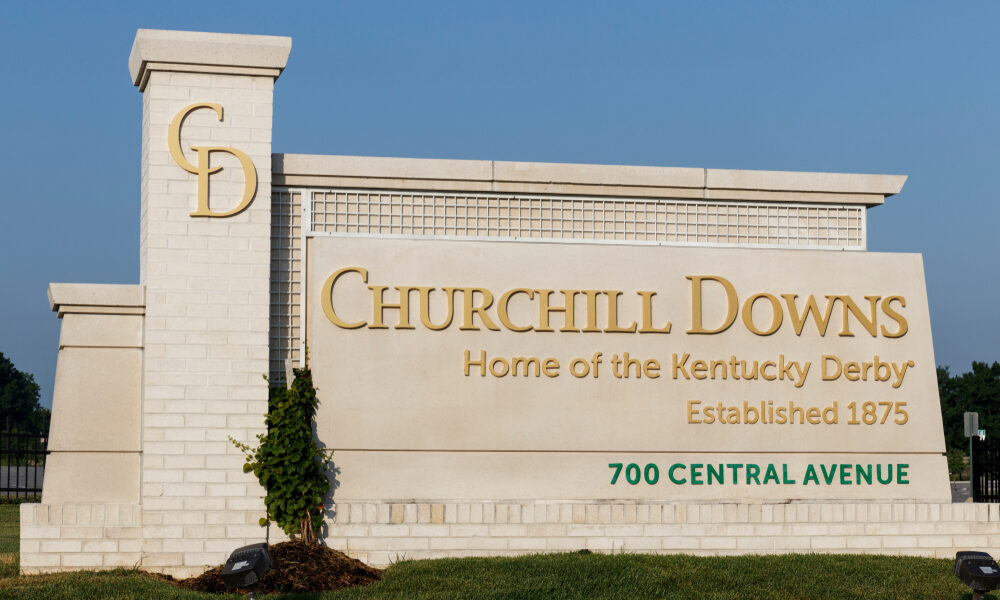

It’s been a very good month for Churchill Downs.
The operator on Tuesday agreed to buy the intellectual property of the Preakness Stakes and Black-Eyed Susan Stakes from 1/ST Maryland for $85 million.
This month, Virginia Governor Abigail Spanberger vetoed Senate Bill 661, which would have legalized electronic skill‑game machines in convenience stores, truck stops, and small businesses. Churchill favored the veto.
And on Wednesday, Churchill Downs posted record first-quarter revenue of $663 million, and Adjusted EBITDA of $257 million.
Churchill Downs CEO Bill Carstanjen was upbeat during the call, notably about the definitive agreement with the Preakness. Carstanjen said part of the company’s strategy is to seek iconic, unique assets.
“We think the Preakness is one of those assets,” Carstanjen said. “We think it has tremendous potential and tremendous history, and as it unfolds, we certainly are available to the state and happy to work with the state to help them figure out how best to transition that property into something great, like it’s been in the past. It’s entirely consistent with how we look at things like the (Kentucky) Derby.”
Carstanjen added that the Kentucky Derby remains the crown jewel in Churchill’s holdings, and that he expects, over time, to focus on the Preakness in the same way.
“It’s about driving high-end customer participation and encouraging sponsorships, and certainly attendance and viewership can be a part of it,” Carstanjen said. “I don’t have it at my fingertips, the information this year for all the markets that the Derby will be telecast but it’s a very impressive picture, and it’s a growing picture. Everything we see from an international perspective is positive and growing and encouraging, and you’ll see us focus more on that over the coming years. Because there’s a big population out there in the rest of the world that’s in particular interested in Thoroughbred racing, as well as the United States.”
Carstanjen said that while Churchill Downs is pleased with Spanberger’s veto of electronic skill‑game machines at convenience stores, truck stops, and small businesses, he realizes that any future legislation will be fluid.
“What happened in Virginia is part of a healthy democratic process,” he said. “There were lots of discussions. There were lots of diversions of views, and the state came to a conclusion on how they wanted to think about gaming for the time being.
“I’m encouraged by some of the dialogue, and some of the discussion there that their progression on gaming issues is a positive one from our perspective. … Generally, Virginia shows a lot of elements of a very stable environment for us.”
Historical racing machines have been a boon for Churchill, notably in the state of Kentucky. Carstanjen noted that the February opening of Marshall Yards in Calvert City is part growing, emerging markets in the state.

“They haven’t reached maturity,” Carstanjen said. “They’re still growing as the product continues to get better. We continue to have more options, more variety of products, and they certainly are something we feel positively about, and we look forward to expanding our offering.”
J.P. Morgan analyst Dan Pollitzer wrote that “overall, we view this as a solid report, as weather was likely a material drag in the quarter ($2.5 million and $2 million for Kentucky and Virginia HRMs, respectively, plus ~$2.5 million in gaming).
“Oddly, Churchill Downs did not repurchase any shares in the 1Q; this is the first quarter since 2Q23 that CHDN did not repurchase any stock, despite the valuation at seemingly attractive levels.”