

Like many businesses, casinos underwent seismic changes when COVID struck.
Peter Arceo, Chief Gaming Officer for Yuhaaviatam of San Manuel Nation, noted it was a shock to casinos and changed the way the operator looked at departments, notably hospitality.
“In order for us to be efficient, we had to rethink the way we designed our areas, including the areas that support staff worked in,” Arceo said.
Casino design has undergone numerous changes in the last few years. Architects and design firms are challenged to keep abreast of demands for lighting, restaurant and dining options, entertainment, and even parking.
“In the past five years, I think, it’s changed in a way where our clients’ goals are a little bit different,” said JoyceLynn Lagula, a principal and entertainment design leader with Perkins Eastman, a global design practice. “They’re asking us to integrate a lot more technology and flexibility into the gaming floor. They want it to be flexible, but now they want it even more versatile.”
For Arceo’s properties – including Yaamava’ Resort & Casino at San Manuel, Highland, California, and the Palms Casino Resort in Las Vegas – that meant reconfiguring the approach to hospitality.
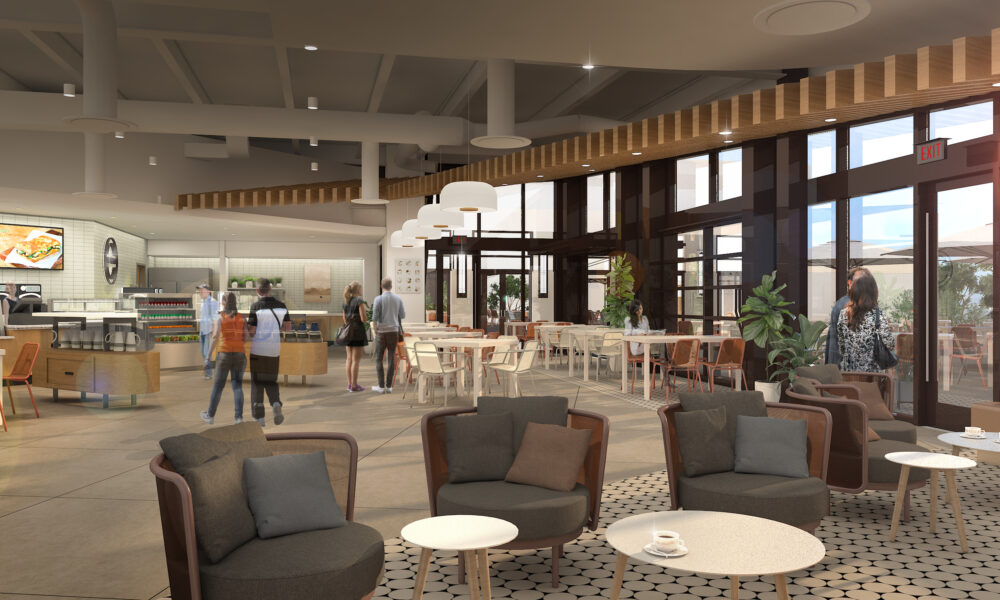
“In order for us to be efficient, we had to rethink the way we designed our areas, including the areas that support staff work in hospitality,” Arceo said. “Also, consumer behavior changed. People were opting for more fast casual and to-go. And you could talk to both casino food and beverage operators and non-casino food & beverage operators, they will give you the same answer: more to-go, more fast casual.”
San Manuel’s food & beverage spaces were redesigned to account for changing consumer behavior.
Brett Ewing, a principal with the Cunningham Group in Las Vegas, notes that many casinos are underutilizing square footage. He points to Yamaava’ Resort & Casino as an example of an operator that has been able to use its game floor efficiently while taking up less of a footprint.
“We have to get more creative with space and the flexibility,” Ewing said.
That includes providing areas where people can meet and converse.
“I’ve always believed that people want to congregate,” Ewing said. “We still have to create spaces to come together, because they want to be together. They don’t always want to be sitting at home.
Because of the “intensity in the casino, you need those spaces to regroup and take a break,” Ewing added.
During recent years, entertainment options have become much more important to a casino’s offerings. Music concerts, comedy shows and sporting events are offered at regional and tribal casinos, not just destinations in Las Vegas.
“I like that kind of newer request, because I think the more dynamic of an environment, you get to attract more and different demographics,” Lagula said.
Ewing’s firm is working on multi-purpose, multi-use space for Wildhorse Resort & Casino, a tribal operation near Pendelton, Oregon.
“Especially with tribes, there’s a lot of community events that happen,” Ewing said. “And we hear on these properties, people are coming in and wanting to do weddings at the more established properties that have turned into resorts.”
Not so long ago, casino exteriors were emblazoned by brilliant lighting on the outside, beckoning customers to enter. The insides were darker, smokier havens where people could gamble anonymously.
“There was that old notion, you get them in a dark box and you don’t let them see clocks or the sun’s coming up outside,” Ewing said. “That’s kind of old school.”
“A lot of clients and the newer casinos want brighter,” Lagula said, “and kind of this more organic, minimalistic aesthetic.”
The exception is poker rooms.
“When it comes to a poker room, I feel like what they ask us as designers is more intimate, more kind of semi-private because of the type of player,” Lagula said.
Recently, a new consideration for design firms has emerged: The advent of self-driving cars and rideshare technology. Arceo said that casinos will need to accommodate how people arrive at venues.
“If your front drive is not optimized for that, how are you going to handle it?” Arceo said. “You have to think about that.”

Arceo added that Uber and Lyft riders pose another issue.
“Were does rideshare go?” Arceo said. “If you look at Las Vegas, people are jamming them in parking garages. And I’m not sure that’s the right place for that. You look up and down the (Las Vegas) Strip and that’s where they’re slamming them, a lot of it’s in parking garage. And I understand why it’s because when those buildings were erected, rideshare didn’t exist.”
“A lot of the properties we design a for, the customer can’t get in and out easily,” Ewing says. “And if they have options, they won’t come back. The whole traffic and circulation is extremely important.”

