

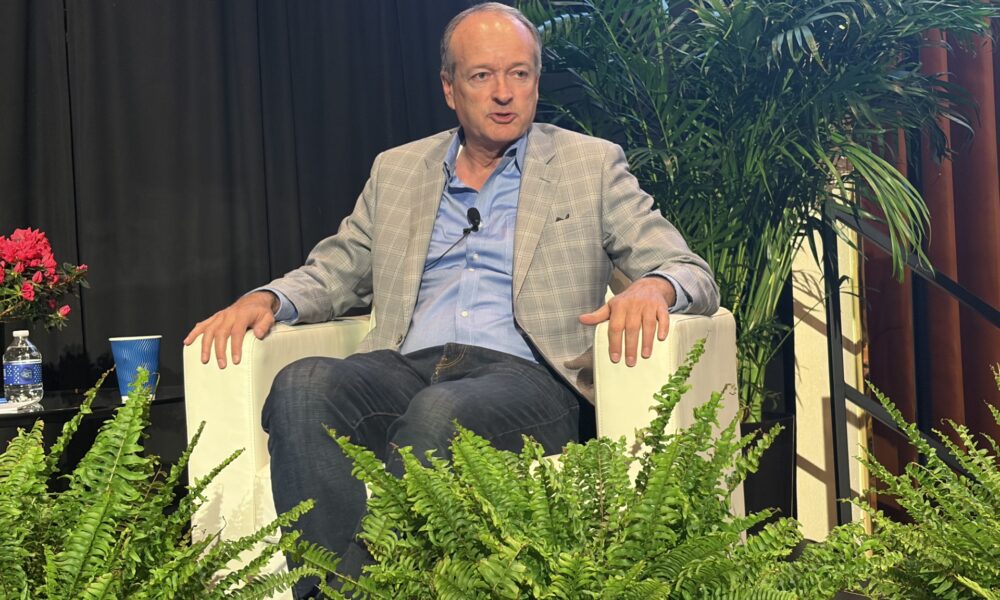

The CEO of Boomer’s Sportsbook criticized the prediction market industry for its “gamblification of everything in America” and targeting teenagers and students on college campuses as customers.
Sportsbook-industry veteran Joe Asher let loose on prediction markets when he spoke Tuesday at Circa Las Vegas during an annual gaming conference hosted by the Nevada Society of Certified Public Accountants.
Asher said it’s incredible that prediction markets have used language in the Commodity Exchange Act to justify their existence in court cases. When the best lawyers in the country argued in 2018 before the Supreme Court to overturn the Professional and Amateur Sports Protection Act (PASPA), stopping the federal ban on sports betting and putting it under state jurisdiction, no one believed that sports betting had been legal all that time — as prediction markets argue today.
“Back in 2018 before the Supreme Court, nobody talked about the Commodity Exchange Act in that litigation,” according to Asher, a lawyer.
Asher lamented the operation of prediction markets outside the state regulatory system that has operated in the country for decades. He pointed out that prediction markets continue in Nevada despite a court order to cease and desist.
“They got Donald Trump Jr. to be an advisor for Kalshi and advisor and early investor in Polymarket. The CFTC (Commodity Futures Trading Commission) has only one of five appointees (Chair Michael Selig) who’s a cheerleader for the industry and in effect doing the administration’s bidding around it,” Asher said. “They used to talk about it not being gambling, but now they’ve even moved away from that. Now they’re joining the National Council for Problem Gambling. That’s interesting, because they’re ‘not involved in gambling.’”

Asher was asked why prediction markets have become so popular. He said that they operate in states where sports betting isn’t legal, the same reason that overseas black markets have long existed.
“Kalshi has targeted teenagers as well and on college campuses in particular,” Asher said. “Anecdotally, you hear from folks that their teenagers are all gambling on the prediction markets. I don’t think that’s a good thing. The gamblification of everything in America is not a positive thing at all.”
Gambling is “better legal and regulated than not,” but without guidelines, it “invites social problems,” Asher said. “The state regulatory framework has served us well. The regulations in place around self-exclusion and integrity monitoring are all positive. I believe the legal age should be 21 instead of 18. Some states have 18, but broadly speaking it’s 21-plus.”
Asher said what upset him early on was when Kalshi marketed prediction markets as investments.
“It’s not an investment. It’s gambling. I’m all for gambling. I have a pretty nice life because of gambling, but it needs to be marketed for what it is — entertainment and having excitement and interest in a game. It’s not an investment class like utilities, bonds, and equities.”
Asher talked about margins in the sports betting industry. Boomer’s model is to offer a low price to bettors in comparison to competitors. Boomer’s is a startup that launched in August and is the lone independent operator in Nevada.

Caesars Entertainment’s objective is a 10% margin, while FanDuel and DraftKings have even higher margins, Asher said. Margins increase by reducing the payoffs on parlays or increasing theoretical margins on the products.
“The customer gets less enjoyment out of betting (with these margins), so we’ve made lower margins a real focus,” Asher said. “At the end of the day, would you rather hold 10% of a $1 million or 6% of $2 million? The focus on margins for margin sake is shortsighted. The ultimate metric is revenue in the business. A higher-margin product is not necessarily better, in my opinion, and it certainly takes customers’ money much more quickly. A lower-margin product is still a profitable business, but one where customers get more return for the money more often.”
