

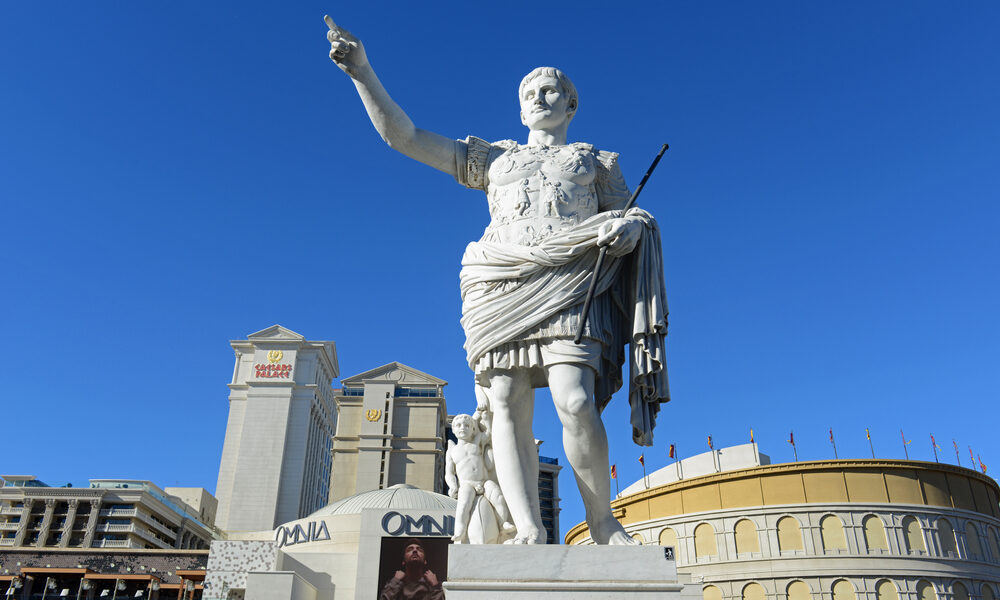

A J.P. Morgan analyst says a potential Caesars Entertainment sale in the low- to mid-$30s share price “is rational and achievable” through several deal structures, but was skeptical of a leveraged buyout by billionaire casino owner Tilman Fertitta.
Analyst Daniel Politzer said Caesars has been trading at about 20% free-cash-flow yield for much of the past year, as public investors have focused more on risks — demand on the Strip, regionals maturing, leverage, and digital competition — than on its strong cash-flow generation, even while credit markets have remained accommodating.
“Caesars appears at an impasse on accretive capital allocation,” Politzer said. “To date, debt reduction and share buybacks have not provided meaningful support to the share price. Alternatively, management can explore strategic options, including a reported management buyout, to increase their equity stake and share more directly in Caesars’s attractive free-cash-flow profile.”

With shares at $27, a potential takeout in the low- to mid-$30s, and a year-end price target of $35, Politzer said the market is ascribing about a 55% deal probability. “We expect an update in the coming weeks, as Fertitta’s 45-day exclusivity period nears its end. Note that Caesars has not commented on the news reports of a potential takeout so far.”
Politzer laid out three takeout scenarios: management led; $2 billion from an equity sponsor such as Fertitta; and traditional debt financing.
“We think the [Fertitta] scenario is least likely, as a change of control would trigger costly debt breakage/reissuance costs and open the door to GLPI and VICI seeking remuneration,” Politzer said. “In a merger, asset sales may also be utilized, both as a source of funds and for antitrust reasons. We assume a total of $16 billion of capital would be needed, $6.5 billion for equity takeout, $400 million transaction/debt breakage/issuance fees, and $9.3 billion to refinance Caesars’s debt.”
There are other deal considerations, Politzer said.
Does a deal address Caesars’s low rent coverage with VICI and will the structure allow VICI/GLPI input? Will there be a change in control, which likely triggers a repurchase of Caesars’s bonds? What is the max leverage 6.5 times lease-adjustment? And how receptive will credit markets be, assuming 8.5% on newly issued debt?
Does Fertitta have sufficient liquidity for a deal, and what would his involvement imply for his $1.4 billion Wynn Resorts stake?. What assets could shake loose and who are the potential buyers? How long to close (possibly 12-15 months)? Are there antitrust concerns?
A Caesars takeout at $31 to $35 implies seven times 2027 EBITDAR and a 15% free-cash-flow yield, Politzer said. That’s a positive valuation mark for OpCo peers.
“Extrapolating, MGM could be worth $50 to $60 with a big gap between free cash flow versus EBITDAR implied values and PENN $25 to $30,” Politizer said. “More broadly, a deal should support U.S. gaming valuations, refocusing attention on intrinsic cash flow rather than just earnings momentum. Additional asset sales could follow too.”
Politizer said U.S. gaming OpCos MGM and PENN trade at 40%/10% discounts to their long-term average, reflecting concerns around competition, including land-based, digital, and quasi-legal and concerns about demand/macro uncertainty, and capital structure such as master leases compounded by investor preference for growth over value in a higher-rate environment.
