


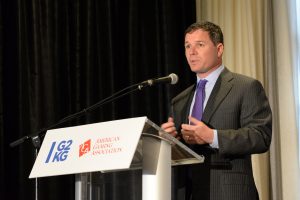
 The role that casinos have played in creating jobs and economic transformation in eastern Pennsylvania over the past decade was on full display Thursday morning at an American Gaming Association roundtable with area business and political leaders at SugarHouse Casino in Philadelphia.
The event, part of the AGA’s Get to Know Gaming campaign, was headlined by U.S. Congressman Pat Meehan, state senator Larry Farnese, Julie Coker Graham – president and CEO of the Philadelphia Convention and Visitors Bureau – and executives from the SugarHouse, Parx Casino and other local business groups.
AGA CEO Geoff Freeman kicked things off by highlighting how far casino gaming has come in the Keystone state. Once cast as a pariah by critics and opponents during the fight to legalize the industry in 2004, Pennsylvania now has 12 casinos that employ more than 17,000 people and produce more than $6 billion in annual economic activity – making it the nation’s second largest gaming market.

The industry generated $1.3 billion in tax revenue in 2015, according to the Pennsylvania Gaming Control Board, meaning that gaming revenues now comprise around 4.0 percent of the commonwealth’s total budget.
“This industry has delivered to Pennsylvania. It has delivered to local communities and we couldn’t be more proud of that,” Freeman said. “Our commitment to local communities in which we’re doing business is strong today and only growing in the future.”
U.S. Representative Pat Meehan echoed that sentiment. “You just have to step back a few years and look at this,” he said, harkening back to the legalization fight of 2004. “If you look at the record, [those who saw the implementation of casino licenses] got it right” he said, noting that the state’s casinos have become not just jobs or an industry, but rather “an anchor for economic revitalization in challenged areas.”
But a pair of recent developments in Harrisburg, the state capital, have cast a pall over the state’s gaming industry. In July, the legislature approved a two percent tax hike on table games from 14 to 16 percent, which will siphon an estimated $17 million annually from casinos into the state coffers. This increase comes in addition to the 54 percent tax that Pennsylvania casinos already pay on slot machine revenue, making the state one of the highest-taxed gaming jurisdictions in the country.
 In another jolt to the industry, the Pennsylvania Supreme Court ruled in late September that part of the state’s scheme for taxing slot revenues is unconstitutional because it forces different casinos to pay different rates depending on their size and location. The state constitution requires that taxes across a sector must be applied in a uniform manner.
This decision could affect SugarHouse, located on the Delaware River and the only casino within the Philadelphia city limits, because it is currently one of only a handful of casinos in the state not required to pay a minimum $10 million tax to their host municipalities.

The court tasked the state legislature with fixing the problem, giving it 120 days to amend the 2004 law that first instituted gambling in the state.
Larry Farnese, a Philadelphia-based state senator and a leading advocate for gaming in the legislature, stressed that coming up with a fix will be a top priority moving ahead.
“I anticipate that the remaining legislative days will be spent discussing and coming up with a remedy,” he said. “We’re very concerned about it and want to make sure we get it done and get it done quickly.”
That process will almost certainly open the door for political horse-trading and feather-ruffling to get a deal done, creating a new opportunity for new forms of gambling like online play and video lottery terminals to be introduced.
As they reconsider the state’s gaming framework, Freeman urged Pennsylvania legislators not to think of casinos as a short-term cash cow but as long term community and economic partners.
“We don’t have to look far to Atlantic City to see what short term thinking does,” he said. “Long –term thinking, more progressive thinking…is going to look at how do we attract new customers, how do we make the product more compelling, what are the games that tomorrow’s customers are interested in.
