

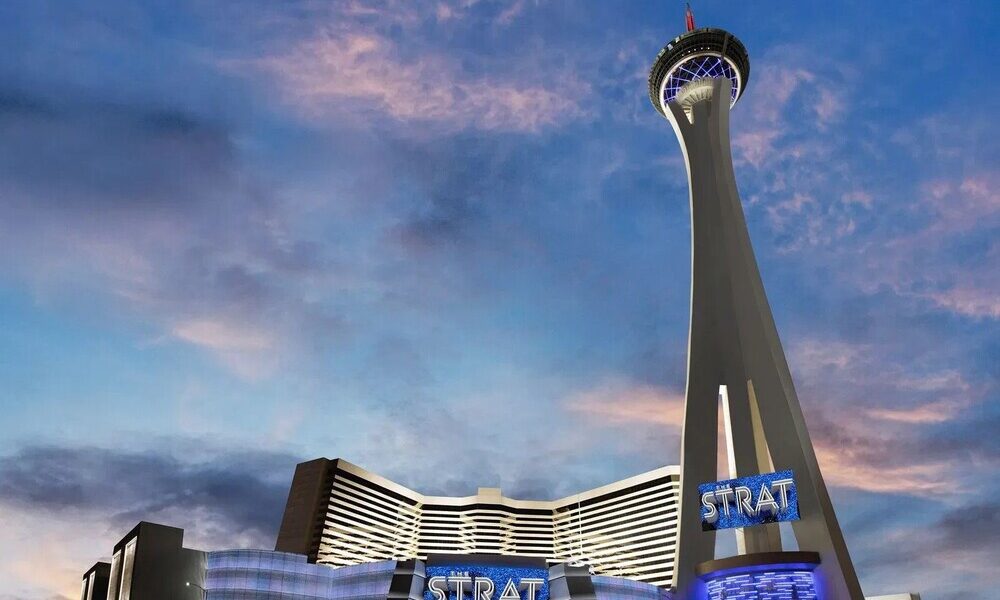

The Nevada Gaming Commission Thursday signed off on Golden Entertainment taking the company private.
The Las Vegas-based casino operator whose flagship property is The Strat on the Strip, has dealt with a lagging stock price that company executives said resulted in investors not properly evaluating it, according to CEO Blake Sartini.
Golden Entertainment is selling its operating assets to Sartini and affiliates and its seven casino real estate assets to VICI Properties through a sale-leaseback arrangement.
Under the sale-leaseback, VICI will become Golden’s real estate partner for Golden’s flagship property, The STRAT Hotel, Casino & Tower on the Las Vegas Strip; Arizona Charlie’s Decatur and Arizona Charlie’s Boulder in the Las Vegas locals market; the Aquarius and Edgewater Casino Resorts in Laughlin; and the Nugget Hotel & Casino and Lakeside Hotel & Casino in Pahrump. Golden will continue to own the real estate for Gold Town Casino in Pahrump. Golden Entertainment also operates 72 gaming taverns in Nevada.
Some 99% of shareholders approved the deal that will close in the second quarter for $30 a share compared to the $20 a share prior to the announcement.
Commission members cited no concerns in approving the changeover.
Commissioner Brian Krolicki praised Sartini and his family for being part of the fabric of gaming in Nevada for decades. He said he understands the need for the change. “I’ve been part of a public company going private and it’s not easy. I just want to know who are the 1% of shareholders who voted against the transaction.”
Krolicki said he appreciates that the transaction was at a premium price. The cost of compliance and disclosures for public companies and quarterly reporting runs millions of dollars.
“You do these things to access capital markets,” Krolicki said. “It’s been an interesting transaction to watch. It’s compelling and makes sense, even though it’s counterintuitive.”
In his discussion, Krolicki pointed out how large VICI’s holdings have gotten on the Strip and should merit discussions in the future on what the implications are for the gaming industry.
“I’m not trying to be aggressive in that comment at all, but the fact is that you have a landlord controlling a lot of both sides of the street. I wonder what the impact might be. We should keep that in the back of our minds going forward.”
At the Gaming Control Board meeting two weeks ago, Board member George Assad was concerned that VICI might be a monopoly. “Once these contracts expire, if they want to raise the rents by 5%, 10% or 20%, they have you in a bad spot,” Assad said. “I would like to see some real estate transactions with some other companies that may get involved in these leasebacks.”
The Golden lease with VICI is for 30 years with four five-year renewal options. The rent will be allocated proportionally based on revenues and profitability across the properties.
One question that came up during the hearing was about the future of the Colorado Belle in Laughlin that closed during the pandemic and hasn’t reopened. Sartini said Golden sees the 22 acres on the Colorado River as a significant asset and that VICI is a potential partner in development of that site.
“They have an interest in seeing us grow. They also have the capability to finance a lot of that growth,” Sartini said. “It would be logical to assume that VICI in some form would be involved. Laughlin is continuing to show significant potential. We sought VICI as a landlord and potential growth partner. That particular piece may come to fruition.”
Sartini thanked regulators for their support and said it was important to get timely approvals for the transaction with a “significant number of people and entities that hang in the balance” until formal approvals are given. That includes lending institutions and legal and administrative support, along with employees.
In the need for the deal, Sartini talked about how Golden started trading publicly in 2015 through a reverse merger. The company grew throughout the years and Sartini cited the purchase of the American Casino assets in 2017, including The STRAT and two Arizona Charlies properties in Las Vegas and Aquarius Hotel & Casino in Laughlin. At the time, Golden had a Maryland casino, three in Pahrump in southern Nevada, the state’s largest slot route at the time and the largest tavern portfolio in the PT’s brand.
The share price began at around $7 and climbed to a high of $59, Sartini said. Over time, Golden divested from non-core operation that included the Maryland casino and two slot routes, with a goal of resetting as a brick-and-mortar casino operator based in southern Nevada.

The transactions strengthened the balance sheet significantly and allowed for patient growth pursuits. But those growth opportunities became harder to find and those considered by the Board were deemed too financially risky, Sartini said. “From an institutional investor standpoint, Golden became too small to gain attention from the public market.”
The lack of organic growth further limited investor interest, Sartini said. No viable merger candidates were found and the Golden board considered an outright sale of assets. It was then they discovered the real estate had the most value through its sale. The board decided, however, that the sale of property with being an operator with limited organic growth prospects wasn’t in the best interest of shareholders, Sartini said.
There will be minimal personnel changes by going private and nothing changes regulatory wise as well. “We remain committed to our team members and the broader Las Vegas community.”

Golden will retire the debt in the transaction, which will save on interest expenses.
