

In 2003, the National Council on Problem Gambling launched a program that would grow into monthlong awareness of treatment for gambling ills. What started as a week in 2003 grew into designating March as Problem Gambling Awareness Month in 2014.
According to NCPG Director of Public Affairs Cait Huble, the increase from a week to a month has enabled the non-profit organization to increase awareness of gambling-related issues. And it is no coincidence that PGAM overlaps with one of the country’s biggest wagering events, the NCAA’s March Madness basketball tournament.
“We always say that was a feature, not a bug,” Huble said during Tuesday’s NCPG seminar Preparing for Problem Gambling Awareness Month 2026. “During March Madness specifically, there is an increased awareness on gambling. Way back in 2003, before sports betting was legalized in many U.S. states, PGAM was established in March for a reason. It was designed to use that additional attention on gambling to raise awareness of problem gambling.”
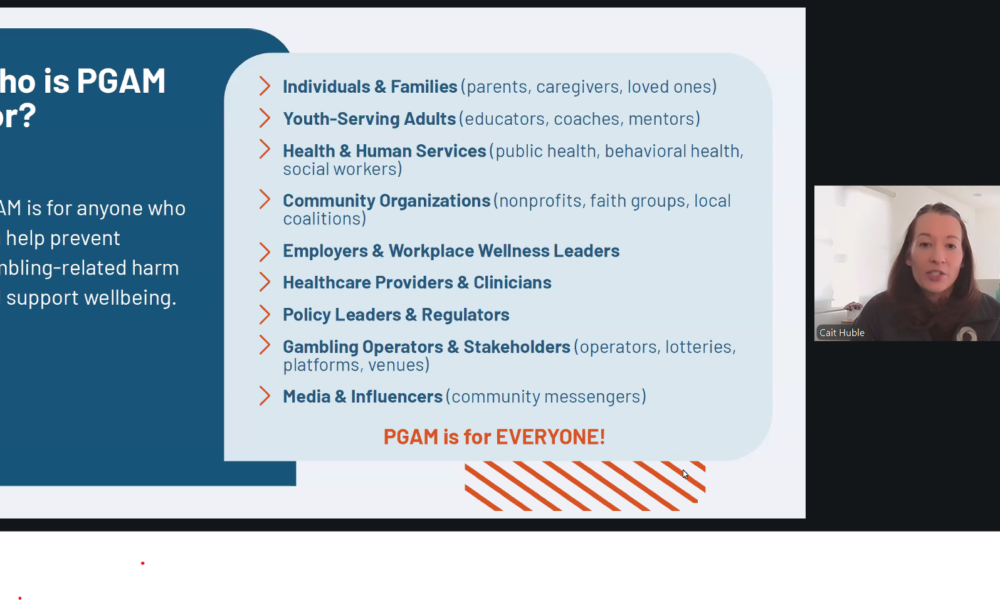
This year’s theme for PGAM is Caring Communities – Stronger Futures. Huble said the goal is to emphasize the importance of getting all stakeholders – including friends, families, educators, and healthcare professionals – pulling together to address problem gambling issues.
Recognizing that communities can change and encompass different constituencies is an important tenet of PGAM this year.
“You may speak to one community of lottery retailers and speak to a different community at a senior center later in the day,” Huble said. “That can change throughout the month, and we don’t feel like it has to be defined explicitly one way.”
The goal is to build not only awareness, but strong and caring communities where people with issues can feel comfortable. It varies, Huble said, what those communities look like.
“Sometimes it’s as simple as sharing awareness messages or resources, starting conversations to reduce stigma, hosting events in your community, making it easier to find and access help,” she said.
Huble said that often it “feels like baby steps, but at the end of the day, there is that opportunity to build the stronger future, and that’s what we’re working towards.”
Communities can vary based on the population that is targeted. Huble admitted that it “may change 100 times” for those addressing issues, which is why it’s important to identify subjects. There is no one size fits all approach that works.
“Maybe I’m talking to 16-year-old boys about the risks of sports betting, and they’re not going to listen to me,” Huble said. “There’s a better messenger, I promise. And so, it really changes depending on who that community is and offering what support looks like locally.”
For those working to help those addressing problem gambling issues, PGAM messages, Huble said, are merely guides. There are no activities that are required.
“It’s not a checklist of what exactly you have to do to participate,” Huble noted. “So, some organizations can say I can participate by putting up a few social media posts, and that’s wonderful. Some people can have big, great events, or a conference, or on-campus screening events. Those are all wonderful.
“But none of them are explicitly required. As we’ve mentioned, serve your community in the way that fits them best, rather than following a pre-formatted list. We trust you to know what’s best for your community and what your bandwidth is on your own team.”

