
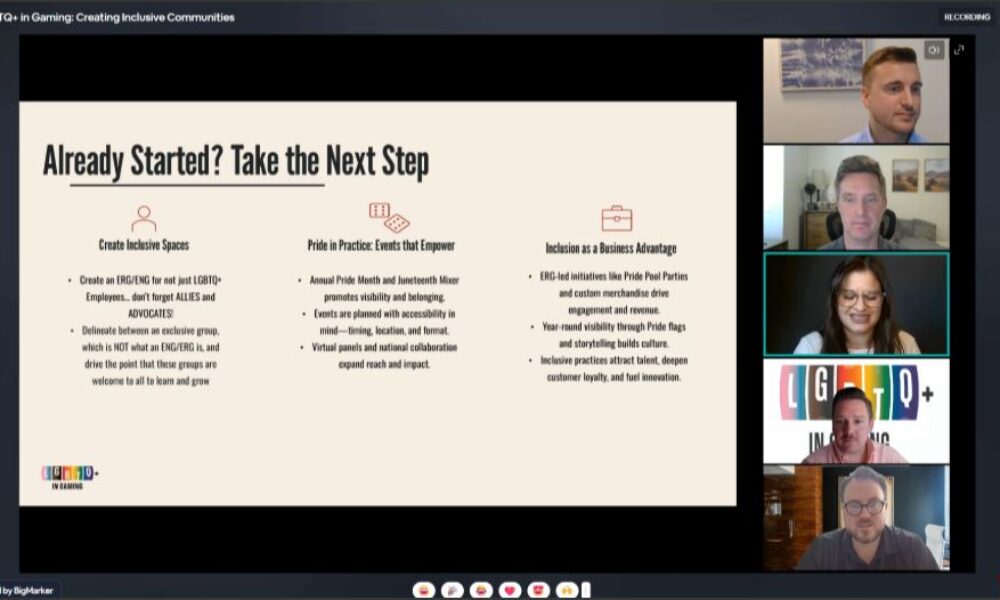

During the recent webinar, LGBTQ+ in Gaming: From Ally to Advocate, Felicia Hendrix talked about a family member admitting they were gay. Hendrix wondered if they had a rough time coming out at home and what must work be like?
“We’re all greater when we can embrace others in diversity. So be an ally, not just personally, but also professionally,” said Hendrix, Penn Entertainment’s Executive Vice President, CFO. “As an executive at Penn, I think it’s really important to let those team members know, particularly those who are trying to figure out how to work their way through their careers, that w’re here for them.”
Hosted by Brooke Thomas, Seminole Hard Rock Services People & Culture Executive and a founder of the LGBTQ+ in Gaming group, and supported by the American Gaming Association, the webinar concentrated on how allies can support fellow workers in the LGBGQ+ community.
Stephanie Pi’imauna, Seminole Hard Rock Support Services Senior, grew up as the youngest of 12 children. She remembers what it was like to be unseen.
“My journey from my own childhood, reflecting on my own experiences of feeling invisible, helps me highlight for other communities that might also be the same,” Pi’imauna said. “More importantly, the last couple of years with this particular community, it’s been challenging to watch how others don’t feel the same or see our colleagues in the LGBTQ+ community as peers, friends, partners, family members, and back again to really a category of mothering.
“It just it’s been a challenge to continue to do the work in an environment that feels like it is consistently pushing up against you.”

Thomas emphasized that being an ally is more than just expressing token support for the LGBTQ+ community. It’s being active, including not being afraid to speak up when rude comments or behaviors occur.
“If you’re trying to go to that space, especially if it’s not a space you’ve been in before, if you let the jokes or comments go, I don’t know if that person’s ready for a leadership role,” Thomas said.
Being an ally, according to Pi’imauna, carries with it responsibility.
“What I think it requires are the tenacity and the persistence to ‘be annoying,’” Pi’imauna said. “Advocacy sometimes is. I’m consistently in spaces where we’re ideating or brainstorming or doing high-performance reviews or identification of hypotheses, and consistently bringing up names, constantly bringing in names, not because I think my colleagues are dismissed necessarily.
“It’s: Are we considering these folks and continually mentoring (them)?”
Hendrix believes that some people who want to be an ally may have concerns or fears. Those people might be hesitant to offer advice or express support for a community of which they are not a part.
“Who am I in to come in and tell people how to do things? Is that really what people want?” Hendrix said. “And I do think that you need to be courageous in opening yourself up, in interacting with the community that you may not be part of.
“You may support it in your mind. But to actually physically go out and support it, you will really see that you will be accepted and people will accept your help. Not everybody, actually, is going to accept your help, but people will and they’re appreciative.”

