
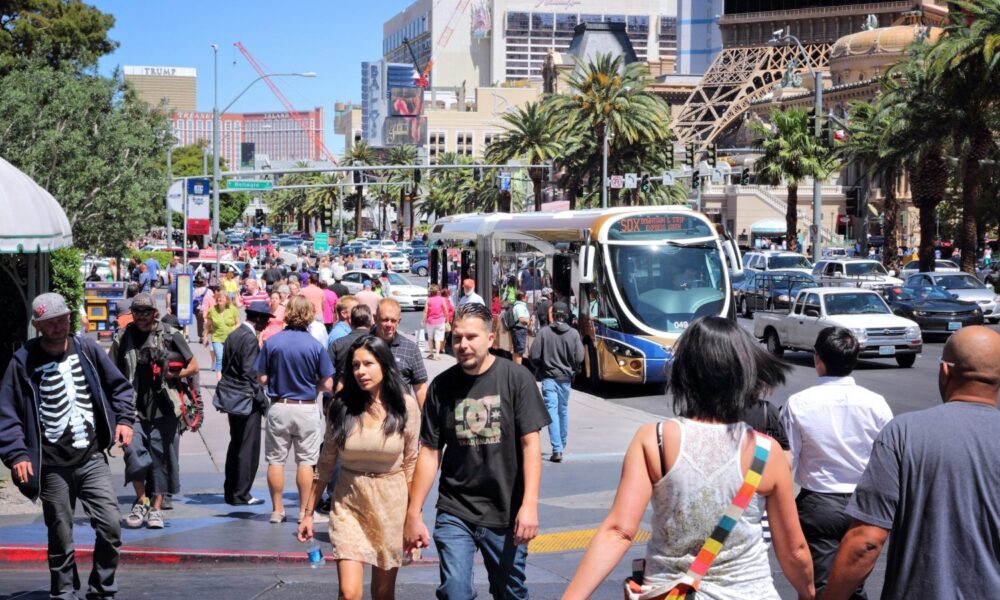

Las Vegas’ 2025 visitation, 38.5 million, is reminiscent of what the city saw in the first decade of the 2000s, but tourism officials are hoping to build off that in 2026. With a strong CES to start the year and reports from tourism officials and casino executives that they expect 2026 to be the best year in history for convention business in Las Vegas, there’s optimism for a rebound.
The 38.5 million visitors were a 7.5% decrease from the 41.6 million in 2024, the high point following the recovery from the pandemic. Las Vegas had 42.5 million visitors in 2019 before the pandemic. That number fell to 19 million in 2020 before going back up to 32.2 million in 2021, 38.8 million in 2022, and 40.8 million in 2023.
Annual hotel occupancy averaged 80.3%, down 3.3 percentage points year over year. Average daily room rate averaged $183.52, down 5.0%, while revenue per room reached $147.30, down 8.8%. Despite year-over-year declines, ADR and RevPAR were both the third highest on record.
Tourism officials point at consumer confidence and the economy as the key reasons for the decline, along with a drop off in tourists from Canada for political reasons. The industry, however, admits that higher prices in the tourism corridor may have contributed to some people turning away from Las Vegas.
Promotions to attract tourists to the city appear to have helped a rebound in visitation in October and November, whose year-over-year decreases were in the 4% to 5% range, before inching back up to 9.2% in December.
The Las Vegas Convention and Visitors Authority put out a release since the numbers came out, saying 2025 reflected “a year shaped by shifting travel dynamics, economic uncertainty, and evolving policy conditions.”
While leisure and international visitation faced headwinds during the year, convention activity remained a stabilizing force. Las Vegas hosted six million convention attendees in 2025, nearly matching 2024 levels, the LVCVA said. “Viewed within a broader historical context, 2025 represented one of the more complex operating environments the destination has navigated outside of the pandemic period.”
Las Vegas continued to fill more hotel rooms on average than any other U.S. city on any given night. With approximately 150,300 hotel rooms, Las Vegas maintains the largest hotel inventory in the U.S. and second in the world. Las Vegas’ 80.3% occupancy compares to a U.S. hotel occupancy average of 62.3%, according to the LVCVA.
Throughout 2025, travel decisions reflected more cautious consumer sentiment, particularly among value-oriented travelers, alongside ongoing international travel considerations, said LVCVA President and CEO Steve Hill. These dynamics shaped visitation patterns and required continued flexibility across the destination, he added.
“Las Vegas operates at a scale that few destinations can match and 2025 required us to remain nimble as conditions evolved,” Hill said. “Despite a challenging environment, convention demand remained steady, the events calendar remained strong, and the destination continued to adapt in real time.”
The outlook for 2026 is supported by a robust convention, events, and entertainment calendar. The Las Vegas Convention Center is on pace to host approximately 1.2 million tradeshow attendees in 2026, up from one million in 2025, including the return of CONEXPO and several new and expanding shows, Hill said.
Las Vegas will also host major global events throughout the year, including WrestleMania 42, the Las Vegas Grand Prix, UFC International Fight Week, and the National Finals Rodeo, alongside increased international travel tied to the 2026 World Cup and America’s 250th anniversary.
“Las Vegas remains a category of one,” Hill said. “Our focus will continue to be providing value to our visitors and delivering experiences that elevate our place as the leading leisure and business destination.”
The LCVCA touted Las Vegas’ 2025 calendar as reflecting sustained year-round, high-profile activity across sports, entertainment, and major live events.
WrestleMania 41, held in April at Allegiant Stadium, set new company records, generating the largest gate in WWE history and drawing 124,693 fans across two nights. Building on that success, WWE announced WrestleMania 42 will return to Las Vegas in April 2026.

UFC International Fight Week returned to Las Vegas in June, spanning multiple days of fights, fan activations, and events, and attracting tens of thousands of attendees, reinforcing the city’s role as the global home of mixed martial arts.
The A’s Ballpark broke ground in June, marking a major milestone in Las Vegas’ evolution as a professional sports destination. The 33,000-seat ballpark is slated for completion in time for the 2028 MLB season.
The Wizard of Oz at Sphere debuted in August and has surpassed two million tickets sold and generated more than $260 million in ticket sales.
The Las Vegas Grand Prix delivered a global sports and entertainment moment in November, combining Formula 1 racing with high-profile cultural and entertainment elements, including appearances by Beyoncé and Jay-Z, and reaching a worldwide audience of millions across broadcast, digital, and social platforms.
The Wrangler National Finals Rodeo capped its 40th anniversary in Las Vegas in December with its highest total attendance since 2014, drawing 175,846 fans across 10 performances at the Thomas & Mack Center.

