


The land-based casino industry has fallen behind when it comes to using artificial intelligence, but the potential is there to transform gaming and the guest experience.
“The State of AI in Gaming” was a featured presentation Wednesday in collaboration with G2E at the International Conference on Gambling & Risk Taking.
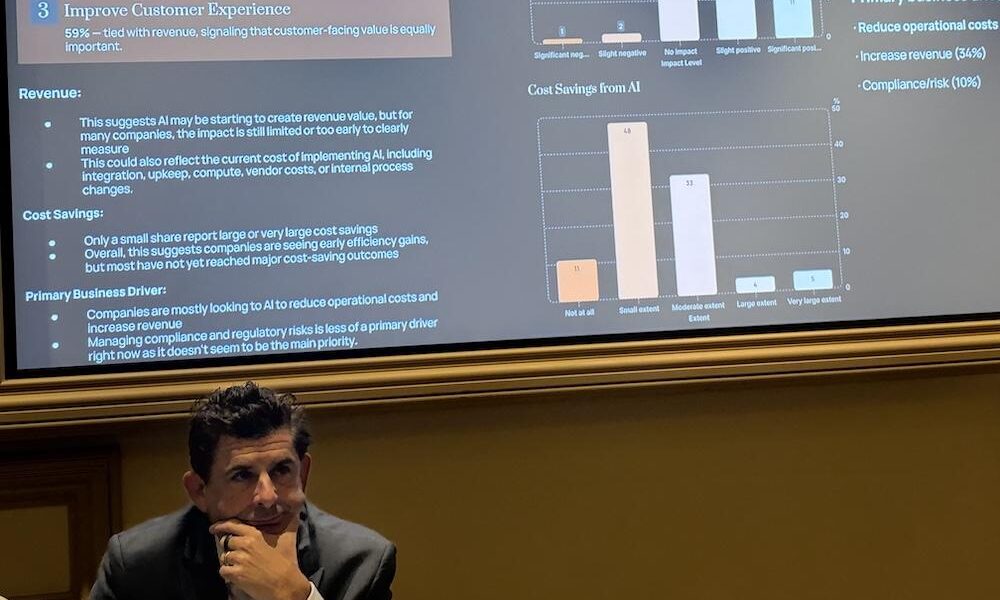
The session built off a report released in April by the UNLV International Gaming Institute in conjunction with KPMG. Their “State of AI in Gaming 2026” drew on a survey of 83 gambling companies.
“One of the things we found in the report is that it seems very clear — and you may have this anecdotally as well — that online operators and suppliers are ahead of the game in terms of adopting AI compared to the land-based operators,” said Rick Arpin, U.S. gaming leader and Las Vegas managing partner for KPMG, who moderated the panel.
The speakers included Melissa Swinehart, a UNLV International Gaming Institute graduate research assistant; Lori Kobashigawa, senior vice president of marketing and innovation for Fontainebleau Las Vegas; Patrick Miller, hospitality and casino executive; and C.J. Foster, chief information officer for Station Casinos.
Foster said the reasons for land-based casinos falling behind are people, process, and technology. So many different systems operate in the casino that it’s difficult to compile all of that data. It’s also difficult to find technology to build on, because it keeps changing, he said.
“From a process perspective, because we’re a regulated body, it’s hard to make changes to our environment,” Foster said. “From a people perspective, it’s difficult to get them enough skills to utilize those tools.”
Arpin found in the report that there’s more of a focus on back-of-house and the technology elements versus using it for regulatory compliance and customer experiences. It’s more inward-facing.
“In our case, we’re an independent hotel in our third year of operation at Fontainebleau,” Kobashigawa said. “It’s a little bit of everything. Yes, to back-of-house conversations tend to be most prevalent. We don’t have a lot of decades-old information. It enables us to have a real-time conversation of what systems to layer in and what rules to consider. We’re also leaning in on the front-of-the-house conversation.”

While there’s a lot of optimism about the use of AI, there’s pessimism that it’s going to cost jobs, Arpin said. He asked Miller if the casino industry can take advantage of AI and be optimistic about it.
“It’s bullish to be optimistic about something that’s transforming all industries and what we do,” Miller said. “Integrated resorts are all these businesses — a legal department, food and beverage company, hotel company, and people company. Those elements are advancing across all of those industries, so there’s definite optimism. There’s a caution to make sure we’re doing it the right way. To bring a lot of things online at the same time, the most difficult part is to bring the people online and bring them up to speed on doing it the right way. In this industry, we think about new things to do. I truly believe we can redo guest services in Las Vegas at a different level.”
Arpin talked about the industry thinking about how AI can change how it does business and how customers experience the casino. Customers, meanwhile, are using AI to book rooms, build an itinerary, and do many other tasks. He asked how that changes how the industry should be thinking about AI?
“That’s what operators have to really focus on,” Miller said. “There’s a focus on the shiny object, saving a bunch of money or doing things faster and better. But at the end of the day, how are the guests using it and interacting with the experience from an AI perspective? The consumer will figure it out sometimes before we do. We have to be attuned with how they’re using it and approaching our products. I don’t know if we’re going to be ahead of them at the pace we’re at. Consumers are moving way faster than we are.”
Foster is most excited about the use of AI for database marketing to segment customers in different ways. That allows for one-on-one personal marketing to interact with guests.
“We’re a hospitality company, and we’re not going to change that,” Foster said. “Agentic AI is starting to take away tasks from people, so they can focus on value-added tasks. It’s about replacing humans, but allowing them to work on tasks that add value.”

Kobashigawa said the industry is about catering to guests and ensuring they have a great experience, and part of that is understanding who guests are and how to welcome them for the first time. Hyper personalization is important.
“We’re trying to understand how to get ready for this next wave by enabling team members to do their jobs and get to better know the guests,” Kobashigawa said. “We tend to draw a lot of the luxury segment, where repeat visitation and understanding how their visits go from start to finish (are vital).”
Arpin said an important aspect of AI that doesn’t get attention is regulatory compliance, which he indicated has a “ton of potential benefit. We don’t think regulators shouldn’t be worried about blocking or inhibiting AI usage, but they should be frankly using it themselves.”
