
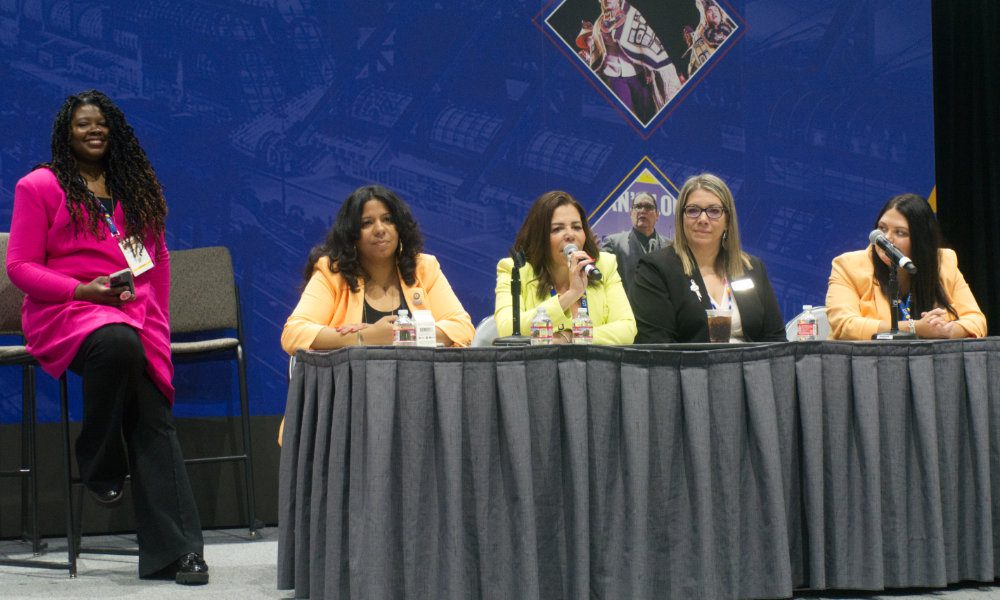

During Wednesday’s session “Global Gaming Women: When Capitalism Meets Culture” at the Indian Gaming Association Tradeshow & Convention in San Diego, panelists offered positive examples of how tribal women can advance their careers.
At the same time, it’s can be important to realize what not to do.
Erica Kosemund was 20 years old and working as a promotions manager and coordinator for a tribal casino in Oklahoma when she was offered a job as a sales rep for Kraft Cheese. When she told the casino’s general manager of her intention to leave, he replied, ‘No, you’re not,’ then convinced Kosemund to stay.
“You think about stories in your life and what could have been and what is,” said Kosemund, Choctaw Nation of Oklahoma Senior Director Gaming & Partnerships. “And Kraft Cheese did that.”
Moderater and Wondr Nation President and CEO Anika Howard noted that organizations with women on their boards and with greater gender diversity outperform similar companies.
“Despite overwhelming statistical proof, women are still under-represented and under-compensated in leadership positions,” Howard said. “The reality is, we need more women in leadership. And it’s not just good for women. It’s good for business.”
The panel showcased four women who launched careers that at times seemed improbable. IGT Vice President of Field Services, Call Centers, and Technology Operations Shondra DeLoach-Perea started her career with the Sandia Tribal Gaming Commission in New Mexico.
It was important to embed herself in tribal culture, DeLoach-Perea said,” to understand who I worked for and what I could bring to the table. And through that partnership, through perseverance and trying to understand working for, at the time, a thriving casino, what I learned was so many people came to work outside of the community itself, non-Natives, not understanding the culture or the importance of family, community, social economics. I took every opportunity to get to know them.”
Kelly Myers, Gaming Laboratories International manager of client solutions, previously worked for tribal gaming commissions and regulators. She didn’t foresee leaving the regulatory side of tribal gaming, but GLI provided a new challenge that also meshed with her heritage as a member of the Iowa Tribe.
“If you want to be a CEO of a company, if you want to run a casino, that’s great,” Myers said. “But there are also people who have a different path, a different drive. Find your fit. Where do you fit in? Where does your heart follow? Follow that instead.”
For Angelina Casanova, board chair for Command Holdings and a member of the Mashantucket Pequot Tribal Nation, success isn’t just a matter of a profitable bottom line. Working for Command Holdings, owned by the Pequots, allows her to make decisions that transcend financial considerations.
“That allows us to take into consideration the things that are important to us as a tribal community,” Casanova said. “Traditional values and all those things that influence encompasses, thinking about community, training leaders, and not just thinking about profits. Because there are times when you’ll have to prioritize what’s best for the community. And that might cost the company a little more, but it’s what’s best for the community.
“So for Command Holdings, that’s kind of written into our DNA as a corporation, to consider what’s best for the community.”

