
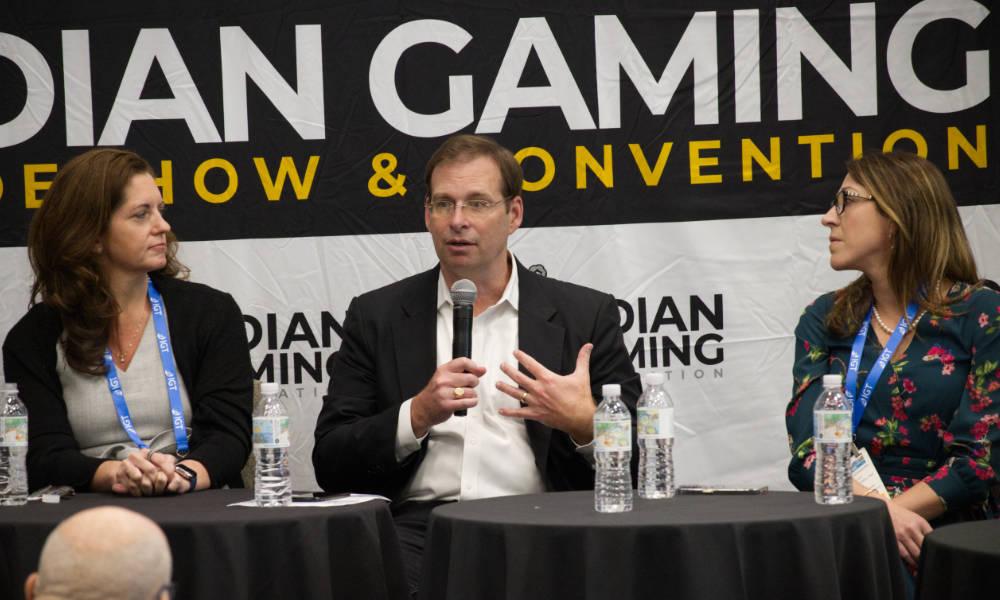

Native American casino operators were reminded at the IGA Tradeshow Tuesday of the importance of responsible-gaming practices, especially in the emerging digital age.
Keith Whyte, executive director of the National Council on Problem Gaming, said, “All too often in public perception, the responsibility is either 100% on the operators side or 100% on the individual side, or it’s the regulator’s fault or problem.” Instead, he cautioned, “It’s a shared responsibility among everyone to minimize gambling-related harm.”
Jamie Shea, chief marketing officer for Strive Gaming, talked about online sports betting, the current hot button in responsible-gaming debates. She said that the digital world actually has better tools to define and identify problem-gaming issues compared to standard casino gaming. “In casinos, you have anonymous players you don’t know unless they bet over certain amounts. You can’t go up to somebody and be like, ‘Dude, I think you might have a problem.’” But you can do exactly that with online-gaming products, since you have so much data. She said, “There’re warehouses of data on everything that people are playing.”

Nicole Scott, director of communications for the International Center for Responsible Gaming , talked about research at the ICRG. Currently, 27 different research projects are underway, “the most we’ve ever had at one time.” She said that sports betting is an area of particular focus.
She also noted that some of the projects produce results that may be obvious, but they still need to be validated. “People who overbet on sports also overconsume alcohol.” She joked, “I know that everybody here is utterly shocked by this revelation, but what’s important about this is now we have data, rather than just anecdotally saying, ‘Hey, people who drink also gamble too much.”
Brianne Doura-Schawohl, a consultant on responsible gaming, said, “The federal government doesn’t address gambling addiction, like it does other addictions.” She also bemoaned the lack of cooperation among agencies. “Sometimes I working with Congress, or state legislators, then I go to the Department of Health, and everybody’s working against one another. We need to be collaborating and learning from one another.”
Most of the panel, moderated by Raquel Buari, executive vice president of administration at Four Winds Casinos, supported the GRIT Act currently under consideration in Congress. Short for Gambling Research, Investment and Treatment, the bill would set aside half of the federal sports excise-tax revenue to fund responsible-gaming issues.
Whyte said, “If passed, the act would be the first-ever federal funding that would go specifically to responsible gaming.” He added there’s strong opposition to this bill, but was hopeful it would pass and urged tribes to support the measure.
As far as research, he mentioned veterans, who have higher rates of problem gambling than others, and that Native Americans have one of the highest percentage among veterans. He said, “This area of research is important, because Indian veterans fall into a crack. No problem-gaming treatments have been validated for Native American culture.”
Doura-Schawohl talked about not only treating problem gaming, but how to get ahead of the issue. “Many say that the problem rests with the gambler. But as operators, we need to know how to prevent the problem.”
Everyone agreed on one point. “All those who profit from gaming have a responsibility to deal with the problems.”

