
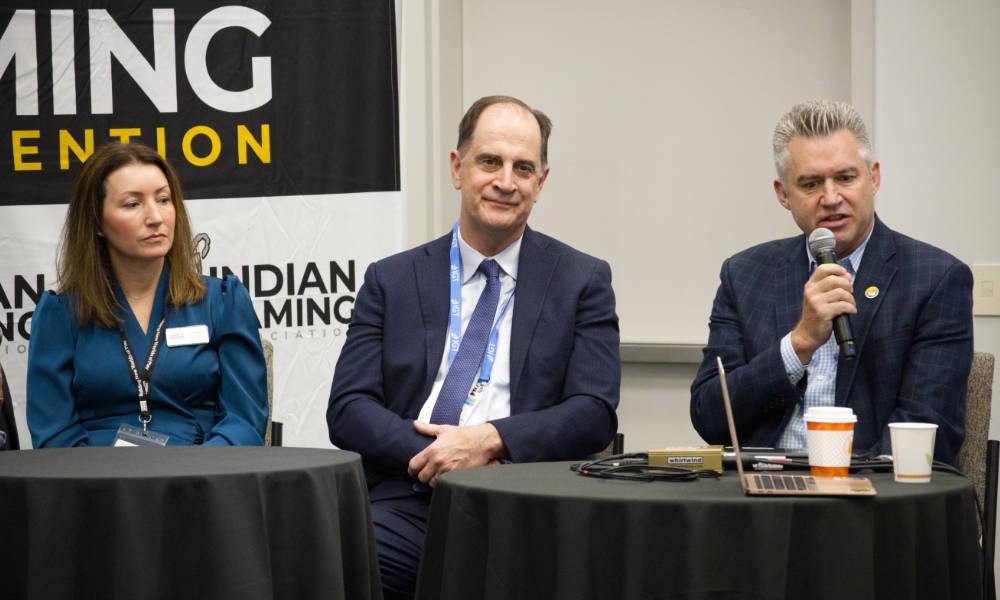

There was total agreement on this prestigious panel that casino gaming needs to constantly evolve to ensure that the industry remains relevant to current players and those who may soon join them.
Ken Bossingham, senior vice president of sales at IGT, said, “The industry has historically been slow to innovate. And changing demographics will present a huge challenge to the industry in the next one to three years. We’ve got to continue to figure out how to get closer to existing players and then, as players evolve, we need to learn the kinds of playing attributes that the new generations are going to demand.”
Siobhan Lane, CEO of Gaming at Light & Wonder, added, “Artificial intelligence is the obvious change coming. At L&W, we concentrate on how to leverage that technology, especially operationally on the system side. AI can be used here and now to track player’s sessions. It allows us to predict future play and the live cycle of each play session.” That can be used, she said, to both enhance the experience and help mitigate any responsible gaming issues.
“Technology is not the main problem,” according to Harold Newmann, CEO of Ainsworth, “it’s that we’re spoiled by content. We’re expecting the same from our casino experience as we do from other forms of media. Some of the newer games are very exciting; they even have trailers like movies and TV to promote them. With the older machines, there’s no movement and they’re just stuck.” He said, “Content becomes more and more important, especially with the younger generation.”
Keeping up with trends in both content and player behavior is now a priority. James Starr, president of VGT-Aristocrat, noted, “We have insight teams that closely follow social media.” The other panelists agreed when he said, “Online free-play games give us great feedback. Almost always, what works well online can translate to a good game on the casino floor.”
Lane added, “There is strong crossover from different media. We partner with industry influencers and they’ve provided a huge marketing channel. They also provide a great platform for players to be able to easily learn and experience the game before they even step into a casino environment.”
Bossingham said that initially, land-based operators were really concerned that online gaming was going to cannibalize their revenues. “I think we’ve now learned that online in the U.S. is actually doing the opposite and growing profits. We can gain a lot of learning from online versus land-based, because it is so timely. It helps us understand how we can deliver the best possible player experience.”
Neumann, who has a background with Novomatic in Austria, felt the industry here could get more involved with biometrics and blockchain. “Players in Europe can go cashless with just a thumbprint, eliminating cash, tickets, and other player friction.” He also was enthusiastic about blockchain’s ability to deliver omnichannel experiences, where a game can be played in any physical format, from a casino slot machine to a PC, tablet, or cellphone.
Margaret Ellis, a Millennial member of the Oneida Wisconsin tribe, moderated the panel and noted, “Time is a big thing with my generation and we’re online with everything. I’m working from home and on my computer all the time.” She welcomed the ideea that the blockchain could allow her to play on different platforms and that it opens the future to playing socially together with friends, “who like to go in and go out in and enjoy each other socially on our limited timetables.”
Lane summarized the optimism of the tech future, saying, “We can tap into technology and cultivate the right experiences to embrace these complementary channels that will converge across digital and land-based. Then we can drive a lot of value creation within the industry and for the tribes, so that everyone is a real winner.”

