

Calling it a risk to everything tribal nations have built from casino gaming, the Indian Gaming Association kicked off its annual conference Monday going full-throttle against sports betting prediction markets. They also announced plans to raise several million dollars to file a lawsuit against the Commodity Futures Trading Commission, the federal agency that authorized it.
IGA held a four-hour workshop in which tribal leaders and lawyers outlined the impact of prediction markets led by Kalshi, Polymarket, DraftKings, FanDuel, and others encroaching on their territories and taking revenue away from tribes.
Only a couple of minutes into the discussion on Monday, the tone was set by Conference Chair Victor Rocha, who spoke to an room full of tribal leaders from across the country at the San Diego Convention Center.
“I know we will win this in the end,” Rocha said. “We’re fighting with Wall Street and the tech industry, all of these people who want to disrupt society. They don’t care about America. They don’t care about your future. They don’t care about your children or your schools. It’s all up for disruption. Everything we fought for in the last 30 years could be gone in a snap.”
Rocha said prediction markets want to “Uberize America,” essentially do what Uber did to the cab industry.
“They don’t care about what tribal and commercial gaming have done. They don’t care about the jobs it has created. This enemy is only looking at the money, only looking at the profit. They don’t consider you a partner or equal. I know those are harsh and strident words, but it’s true. I use those words to let you know what we’re up against and what kind of fight we have ahead of us.”
Tribal leaders said a clear strategy has emerged throughout the workshops: a coordinated approach combining education, coalition-building, litigation, and federal legislative advocacy.
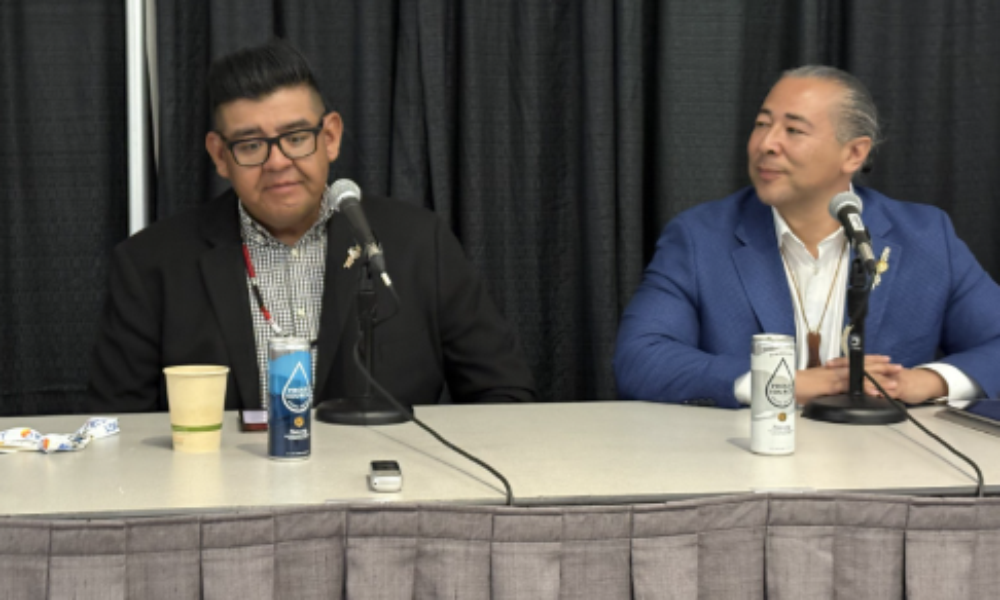
IGA Chairman David Bean in the final session outlined the growing threat of prediction markets, the fight ahead, and the strategy to defeat the operators. In recent months, Bean said he has traveled to 16 tribal nations across the country, educating them about what they are facing.
“The (gaming) industry has grown under strong regulation and here we are faced with this illegal online sports betting market through the prediction market platform,” Bean said. “This is a threat to the gaming industry and tribal and state sovereignty.”
Bean said they are pursuing a parallel path of litigation and legislation, with Congress having introduced bipartisan bills that would prohibit sports betting and casino games on prediction market platforms.
“We’re excited about having representatives and senators onboard, but at the same time we are preparing to file a lawsuit against the CTFC. We have been gearing up for this moment.”
The lawsuit will allege the CTFC isn’t enforcing its own regulations prohibiting sports betting.
After the workshop, Bean said IGA pushed for funding from tribes during the workshop, and that will continue through the conference and beyond. “Initially, we believe it will cost between $3 million to $5 million and maybe beyond that. That will get us started.”
IGA’s Board of Directors Monday night adopted a formal resolution opposing the efforts to regulate event contracts, including sports-related prediction markets. The Board said the resolution underscores IGA’s position that these activities constitute gambling and fall exclusively under the jurisdiction of tribal and state governments.
“Today, our Board took decisive action to protect what generations before us fought to build,” Bean said in a statement after the meeting. “These so-called prediction markets are an attempt to bypass tribal authority and recast gambling as a financial product. We will not allow that. We will stand united to defend tribal sovereignty and the integrity of Indian gaming.”
The resolution calls on Congress to clarify that sports contracts are gambling activities regulated by tribes and states and urges tribal governments nationwide to submit formal comments opposing the CFTC’s proposed rulemaking ahead of the April 30 deadline.
“This is federal overreach, plain and simple,” Bean said. “When outside entities attempt to operate gambling under a different name without respect for our laws, our compacts, or our sovereignty, we have a responsibility to act. And that is exactly what this Board has done.”
James Siva, chair of the California Nations Indian Gaming Association who sat on the final panel with Bean, said afterward there will be no problem raising the legal fund from tribes.
“A lot of tribal leaders are walking out of here with their eyes wide open,” Siva said. “We’re going to see a lot of support. We might get close to (the initial goal) before the end of the convention.”
States and some tribes are already locked into legal battles in state and federal courts against prediction market operators. Arizona has filed criminal charges against Kalshi while Nevada has won in state court to stop Kalshi and others from offering sports betting and other wager in the state at this time.
Tribal leaders said the legislation fight will be difficult. Many representatives know little about it or don’t want to take on the Trump Administration, with Donald Trump Jr. working on behalf of the industry. Bean said he talked to a member of Congress who said it was like “making a choice between friends.”
“We pushed back on that,” Bean said. “This is not a choice between friends. It’s a choice between following and ignoring the law.”
Siva said the prediction markets went from yes or no bets to combined contracts, essentially parlay bets. He assumes they’re working blackjack, baccarat, and slot machines.
“If they can make the math work, it’s in the very name itself,” Siva said. “The Arabic word kalshi literally means ‘everything.’ That has always been the goal from the onset – to offer gaming on everything.”
Throughout the day, speakers on the panels emphasized that the issue extends far beyond gaming, touching on consumer protection, regulatory authority, and the preservation of tribal and state sovereignty. Bean closed out the day’s programming with a call to action, reinforcing the urgency of the moment and the need for unified advocacy.
“It makes sense for us to build a coalition of partners who share common interests in protecting lawful markets and regulatory authority,” Bean said. “We cannot do this alone, because this affects more than just tribes.”
IGA has the right partners: the American Gaming Association, leaders in Republican states, and organizations that haven’t always been their friends when it comes to tribal gaming, Siva said.

“We will not lose this fight. I know there’s a bit of pessimism in this room, but it is not this issue and not this day. It is not this issue and not this day,” Siva said in repeating himself to applause in the room.

