

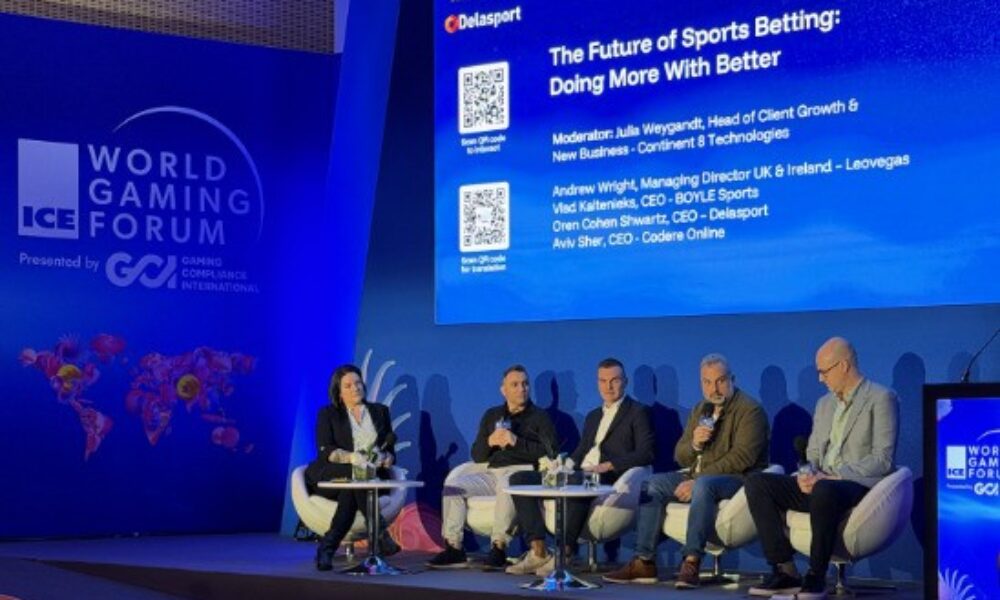

Inside the Sport Leaders Conference at ICE Barcelona, the conversation around sports betting was less about what comes next and more about what no longer works.
The panel, “The Future of Sports Betting: Doing More With Better,” brought together Andrew Wright, Managing Director UK & Ireland at LeoVegas; Julia Weygandt, Head of Client Growth & New Business at Continent 8 Technologies; Oren Cohen Shwartz, CEO of Delasport; and Vlad Kaltenieks, CEO of BoyleSports.
Together, they examined how operators are navigating slower growth, tighter regulation, and rising expectations from bettors.

While innovation and technology featured prominently, the discussion remained grounded in operational reality. Panelists noted that most sportsbooks are now offering largely the same content. Live events, markets, and odds have become standardized across platforms, leaving limited room to compete on inventory alone. Several speakers emphasized that higher payouts or marginal pricing advantages are no longer sufficient to drive sustained growth.
Major international sporting events, including the World Cup, were cited as flashpoints for both opportunity and risk. While these tournaments continue to attract both new and casual bettors, panelists agreed that legacy acquisition strategies are increasingly ineffective at retaining those audiences. The focus, they said, must shift toward what happens after the initial bet is placed.
Personalization emerged as a central theme. Speakers discussed that bettors now expect platforms to respond dynamically to their behavior, preferences, and timing, particularly as sports consumption becomes more fragmented. Static journeys and one-size-fits-all promotions were described as misaligned with how fans engage with sports across devices and channels.
Artificial intelligence was framed as an enabler, rather than a silver bullet. Panelists pointed to AI’s growing role in personalization, UX and UI optimization, and integrity monitoring, including identifying irregular betting patterns. At the same time, they acknowledged that innovation in regulated markets often moves more slowly than in unregulated environments.
Regulation itself was a recurring point of discussion. Speakers warned that excessive friction risks pushes players toward the black market, where protections are weaker and oversight is limited. The panel emphasized the need for ongoing engagement among operators, suppliers, and regulators to ensure that consumer protection measures don’t undermine the regulated market’s competitiveness.
Partnerships among sportsbooks, sports teams, and media organizations were also addressed. While sponsorships and integrations remain an important part of brand strategy, panelists were candid about the difficulty of measuring direct returns. The consensus was that partnerships must be clearly defined in purpose, whether aimed at awareness, engagement, or long-term brand positioning.
From an operator perspective, Kaltenieks summarized the direction of the industry by pointing to “engagement and experiences” as the primary drivers of future differentiation, rather than volume-led expansion.
The session closed with a call for focus. Instead of chasing constant expansion, panelists encouraged operators to improve execution, sharpen product relevance, and invest in sustainable customer experiences. As discussed on stage, sports betting is entering a phase where doing fewer things better may matter more than doing more things faster.

