


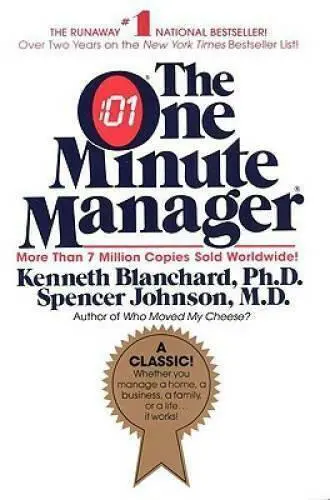
 The One Minute Manager
By Ken Blanchard & Spencer Johnson
107 pp., 1981, Harper Collins
Some lessons are worth taking again. Some books should be read again. And some practices never get old. So forgive my short preface to this review.
Thankfully, profits for non-tourist dependent casinos are reaching all-time highs as the pandemic recedes. The combination of pent-up demand and improved efficiencies forced upon us, has resulted in some good times. At least for those with casino stocks or ownership positions.
Yet, there are still some dark clouds hanging around for the rest of us. The biggest concerns are a lack of new employees and a fear of spending.
The recession of 2008 saw quite a bit of the latter. While the economy improved steadily and consistently after 2009, many operators delayed capital purchases far too long. In effect, they left “money on the table” to be claimed by those operators who continued to aggressively refresh their floors.
However, in ‘08/’09 there was never a lack of new job candidates. The layoffs then were more of an opportunity to “right-size,” rather than major force reduction. As things got better, not that many jobs returned. And for every job then, there were multiple candidates desperate to fill the openings.
Post-COVID fears, and the corporate appetite for short-term returns, will most-likely delay capital spending again. Hopefully, that doesn’t happen. But it probably will. A more serious problem may be staffing.
Ironically, despite record unemployment, many operators are finding it difficult to fill their open positions. Pundits are blaming high unemployment benefits, lingering pandemic fears and low wages. Some of those concerns may ease, but don’t count on wages being increased soon (see “Post-COVID fears” above).
The practical solution is to ensure that you don’t lose the team members you already have…and to keep them happy and productive. Exit surveys have consistently recorded that the primary reason anyone leaves a job is not low wages, but rather dissatisfaction with their supervisor and/or leadership. Positive word-of-mouth about a good work environment is also one of the best recruiting tools.
While it’s been around forever (I believe that 1981 was the start of ‘forever’), The One Minute Manager by Ken Blanchard and Spencer Johnson has been an invaluable resource to refresh—or jump start—your leadership skills. It was a best seller for decades and has spun off more sequels than the Fast and Furious movies. Two of them are The One Minute Mother and The One Minute Manager Meets The Monkey (really).
In 2015, the authors also updated the original book. Now called The New One Minute Manager, it is a bit more politically correct and includes some updated social norms. Both books are excellent, so why pass up a bargain? You can find the original for about $4 or less on eBay, while the new ones go for $19 in hardcover or $10+ for a new soft copy.
For that extra money, the authors did add one new ‘secret’ called the “re-direct” concept. It embodies a more cooperative management approach, rather than the original “take charge” style.

You’ll also see some modifications in the re-write aimed at gender equality and less emphasis on physical “touching” as a way to make conversations more meaningful. I clearly remember in the early (and confusing) 1990s attending a Blanchard seminar that stressed the value of touching while communicating. But about two months later there was another mandatory seminar that warned against even thinking about touching anyone, anywhere, anyplace. Times change.
However, most of the basic principles of the original book are still solid and worth your time. In reading reviews about this book, many said that these ideas are too simple, and that everyone today already knows all these basics. I strongly disagree. In my current role as a consultant, I find the majority of clients would benefit greatly by learning and applying these techniques on a consistent basis (except maybe the touching part).
Blanchard and Johnson also pioneered the “small” management book format, using storytelling as the delivery vehicle. While it is 107 pages, they’re small pages. It’s a quick read that you can knock off in a relaxing evening.

Some critics argue that we probably all know (or should know) these principles. While that may be true, I feel it is also extremely important to elevate them every once in a while to “top of mind.”
Done in the same ‘small’ style, I’d also recommend Blanchard’s Gung Ho and Johnson’s classic Who Moved My Cheese? Both those, and the two versions reviewed above, are short reads with long-lasting impacts.
If you haven’t absorbed “One Minute,” you should do so as soon as you can. If it’s been a year or three, a re-read is overdue.
