

Mindway AI’s unique software tool to provide early detection of problem-gambling behavior and encourage operator intervention is available for land-based casinos around the world.
The Danish company’s GameScanner software already is licensed in 64 jurisdictions globally and reviews actions of almost 15 million online gamblers a month. The biggest land-based installation, announced in September, is at Crown Resorts’ three Australian casinos.
“It’s like having a virtual psychologist looking at your player data 24/7 and pulling out the needles in the haystack,” said Paula Murphy, Mindway’s head of business development.
Mindway, founded in 2018, is the brainchild of Kim Mouridsen, a neuroscience professor at Aarhus University in Denmark. Murphy said Mouridsen originally was using machine-learning technology to develop an early-warning system for people at risk of stroke. His idea was to have a team of medical specialists pinpoint patterns within brain scans of previous stroke patients so he could devise an algorithm to recognize those patterns within brain scans of people potentially susceptible to one.
Aarhus also has a Research Clinic on Gambling Disorders, which was looking for ways to identify people at risk of compulsive gambling before they suffered severe harm. Mouridsen explained his medical diagnosis project to the Research Clinic and suggested adapting it to gambling by substituting psychologists for the medical specialists and using player data in place of brain scans, she said.
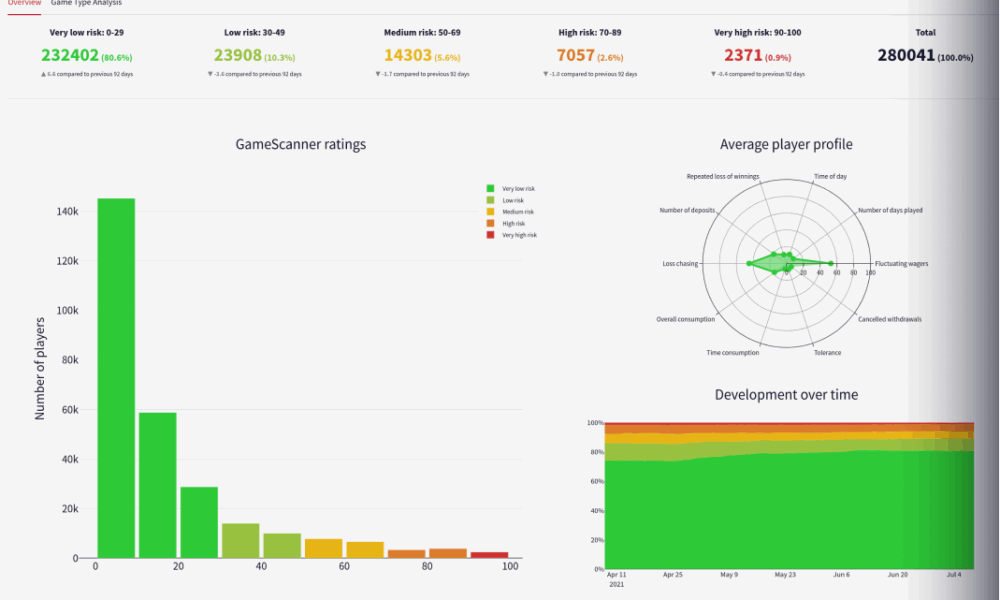
Based on findings from several research and clinical psychologists with expertise in gambling behavior, GameScanner recognizes normal play as well as signs of addictive behavior. Using an operator’s data on carded play, the software analyzes each individual’s risk based on a variety of factors including playing frequency, loss-chasing, impulsive transactions, and the length and time of gambling sessions. It then assigns each player to one of five risk categories, from “very low” to “very high.”
“We don’t just tell operators the overall risk level, but we tell them why the AI has assessed that risk level,” Murphy said. For example, a player who frequently gambles in lengthy sessions running into the “antisocial” early-morning hours differs from one who consistently overspends their bankroll. The first demonstrates an inability to stop and needs help with time limits, while the other needs help with spending limits.
“It’s all about helping the player manage their individualized behavior,” Murphy said.
GameScanner can alert operators when a player exhibits risky behavior, allowing a staffer to check in with them. “The whole idea is to catch it early and have a dialogue with your players,” she said. “Point to strategies that can help them manage their session time or their deposits, whatever is the issue for that player. You’ll see their risk score decreasing because you’ll see them controlling their own gambling behavior.”
She said the vast majority of players fall into the two lowest risk levels, with about 10 percent in the “high” or “very high” category; the percentages are similar for online and land-based gambling. Players younger than 25 tend to be at a higher risk for problem-gaming behavior, primarily because their prefrontal cortex, the part of the brain governing decision-making and impulse control, is typically not fully developed, she added.
Mindway also developed Gamalyze, a gamified version of a neuroscience test that lets users assess their own risk tolerance in gambling. Murphy said many operators and treatment organizations provide it on their websites or apps. A new version that uses a sports-betting format is in the works.
Helping players recognize behavior linked to compulsive gambling can have long-term benefits for them and for operators. Murphy said players who take the message to heart can continue their preferred pastime safely. From an operator viewpoint, keeping that player as a long-term customer, rather than losing them to burnout, increases net revenue. She said online operators using GameScanner have reported that self-exclusions have dropped to “almost zero” because of the successful interventions.
“We’re about player protection, not player prevention,” Murphy said. “We don’t want to prevent anybody from enjoying their leisure activity. We just want to protect the people having issues with it.”

