
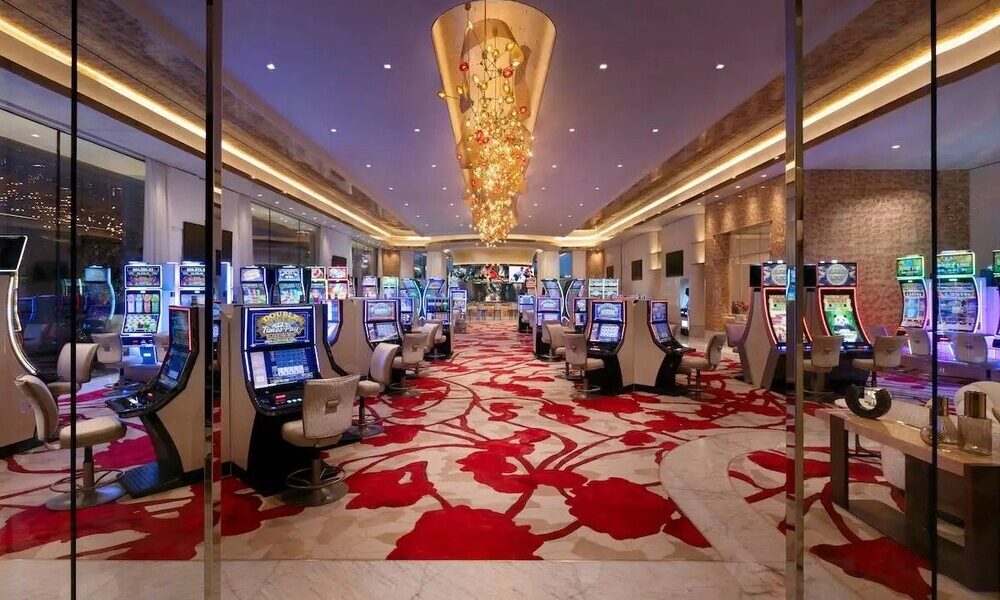

The Durango Casino & Resort in southwest Las Vegas unveiled a $120 million expansion this week and is preparing to spend $385 million more starting on Jan. 4.
Red Rock Resorts is coming off its highest third-quarter net revenue and adjusted EBITDA in company history, while maintaining a near-record adjusted EBITDA margin. It was the fifth consecutive quarter of record adjusted EBITDA and executives point to Durango as contributing to those numbers by attracting new guests and driving incremental play from existing customers.
The newest expansion was unveiled Monday night during ceremonies showing off the addition of 25,000 square feet of casino space, including an 8,000-square-foot high-limit slot room with 120 machines and bar, and a new parking garage with about 1,800 spaces. Altogether, some 250 slot machines were added, bringing the total to 2,200.
The next phase will add 275,000 square feet to house about 400 new slot machines and increase amenities, including a 36-lane bowling facility, movie theater, restaurants, and entertainment venues. Once construction starts in early January, it will take about 18 months to complete.
Red Rock executives are touting the next expansion as helping Durango capture additional market share, especially as more than 6,000 homes are expected to be built within a three-mile radius in the coming years. The southwest valley had been undeserved, with residents having to drive seven to eight miles to reach the nearest casinos.
Truist Securities analyst Barry Jonas hosted meetings this week with Red Rock Resort CFO Stephen Cootey and wrote in a note to investors that the Las Vegas locals market remains among the best in gaming and that the fourth quarter is holding steady for Red Rock. He rated Red Rock Resorts stock as a Buy, based on “best-in-class” assets across the locals market.
“The larger $385 million 2.0 expansion should drive growth further,” Jonas said. “The 2.0 shouldn’t delay any other pipeline projects, with further details potentially revealed around the fourth quarter of 2026. Construction continues across Green Valley Resort and Sunset Station renovations (in Henderson) and while there will be some disruption in the first half of 2026, management continues to target net ROI of 20%.”
Jonas highlighted management’s view of the locals market as “fundamentally different and well protected” from the current softness on the Las Vegas Strip. Red Rock noted that 70% to 80% of its revenue is from gaming compared to about 70% of non-gaming revenues for Strip operators. Additionally, Red Rock Resorts is less reliant on tourism; 50% of customers come to their properties about four times a month.
As for the Durango, Jonas said while management expects a 20% ROI, it could be a slower ramp. They hope to capture more incremental gaming spend, as a large portion of guests are already in the door.

“Ultimately, management is unsure what the disruption impact will be, but is hopeful it will be minimal,” Jonas said. “In the meantime, given the 18-month time frame, customers should be able to adapt their habits and adjust accordingly.”
Other Red Rock projects remain in the planning stages, including adding rooms at the Durango as part of a third expansion. Jonas said the Durango expansion isn’t expected to slow other growth projects.
At the Durango opening Monday night, Dave Horn, vice president and general manager of the property, gave brief remarks before cutting the ribbon to open the high-limit salon.
Horn told CDC Gaming that when the property first opened, they thought the high-limit room was underwhelming as the rest of the property. The new concept was to elevate what they offer at Red Rock Resort in Summerlin and at Green Valley Ranch and Santa Fe Station.
“We wanted to put it on a pedestal as one of the best high-limit rooms in the city and I think we’ve done that,” Horn said. “It’s an amenity level of what our guests are looking for, whether local or out of town, and that’s what we achieved.”
Horn said it’s nerve wracking to go from one expansion to the next, but added he’s used to it by now. Their team is great at functioning with construction; the expectation is for a July 2027 opening.
“That’s going to help, because we now have a whole package we can advertise from a guest experience,” Horn said of the next phase.”
Jonas said management noted that its Red Rock casino is on track in its recovery from Durango cannibalization. Following the opening of Durango, management expected Red Rock to “bear the brunt” of the impact, with a three-year expected time frame to backfill.
Management continues to expect an $8 million construction disruption impact from Green Valley Resort and $1 million to $1.5 million at Sunset Station in the fourth quarter. Looking to 2026, management expects a similar impact of about $9 million in both the first and second quarters, Jonas said. “Management sees 2028 as the first full year clean from any disruptions, as well as a full-year benefit from Durango North, which is scheduled to be completed mid-2027.”
Red Rock executives remain excited about the benefits from the “One Big Beautiful Bill” passed last summer by Congress, thanks to its tax benefits from accelerated depreciation. Red Rock won’t be a taxpayer in 2025, with additional relief in 2026, Jonas said.
“Management also expects revenue benefits from increased tax refunds/benefits, as consumers historically have used extra stimulus for leisure and gaming offerings,” Jonas said. “For example, the $6,000 tax credit on senior citizens could be meaningful, as there are about 300,000-plus seniors in the Las Vegas area.”
In Red Rock’s new tavern business, Jonas said the two recently opened taverns are progressing well, with plans to roll out five taverns in 2026. Management views the tavern business as a customer-acquisition tool as well.
Jonas said Red Rock Resorts didn’t take a serious look at the Golden Entertainment sale, as the company feels more comfortable as developers than acquirers.
In another item, Red Rock could look to sell excess land at its Cactus Avenue and Las Vegas Boulevard South site where it plans a resort. Jonas said not all of the land is needed for a potential project, in addition to a parcel driving about $4 million to $5 million of EBITDA from rent.

