

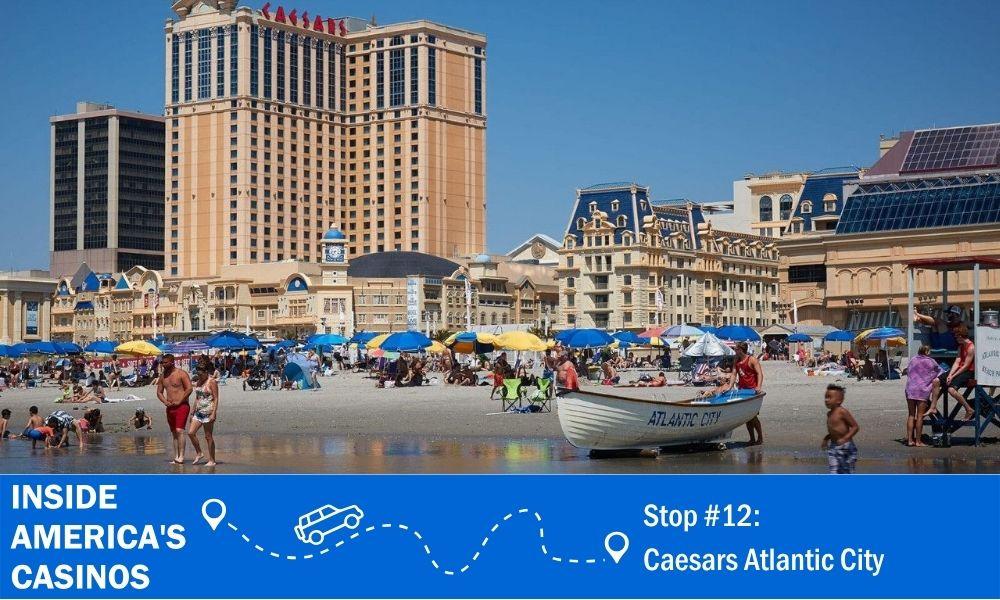

Join CDC Gaming as we embark upon a road trip Inside America’s Casinos. For our 12th stop, we visit Caesars Atlantic City.
When going through my list of Atlantic City properties I had to visit during this road trip, I deliberately put Caesars Atlantic City Hotel & Casino as one of my last visits. Having been to Caesars’s properties around the country, I knew what to expect from the brand. But I was interested in seeing how it interacts with its surroundings in Atlantic City.
By the time I arrived at Caesars Atlantic City, I’d already experienced several different versions of the city’s casino culture: the self-contained resort experience at Borgata, the polished modern vibe of the Ocean, the party atmosphere at Harrah’s, and the old-school charm at Bally’s, all in the past two days. But I knew Caesars would be different.
Not because it’s the newest, largest, or most luxurious — it’s not any of these. It’s because wherever I visit a Caesars property, be it Las Vegas or Detroit, it always tries to give guests a larger-than-life, glamorous, theatrical experience. I was curious to see how this ambition sits with Atlantic City’s aging Boardwalk.
One of Atlantic City’s defining brands
Caesars Atlantic City opened in 1979, making it one of the state’s pioneering casinos after New Jersey legalized gambling through the 1976 Casino Control Act. As the early days of Atlantic City suggested, it wanted to become an East Coast alternative to Las Vegas. Therefore, most early-day casinos positioned themselves as friendly holiday and seaside destinations. However, they still leaned heavily into the gambling functionality and revenue.
Being associated with the Vegas brand name, Caesars Atlantic City didn’t just hit the ground running. It was one of the key drivers in creating the city’s momentum as a glamorous, upscale, gambling destination.

Caesars Atlantic City brings Roman escapism to the Atlantic City Boardwalk. (Ziv Chen photo for CDC Gaming)
Arriving at Caesars — Center of the boardwalk
As I was walking toward the center of the Boardwalk on my way to Caesars, my destination was clear before I got there. I was drawn by the Roman-inspired exterior, illuminated signage, imposing sculpture, water fountains, and of course the brand logo/name in its famous red Roman-style font.

Just like when I walk on the Vegas Strip and hit the Caesars Forum, I know I’m about to enter a parallel environment that’s nothing like the outside. When I was standing outside Caesars Atlantic City, the expectation was no different.
First impressions — Theatrical ancient Rome
Caesars belongs to an era that started in Las Vegas in the early 1990s with Steve Wynn, when casinos didn’t try to blend into lifestyle hospitality. Instead, they were trying to create a universe of escapism and fantasy for gamblers and their families. Unlike other casinos that left these aspirations on Las Vegas Boulevard, Caesars is one of the brands that has replicated the theatrics and fantasy across its properties.
But even coming armed with that knowledge, I was still fascinated by how strongly Caesars Atlantic City still reflected this older casino-design philosophy. Exactly like I remembered from Caesars Palace in Las Vegas, the Roman theming here isn’t subtle or symbolic; it’s part of the entertainment. Even if briefly, I felt transported to another place and time.
The design — Fantasy and nostalgia
As I walked into Caesars, I immediately noticed how this property remains committed to the brand’s playbook. Columns, marble-style finishes everywhere, Roman statues, ornate ceilings — it’s almost like the architects were instructed to make everything overly dramatic.
Perhaps the Borgata used similar design elements (like marble), but unlike the Ocean, designed as a modern casino that projects minimalism and neutral luxury, Caesars gave me the feeling that it’s purposely theatrical and won’t apologize for it.
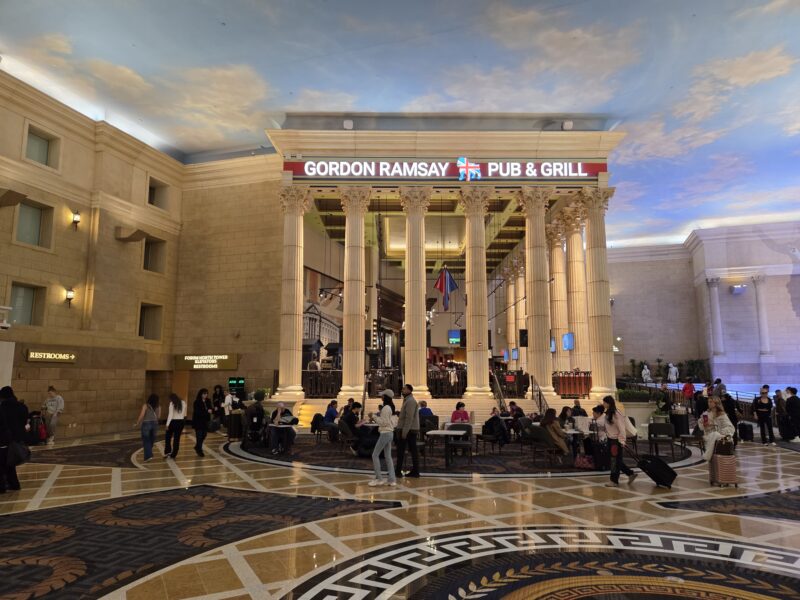
Gordon Ramsay Pub & Grill at Caesars Atlantic City. (Ziv Chen photo for CDC Gaming)
Beyond gaming – A stroll through ancient Rome
By its theatrical thematic nature, Caesars is built to deliver family entertainment that extends far beyond gambling. As expected, I had to walk through a fictional version of Rome, with marble hallways, piazzas with shops, restaurants, and bars, waterfalls, statues, and everything else I knew would come straight out of the brand’s design playbook.
The hotel has three towers, 1,144 rooms and suites, 10 restaurants, and a good choice of nightlife, including a mountain bar, dive bar, beach bar, and toga bar. A live-entertainment venue, conference space, and high-end shopping combine with everything else you’d expect to find in the brand’s interpretation of ancient-Rome-meets-modern-time-hospitality.
Unlike other Atlantic City hotels, which treat the Boardwalk as a backyard, the Caesars property is integrated. A beach bar, inviting entrances, and food joints on the Boardwalk are all operated by the hotel.
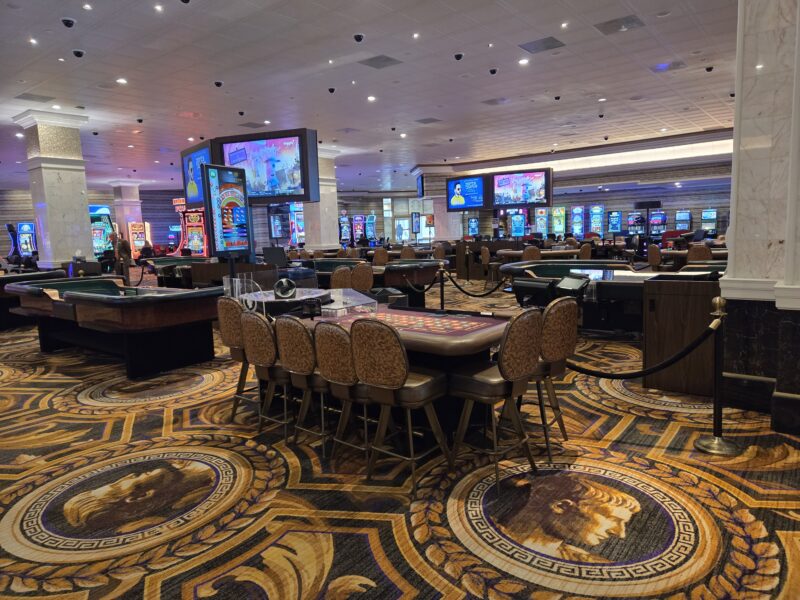
Caesars Atlantic City has a dedicated table-game section on the ground floor. (Ziv Chen photo for CDC Gaming)
The gaming floor — Diverse casino experiences
Caesars Atlantic City’s gaming floor spans 145,000 square feet, including a 15,000-square-foot sportsbook. It has over 1,700 slot machines, around 130 game tables, and a poker room with around 30 tables.
It’s not the largest casino in the area, but it sure feels like it, thanks to segmentation into different floors and parts of the building, each with a unique design that gave me the feeling I was visiting a different casino altogether.
Starting in the sportsbook area, detached from the main property, the design is urban and young with dark walls and carpeting, bars, bar food, a stage for live music, arcade games, the sportsbook itself, and a good range of slot machines. It has an upscale sports-bar feel.
Then I moved to the main gaming floor, which was much more of what I expected from a Caesars property in terms of design. As I was walking through the second floor, I noticed only slots and very few table games. When I asked the staff, they pointed me downstairs to the ground floor, where the table games are. While the slot area upstairs has marble pathways, the ground floor ismostly carpeted, giving a more traditional feel.

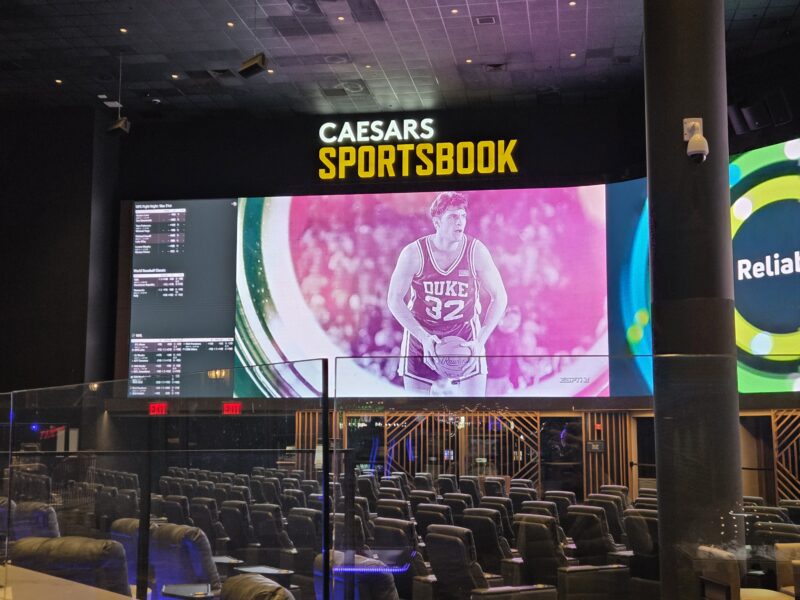
The Caesars Atlantic City sportsbook is a modern section with younger crowds. (Ziv Chen photo for CDC Gaming)
The crowd: Tourists and returning Caesars guests
I found in Caesars Atlantic City a diverse mix of guests, including many tourists who are also staying at the property. These included gamblers and non-gamblers, who comprised many families dining, shopping, and wandering around the theatrical spaces. Players were of mixed ages, although the sportsbook area had many more younger slot players compared to the main hall, where crowds tended to be older.
One interesting thing I noticed was that the majority of people I spoke to were returning visitors and avid Caesars Rewards members, who told me they came to the property after receiving special offers and promotions.
Leaving Caesars Atlantic City – A surviving piece of casino theater
As I stepped out of Caesars and back onto the Boardwalk, I looked up at the red Caesars sign and thought about how rare this style of casino has become.

Similar to Atlantic City, which is busy reinventing itself to appeal to new demographics and changing consumer habits, many casino properties are moving toward more modern cleaner designs that project subtle luxury as opposed to over-the-top glamour.
Caesars dates back to a time long before that subtle shift began. It was one of the first casino brands to openly embrace Vegas-style fantasy, design spectacle, and theatrical excess. And while I felt that parts of that approach no longer fit, especially not with younger crowds, I thought there’s something refreshing about the commitment.
As I walked down the Boardwalk, I realized that Caesars isn’t trying to become a minimalist luxury resort. It’s trying to remain Caesars.
