



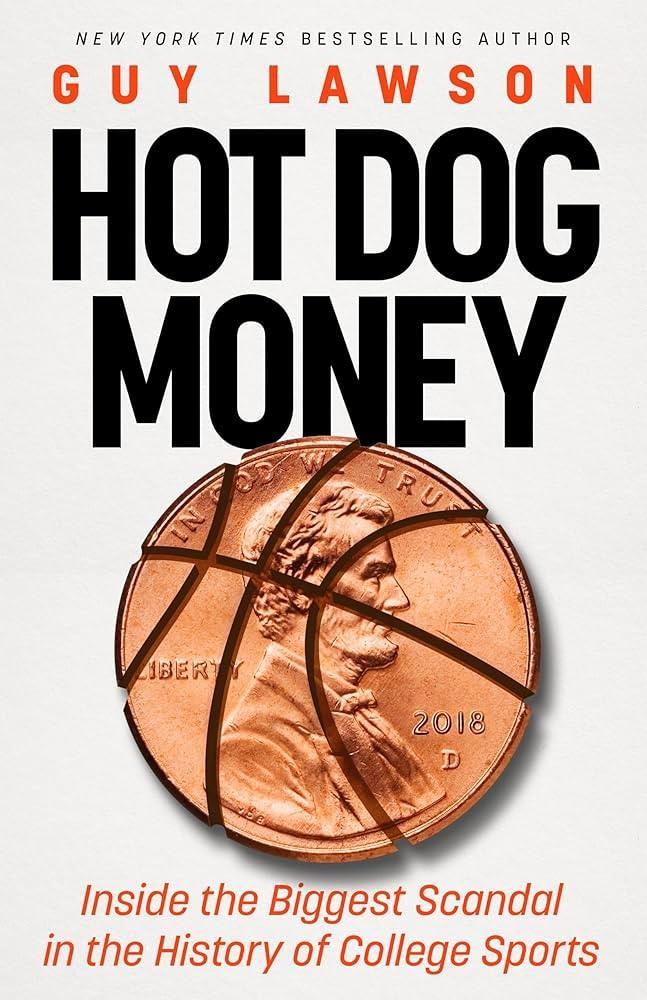
 Hot Dog Money – Inside the Biggest Scandal in the History of College Sports
Author: Guy Lawson, 2024, Little A, 314 pages, $28.99
Despite being around forever, sports betting is hotter now than ever before. The gaming business, in its many forms, has also been riding that wave. Make no mistake, college sports is a big business, too.
Prediction markets. Derivative contracts. Online books. Offshore platforms. What was once the exclusive domain of Nevada’s sportsbooks and the corner bookies is now a sprawling digital marketplace that trades on everything from touchdowns and point spreads to individual stats and transfer portals.

Author Guy Lawson
So, when Guy Lawson bills Hot Dog Money as “the biggest scandal in the history of college sports,” you might be tempted to shrug. In 2026 dollars, with NIL[i] collectives minting teenage millionaires and pro contracts in the NBA, NFL, MLB, NHL and MLS pushing $100s of millions, the scale of yesterday’s scandals seems like a minor misdemeanor.
But that would be a mistake.
Lawson’s narrative is less about the size of the dollars and more about the plumbing: the pipes that move money through amateur and professional sports. And what flows through those pipes isn’t always clean.
At the center of this story is Louis Martin Blazer II, better known as just “Marty.” He was a self-described financial advisor to professional athletes beginning with football players in the late ‘90s. Most of Lawson’s book is a narrative voiced by Blazer. He specialized in spotting often overlooked college gridiron standouts in the hopes that they would make it big in the pros. But he foolishly skimmed millions from the very pro clients who trusted him. He didn’t keep that money for himself, but rather poured it into speculative ventures like concerts and film projects to impress his players. Most of those investments failed miserably. Desperately, he resorted to a classic pyramid scheme to cover some losses, while stealing more and more from new clients.
Eventually facing federal embezzlement charges, Blazer flipped. He also transitioned from football players to the world of collegiate basketball. He became a key informant for the FBI beginning in 2014. His cooperation helped secure convictions against athletes, coaches, agents and sponsors. The fallout rippled through locker rooms, front offices, and college campuses nationwide.
If you want a pop-culture reference, think “Jerry Maguire.” But while that film glamorized the agent’s role, Blazer was a financial consultant who operated in tandem, but independently, from the agents. He did not negotiate contracts, but “managed” the money that came from them. He cultivated loyalty the old-fashioned way, with access and excess:

- VIP treatment at strip clubs nationwide
- Luxurious parties at mansions.
- Free private jet charters
- Cash on demand with no paperwork
They called that latter benefit “Hot Dog Money.” It was quick cash handed out in envelopes like a concession stand freebie to those players and their families who signed on Blazer’s dotted line.
What author Lawson does especially well is show how corruption rarely starts big. It begins with convenience. With access. With someone saying, “Don’t worry, I’ll handle it.”
In an era where NILi collectives, legalized sports betting, fantasy platforms, and prediction markets are rewriting the financial rulebook in real time, Hot Dog Money reads less like ancient history and more like a case study in how fragile the system is and has always been.
As a result of Blazer’s cooperation, 10 assistant coaches were sentenced and a handful of shoe company executives also ended up in jail. His work resulted directly and indirectly to the resignations of top coaches Rick Pitino (Louisville), Sean Miller (Arizona) and Will Wade (LSU). In a story that moves along nicely, you’ll learn all the details of how these schemes moved from “hot dog money” to criminal charges.
With the massive amounts of money now circulating in sports betting and NIL deals, the scale may have changed. The tools certainly have. But the temptations? Those remain exactly the same, if not more so.
Those temptations have led to multiple point shaving, bribery charges and game fixing. Since the publication of this book, scandals have hit Major League Baseball, the National Basketball Association, college basketball and swimming, the National Football League and the Ultimate Fighting Championship (UFC).
Marty Blazer died in January of 2024 at the age of only 53, just after this book came out. While few details were released, authorities said his death was from natural causes.
The sticker price of “Hot Dog Money” is $28.99 in hardback, but Amazon has it for $12.87 (a dollar less than they want for the paperback edition?). In 2022, Amazon Studios and George Clooney’s Smokehouse Pictures acquired the screen rights to this book.
# # #
[i] NIL stands for player’s being able to benefit directly by selling their Name, Image and Likeness for advertising and promotional purposes. Blazer’s story was one of the major reasons the NCAA grudgingly approved NIL policies. However, many critics argue that NIL has actually made corruption more tempting and done little to stop the grifters like Blazer enticing players. Many college “amateur” players in football and basketball are now becoming millionaires long before their pro careers begin. For college fans, it is disheartening to know that any decent young player on their team will most likely leave to shop for the highest NIL offers.

