
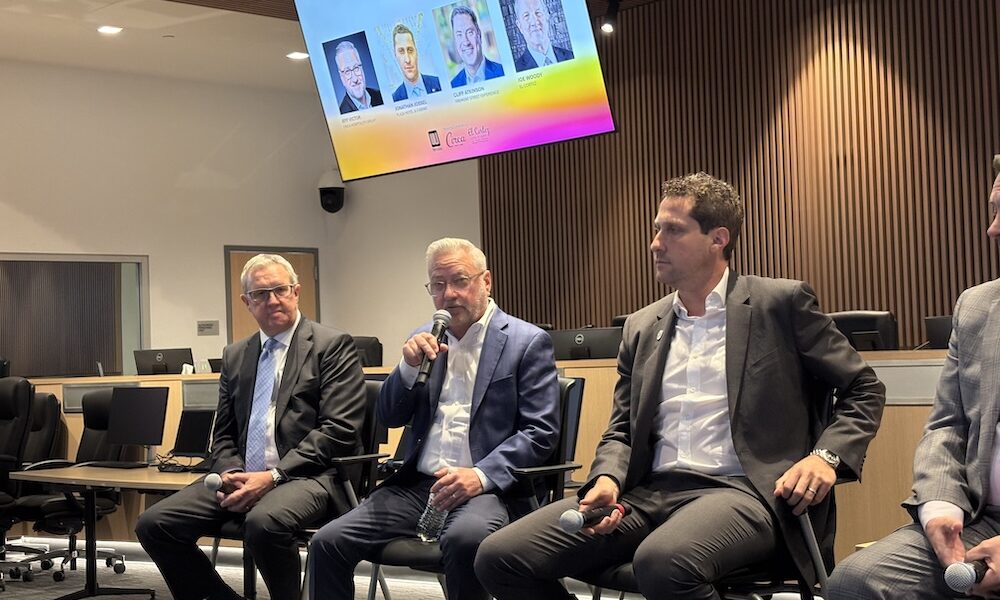

While growing expenses have scaled back capital projects, a top executive with Circa Resorts said the operator is undertaking a room build-out at Circa Las Vegas and planning an extensive remodel of the D Las Vegas downtown.
Vice President Jeff Victor outlined plans for its downtown casino properties during during a recent forum hosted by the Downtown Vegas Alliance. Circa, which opened in December 2020, is co-owned by Derek Stevens, who also owns the D Las Vegas and Golden Gate on Fremont Street.
“Derek is a special guy and he’s an operator,” Victor said. “He’s not a business flipper. He doesn’t have fancy cars, vacation homes, boats, or airplanes. He doesn’t take enough time off of work. Whatever profit we make, he plows back into the company. We have a number of projects coming up that we’re pretty excited about.”
Circa was built with seven shelved-out floors, which Victor said is common in the casino business. It’s best to wait until customers tell you what size rooms and suites they want. Circa completed four floors last year and has started work this month on two more floors. In addition, Victor said the D, an aging property that opened in 1980, will get a complete renovation.
“And we have a couple of other projects that will take a lot of our time,” Victor said.
Though Circa had a record-breaking year last year in terms of revenue, its EBITDA/profit went down dramatically.
“Labor is more expensive,” Victor said. “Napkins and cups are more expensive. That unfortunately throttles capital projects that we would like to do – expansions and new buildings all get compromised.”
Victor, along with other panelists, talked about the state of gaming downtown and Las Vegas as a whole during their discussion.
“We’ve been watching for several years now that the rich are getting richer and the poor are getting poorer,” Victor said. “We’ve watched a shift with the K-shaped economy. We have three different properties at three different price points with three different customer types. Circa has done quite well. Those customers aren’t feeling it like some folks. The D has definitely felt it and the Golden Gate has it quite a bit.”
What’s happening to Las Vegas is not limited to the city, but nationwide, Victor said. A downturn in visitation to Las Vegas makes good headlines, he noted.
Las Vegas visitation fell nearly 8% in 2025 and downtown was hit with occupancy falling to 58.4%, down from 67.1% in 2024. Revenue per room in downtown fell 15% in 2025.
“Downtown is different from the Strip when you’re talking about competing for room rates or occupancy,” Victor said. “The Las Vegas Convention and Visitors Authority has been tracking this for decades and we have a lot of data. The thing that makes me curious is when people refer to a ‘downtown customer.’ That doesn’t exist. There are 155,000 rooms in Las Vegas and downtown only has about 5% of that. Yet tracked through the LVCVA, over half of the visitation comes to downtown, so those numbers look like 42 million to the destination and 24 million come to Fremont Street and downtown.
“That’s because it’s different and does offer value. It’s somewhat akin to going to New Orleans and not going to Bourbon Street. It has a different feel and customers recognize and gravitate toward that.
“They come down to Fremont Street and spend about 3½ hours and visit about 3½ properties during that time. Fremont Street produces content.”
Circa, which requires visitors be 21 and older, is a “specific product that doesn’t exist anywhere else in Las Vegas,” Victor said. The D Las Vegas competes against the Flamingo and Harrah’s with their thousands of rooms on the Strip.
“We’re not dependent on heads in beds, because we have this river of folks walking up and down the street,” Victor said. “Our customer is a Strip customer.”
Las Vegas is feeling the hit from the downturn in travel from Canada, Victor said. International travel makes up 15% of visitation and about one third of that is from Canada.
“They’re saying we’re not coming to America,” Victor said. “They can’t come and post their vacation photos on social media. their neighbors will say they’re out of their mind, that we’re all in this together. It’s difficult to go against right now.”
Jonathan Jossell, CEO of the Plaza Hotel & Casino, said the challenge is comparing what’s happening in Las Vegas to 2022 and 2023 when there was record growth.
“It’s hard to compare when you see headwinds now,” Jossell said. “While things aren’t as good as they were 12 to 24 months ago, they’re still pretty good. We in downtown are many ways a function of the Strip, and it’s difficult to compete with room rates on the Strip when they’re much lower than they used to be. But there is still a tremendous amount of visitation and gaming spend.”
Downtown can’t compete with the Strip in some ways, except when it comes to history and an ability to take care of customers “in a more meaningful way and make them feel special,” Jossell said.
The narrative that Las Vegas is overpriced has gotten out of control, because a lot of people are still coming and having a great experience, Jossell said. What may be driving that is how Las Vegas is an event-driven destination today and events are expensive.
“That perception trickles down to everything else,” Jossell said. “If you come in and get a cheap room and it costs $1,000 to go see the Backstreet Boys at Sphere. Your perception is that it was an expensive trip, even though it was amazing. We have to remember how to bring people here midweek or weekends where they’re not just coming for big events.”
Cliff Atkinson, a former casino executive and newly named president and CEO of the Fremont Street Experience, said while Las Vegas has been facing some headwinds, the city is resilient. A lot is “coming on the books” in 2027 and 2028 that will be a boon for the city. The Hard Rock Las Vegas is opening in 2027 and the A’s baseball stadium will open in 2028.
“We’re reinventing ourselves, what the city is most known for,” Atkinson said, while touting what downtown brings to the table. “It’s an authentic experience that can’t be recreated by going back in time. Downtown delivers value and offers free entertainment every day.”
Atkinson pushed back against Las Vegas being overpriced by comparing it to other cities.
“Take the Waldorf in New York or Cabo. Ours is 50% to 75% discounted for the same experience. However, perception is reality. When you go downtown, we stand out more as a value.”
Joe Woody, chief financial officer at El Cortez Hotel & Casino, said the last six months have been remarkable, coming off reinvestment in the property where they added a bar, restaurants, slot machines, and table games.
“We’re very fortunate,” Woody said. “We’ve seen a change in our customer. Our core customer is still coming in, but we’re also seeing a lot of people come in from the Strip from outside Las Vegas. It’s the higher-end play. We tried to keep our heritage and authenticity. We’re not going to become Aria. We know that if we stay the El Cortez and take care of customers better, it will work out.”
Woody said downtown isn’t trying to go head to head with the Strip, but instead focuses on what the Strip doesn’t have—history. El Cortez has 85 years of it, he added.

“These people want to see what downtown is and where gaming started in Las Vegas,” Woody said. “That brings people down here. There are three segments of customers: our very loyal table game players, our slot players, and adventurous people. Those are people coming to stay at the Venetian, the Wynn, or Bellagio and want to check out downtown and spend three to four hours. They came down for the Mob Museum. We see a lot of the younger generation coming down for the party on Fremont Street. They start at El Cortez and go down the street.”

