
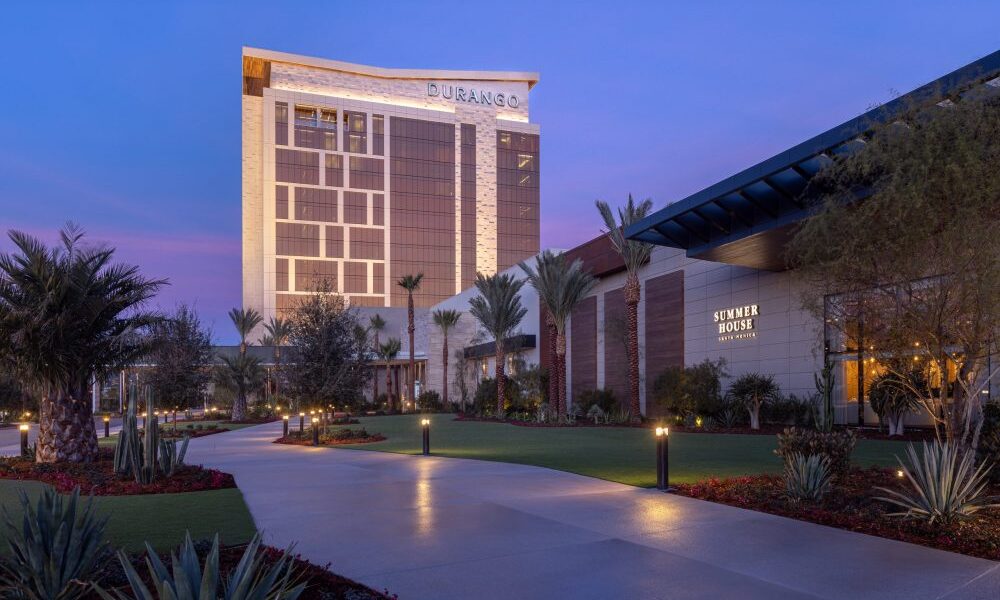

J.P. Morgan analyst Joseph Greff, returning from a tour of Station Casinos’s brand-new Durango Casino & Resort, pronounced that he was “impressed” with the property. He reported, “Its casino floor has great sightlines and a ton of natural light, with floor-to-ceiling windows on both sides of the casino.”
Greff was also taken with the variety of price points and choices among Durango’s restaurants. He lauded its food hall, comparing it favorably with Eataly at Park MGM and the Plaza Hotel in New York City. Demand for the food hall was described as “strong.” Greff added, “Most of the restaurants have an outdoor component, which has been popular with patrons.”
Turning to the hotel rooms, the analyst deemed their quality sufficient to rival those on the Las Vegas Strip. As for the sports book, Greff noted that even it has an al fresco component. He tartly added, “Even Jets fans would love the sportsbook there and it would make watching Jets games more tolerable.”
Describing Durango as “beautiful,” Greff praised its finishes, resembling those of Red Rock Resort, Station’s previous foray into the luxury market.
While on the subject of Red Rock, Greff observed that there had been no net cannibalization of its business (which is what Wall Street anticipated) and that gambling volumes at Durango were running larger than expected. Asian customers represent 30 percent of the adjacent population, a segment that was “performing well.”
Durango has 209 hotel rooms and Greff opined that it could support more. Ditto parking spaces, “given strong F&B demand.” He expects the mooted Phase II of Durango to start late next year, “which is probably the earliest anything could get done in any event.”
The new casino is seeing business from players already established in the Station database, as well as new ones. The younger demographic was also said to be well represented in the player mix.
Greff favorably addressed an aspect of Durango’s online marketing, one for which comparably new Fontainebleau has been criticized. “The property’s positive social-media presence is probably helping with the younger demographic in a way that we have underappreciated.”
The analyst also met with Station upper management while eyeballing Durango. They had little to say regarding future development. However, they were “upbeat” about the Las Vegas Valley’s demographic and population trends. The latter has been trending upward at the rate of 4.6 people per hour between 2020 and 2022. The compound annual growth rate of incomes in the Las Vegas area was measured by Station at 5.3 percent.

Speculating as to what Station would do next, Greff pointed to its 40-plus acres in Inspirada. These are to be developed at roughly two-thirds Durango’s size and at a $450 million price tag. (Durango topped $780 million.)
Less expensive still at $300 million would be the as-yet-unnamed Station project in Skye Canyon. Then would come, per Greff’s analysis, Station’s Cactus Lane site south of rival South Point. That development would likely bear a scale comparable to Red Rock Resort, built for $925 million in 2006.
“Each of these three sites has meaningful residential development planned and possess ideal freeway access,” penned Greff. Station estimated, he added, that 70 percent of Clark County’s future population growth would happen within three miles of Red Rock Resort and/or one of its six total development plots.

